
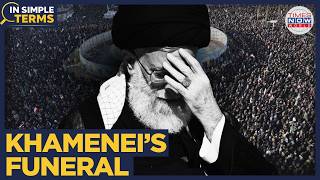
Iran is holding Ali Khamenei's state funeral 131 days after his death because security concerns made an earlier ceremony impossible. When Khamenei was killed on February 28, 2026, during the opening hours of US and Israeli strikes on Iran, the country was still at war. Gathering millions of people in one place while airstrikes remained a threat was simply not an option. Now, more than four months later, Iran is ready — and what's being planned could become one of the largest funeral events in modern history.
Why Did Iran Wait 131 Days to Hold Khamenei's Funeral?
Islamic tradition calls for burial within 24 hours of death whenever possible. So why has Iran waited over four months? Iranian officials have never issued a fully detailed explanation, but the picture that emerges from available reporting is clear: the risks were simply too great to act sooner.
 00:45
Overview of the 6-day funeral schedule across Tehran, Qom, and Mashhad
Watch at 00:45 →
00:45
Overview of the 6-day funeral schedule across Tehran, Qom, and Mashhad
Watch at 00:45 →
At the time of Khamenei's death, Iran was actively under military attack. Organizing a mass public gathering during active hostilities would have created an enormous security vulnerability. Any large assembly of Iranian officials, military commanders, and civilian mourners could have become a target.
Beyond the immediate military threat, Iranian authorities were also haunted by the memory of the 2020 funeral of Qasem Soleimani, where a deadly crowd crush killed dozens of mourners. Planning an event potentially ten times that scale — across multiple cities — required months of logistical preparation. Security, transportation, crowd management, and foreign delegation coordination all had to be built from scratch under extraordinarily difficult conditions.
How Many People Are Expected at Khamenei's Funeral?
Iranian officials and state-linked media have projected attendance of up to 20 million people across six days of ceremonies. While those numbers remain projections rather than independently verified estimates, even a fraction of that figure would make this one of the largest public gatherings in human history.
02:10
Why Iran postponed the funeral 131 days — security and logistics explained
Watch at 02:10 →
For context, the funeral of Ayatollah Ruhollah Khomeini in 1989 drew an estimated 10 million mourners — widely considered one of the largest funerals ever recorded. If Khamenei's ceremonies approach those projections, they could rival or surpass that historic moment.
Authorities are preparing accordingly. Unprecedented security measures, mass transit arrangements, and crowd control infrastructure are being put in place across Tehran, Qom, and Mashhad to handle the expected volume of mourners.
What Is the Full 6-Day Funeral Schedule?
Iran has announced a carefully choreographed sequence of events spread across three major Iranian cities — and possibly extending to holy sites in Iraq:
- July 4–5 (Tehran): Khamenei's body will lie in state at Tehran's Grand Mosalla. Hundreds of thousands — potentially millions — of ordinary Iranians will be able to pay their respects over these two days.
- July 6 (Tehran): The main state funeral procession takes place in the Iranian capital. The coffin will travel through Tehran under extraordinary security, with senior clerics, military commanders, government officials, and foreign delegations in attendance.
- July 7 (Qom): Ceremonies move to the holy city of Qom, one of the world's most important centers of Shiite Islamic scholarship.
- Iraq (Najaf and Karbala): Reports indicate that religious commemorations may also be held in Iraq's holiest Shiite cities before the body returns to Iran.
- July 9 (Mashhad): Khamenei will be buried in Mashhad, his hometown, near the revered Imam Reza Shrine — one of the holiest sites in Shiite Islam.
The choice of burial location carries deep symbolic weight. Mashhad is home to the shrine of Imam Reza, the eighth Imam in Twelver Shiism, making it one of the most sacred destinations for Shiite Muslims worldwide.
04:30
Foreign delegations confirmed to attend Khamenei's state funeral
Watch at 04:30 →
Which World Leaders Are Attending Khamenei's Funeral?
Iran has extended invitations to governments across the world, and foreign delegations from countries maintaining close ties with Tehran are expected to attend. Among the confirmed attendees:
- India: Prime Minister Narendra Modi will not attend personally, but New Delhi is sending a high-level delegation led by Bihar Governor Lieutenant General Syed Atar Hassan and Minister of State for External Affairs Pabitra Margherita.
- Russia and China: Both countries are expected to send delegations, reflecting their deepening strategic relationships with Tehran.
- Regional allies: Delegations are expected from Pakistan, Iraq, Syria, Lebanon, Oman, and Qatar.
- Latin American allies: Venezuela and Cuba are also expected to send representatives.
- Religious leadership: Senior Shiite clerics from Iraq and representatives of regional groups aligned with Tehran are also anticipated.
The level of representation will vary significantly from country to country, but the overall picture is one of a broad coalition of nations from Asia, the Middle East, and beyond coming to pay their respects.
Will NATO or European Countries Send Delegations?
This is where things get diplomatically delicate. As of now, no NATO leader, European Commission official, or EU head of government has confirmed attendance. Most analysts expect Western governments to adopt a deliberately low-profile approach — sending ambassadors already posted in Tehran or lower-ranking diplomats rather than presidents or prime ministers.
The reasons are straightforward. Relations between Iran and Western countries have remained deeply strained for decades, fractured by disputes over sanctions, Iran's nuclear program, regional proxy conflicts, and most recently the Iran-Israel war that claimed Khamenei's life. For any Western leader, attending the funeral of a man whose government was at war with a US-allied state just months ago would carry enormous diplomatic and domestic political costs.
Expect quiet, minimal Western representation — not boycotts, but certainly not high-profile delegations either.
Will Iran's New Supreme Leader Appear in Public?
Perhaps the single most-watched question surrounding this entire event is whether Mojtaba Khamenei — Ali Khamenei's son and Iran's new Supreme Leader — will make a significant public appearance.
Since succeeding his father, Mojtaba has remained almost entirely out of the public eye. No major televised speeches. No public rallies. Very few official appearances of any kind. That near-total absence has fueled intense speculation about both his health and the state of Iran's political transition at a moment of profound national vulnerability.
Iranian officials have not confirmed whether Mojtaba will attend the funeral. But if he does appear — especially at the main July 6th procession in Tehran — it would almost certainly become the most important public moment of his tenure so far. For the Islamic Republic, it would serve as a powerful and deliberate symbol of continuity: the son stepping forward to lead the nation his father shaped for nearly four decades.
That single moment could define how Iran's allies, adversaries, and citizens perceive the country's new leadership for years to come.
Who Are Ali Khamenei's Surviving Children and Family?
Ali Khamenei is survived by several children. His sons include Mojtaba, Mustafa, Massoud, and Moasen Khamenei. He also has two daughters, Boshra and Hoda. Open-source reporting indicates that some extended family members died during the February strikes, but multiple children — including Mojtaba — survived and remain part of Iran's political and religious establishment.
Mojtaba in particular has long been a significant figure within Iran's clerical and intelligence circles, though he historically operated behind the scenes. His succession to the position of Supreme Leader marked a dramatic shift into the spotlight — one he has so far largely avoided.
What This Funeral Really Means for Iran
Ali Khamenei ruled Iran for nearly four decades. He shaped the country's domestic politics, its nuclear ambitions, its regional strategy, and its place in the global order more than any other figure since the 1979 Islamic Revolution. His death — sudden, violent, during a moment of acute national crisis — left an enormous void.
This funeral is not simply a ceremony of mourning. It is a carefully orchestrated act of political theater: a display of national unity, religious legitimacy, and institutional continuity designed to signal to Iran's own population and to the world that the Islamic Republic endures. Whether that message lands — especially if Mojtaba Khamenei finally steps into the light — may be the most consequential outcome of six days of ceremony that the world will be watching very closely.