
Focusing on money stops you from understanding the economy because the economy is not fundamentally about money — it is about real resources, real people, and real work. Money is simply a scoreboard, a spreadsheet that has to balance. When you mistake the scoreboard for the game itself, you end up doing what governments, central banks, and mainstream economists have done for the past 17 years: pulling every monetary lever available and wondering why nothing meaningfully improves for ordinary people.
Why Money Obsession Blinds You to How the Economy Works
Think about what your street actually looks like. Buildings, workers, lorries, tools, land, food — these are the things that make an economy run. Money is just the token system we use to allocate those things. And yet when most people — including highly trained professional economists — talk about economic problems, the conversation almost immediately collapses into a debate about money: interest rates, quantitative easing, money supply, fiscal stimulus.
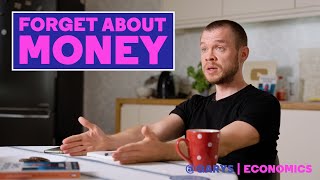 00:45
Explaining 'money centrism' — the instinct to treat every economic problem as a monetary problem
Watch at 00:45 →
00:45
Explaining 'money centrism' — the instinct to treat every economic problem as a monetary problem
Watch at 00:45 →
This is what you might call money centrism — the instinctive assumption that every economic problem has a monetary solution. It is not just a habit of ordinary people; it runs straight through the heart of elite economic institutions. And it is causing serious damage, because it distracts attention from what is actually happening to the distribution of real resources in society.
There is a fascinating parallel in medieval religious history. In Christianity, Judaism, and Islam, one of the central commandments is the prohibition against worshipping graven images — representations of God. The fear was simple and profound: if you make a picture of God, people will start confusing the picture for the actual God. Wars were fought over this question in eighth and ninth century Greece. The worry was that the symbol would replace the reality in people's minds. That is precisely what has happened with money. Money is the symbol. Real resources are the reality. We have started worshipping the symbol.
Did Monetary Policy Actually Fix Anything After 2008 and COVID?
Cast your mind back to 2008. The financial crisis triggered a massive upward redistribution of wealth. The response? Slash interest rates to near zero and launch quantitative easing — printing money on an unprecedented scale. At the time, cutting rates to zero was considered an extreme emergency measure, something so powerful and unusual that it would surely trigger a rapid and robust economic rebound. It did not.
03:10
The Oxford exchange: a classically trained economist argues rates should have gone to minus 3%
Watch at 03:10 →
Then came COVID. Another enormous economic crisis, another enormous upward redistribution of real resources. The response? Slash rates to zero again. More quantitative easing. More money printing. The playbook was identical because the intellectual framework was identical.
Here is the telling detail. In an economics master's programme at Oxford, the response to a critique of these policies was not "you're right, maybe we over-relied on monetary policy." It was: "the problem is we didn't cut rates far enough — we should have gone to minus three percent." Meanwhile, a right-wing think tank argued the opposite: rates should never have been cut at all and should have stayed at three or four percent. Two completely opposing positions, both entirely fixated on the same monetary variable. Neither side asked whether the real problem was the redistribution of actual resources, land, labour, assets, infrastructure — away from ordinary people and toward the wealthy.
Seventeen years on from 2008, the most important lesson that should have been learned is that economists have systematically overestimated the power of monetary policy. That lesson has not been learned. Not by the establishment. Not by the left. Not by the right.
Why Did Printing Money Cause Inflation After COVID?
This one should have been obvious — and was, to anyone thinking in terms of real resources rather than money. During COVID, governments around the world distributed staggering sums of money. In the UK alone, roughly a trillion pounds was put into the system — approximately twenty thousand pounds per person. In the US, the numbers were even larger.
07:20
Why the media's COVID boom prediction was wrong — money was printed, real resources were not created
Watch at 07:20 →
Here is the critical question: did the supply of real resources — goods, services, labour, land — increase to match all of that new money? Of course not. The economy had been partially shut down. Real output had fallen. So you had dramatically more money chasing roughly the same amount of real stuff, in some cases less real stuff. The inevitable result was a redistribution of who could afford what, rising asset prices, and inflation.
And yet the dominant media narrative at the time was one of excited optimism: people have so much saved-up money, when we reopen there will be an enormous economic boom. This is the money-centric illusion at its most dangerous. Printing money and distributing it does not create a single extra house, a single extra hospital appointment, a single extra tonne of food. It only changes who holds the tokens. If you do not change the real resources, you have not grown anything — you have only shifted who has claim to what already exists.
Why Are Living Standards Falling Despite Economic Growth?
Here is the paradox that money centrism cannot explain: GDP figures have grown over the past decade and a half, money has been injected into economies at historic rates, and yet living standards for working and middle class people have fallen. Public services have deteriorated. Real wages have stagnated or declined in purchasing power terms.
The answer is straightforward once you think in terms of real resources: the resources were redistributed upward. When the government printed money and gave it out, asset prices surged. The people who owned assets — property, stocks, businesses — saw their real wealth expand enormously. The people who did not own those assets found that the cost of acquiring them had risen dramatically. The real resources did not grow; they were transferred.
Money centrism makes this invisible. If all you measure is money supply and interest rates, you miss the underlying shift entirely. The forest is burning and everyone is debating what shade of green the leaves were.
Is the Economy Zero Sum? Why Growth Isn't Free
A common objection goes: "This is the zero sum fallacy — we can always grow the economy and create more resources." It is worth taking seriously, because in the very long run, and under specific conditions, it is partially true. But in the short to medium term, and in a fully employed economy, it is dangerously misleading.
Consider housing — the defining resource crisis of our era. To build significantly more houses, you need builders. Where are those builders? They are currently employed building kitchen extensions and luxury renovations for wealthy homeowners. You need building materials. Where are they? They are being used. You need land. Who owns it? The same answer every time.
The historical example of rapid growth that worked — the European colonisation of North America — worked precisely because there were genuine unused resources: vast land, and a supply of unemployed European labour. The Native Americans were driven out, their resources seized. That was the source of the growth. It was not conjured from nothing.
We do not live in that world today. Every builder is employed. Every plot of land is owned. Every tonne of steel is allocated. If you want to build more houses, you need to either free up resources from somewhere they are currently being used, or accept that something else will not get built. There is no third option.
Why Do the Rich Keep Getting Richer While Everyone Else Falls Behind?
Because the people with passive income of a million or two million pounds a week do not need to work for their share of real resources. Their assets — property, equities, businesses — generate claims on real resources automatically. Meanwhile, workers exchange their time and labour for money tokens, and the purchasing power of those tokens erodes as asset prices rise.
If you want to grow the economy in a meaningful way — more housing, better public services, higher real wages — the resources for that growth have to come from somewhere. Right now, a small group of people control an enormous and growing share of all real assets, and they are using a significant portion of those resources on luxury consumption. The builders building the fifth home extension. The private jets. The superyachts. Those are real resources — real labour, real materials — being consumed by people who have captured an outsized share of the distribution.
Either you tax the wealthy and redirect those real resources toward productive investment and broad consumption, or you borrow from them — at a profit to them — and the growth flows back to their balance sheets anyway. There is no growth without distribution. That is not ideology. It is arithmetic.
What Are Real Resources and Why Do They Matter More Than Money?
Real resources are the actual physical and human inputs that make an economy function: land, labour, raw materials, infrastructure, energy, skills, and time. Money is none of these things. Money is a system of accounting — a way of recording claims on real resources and facilitating their exchange.
The critical implication is this: you cannot solve a real resource problem with a monetary solution. You cannot build a house by printing money. You cannot train a nurse by cutting interest rates. You cannot manufacture a turbine by issuing government bonds. At some point, someone has to do the actual physical work with actual physical materials on actual physical land.
When you look at the economy through the lens of real resources, the crisis of the past two decades becomes crystal clear. Real resources — assets, infrastructure, productive capacity — have been steadily transferred from governments, the working class, and the middle class toward a small and extraordinarily wealthy elite. That transfer is the story. Everything else — the inflation, the falling living standards, the collapsing public services — is a consequence of that transfer.
Money is not the economy. The economy is the real things. Until economic policy is built around that understanding, the same monetary tools will keep being applied to real resource problems, and the results will keep disappointing everyone except the people at the very top of the distribution who are quietly accumulating more of what actually matters.