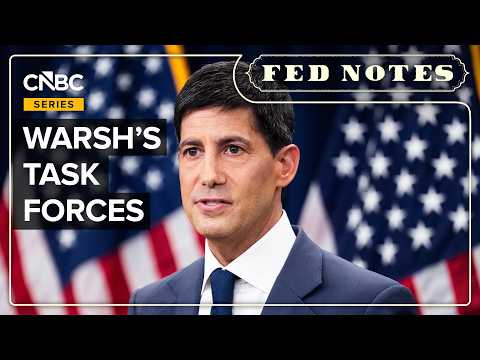
Markets are pricing in one to four rate hikes through mid-2027. That, in one analyst's view, is a significant mispricing — and it may stem from a fundamental misreading of what new Federal Reserve Chair Kevin Warsh is actually setting up. Strip away the political non-answers and the task-force buzzwords, and a coherent and potentially market-moving strategy starts to emerge: change how inflation is measured, upgrade the data the Fed relies on, and create the conditions to cut rates without admitting a policy reversal.
The Inflation Redefinition Play
The most consequential signal from Warsh's early tenure may be his establishment of five internal task forces — covering communications, the balance sheet, data sources, productivity and jobs, and inflation. The inflation task force is the one to watch.
The Fed currently targets 2% inflation using the PCE (Personal Consumption Expenditures) index. But there are alternative measures, and one of them — the Dallas Fed Trimmed Mean — paints a considerably more favorable picture right now.
 01:20
Chart of Dallas Fed Trimmed Mean inflation showing current level at 2.55% with a clear downward trend
Watch at 01:20 →
01:20
Chart of Dallas Fed Trimmed Mean inflation showing current level at 2.55% with a clear downward trend
Watch at 01:20 →
The trimmed mean strips out the most volatile price components and smooths the data. At the moment, the one-month reading sits at 2.55%, while the six-month reading is at 2.3% — essentially within striking distance of the Fed's 2% target. If Warsh's inflation task force recommends adopting this measure as the primary benchmark, the Fed could credibly declare victory on inflation and open the door to rate cuts — without the optics of abandoning its existing target.
This would not be unprecedented. Central banks periodically update their preferred inflation gauges. What would make this unusual is the timing and the political convenience of the switch. Critics will call it goal-post moving. Warsh would likely call it methodological improvement.
Real-Time Data and the AI Angle
The productivity and jobs task force carries its own significant implication. Warsh has indicated it will examine the "implications from AI" — language that signals a belief that artificial intelligence is structurally deflationary, increasing labor force productivity in ways that allow the economy to run hotter without generating sustained inflation pressure.
Beyond the macroeconomic theory, Warsh is pushing for a practical overhaul of how the Fed collects and interprets economic data. This is a legitimate grievance. Post-pandemic, response rates for key surveys — including the Job Openings and Labor Turnover Survey (JOLTS) — have collapsed. Large portions of these reports are now backfilled with estimates, seasonal adjustments, and assumptions. The result is data that arrives with a lag and gets revised significantly over subsequent months.
Warsh's alternative: use private-sector, real-time data sources — including AI-driven analysis of job listings, CEO earnings guidance, and actual hiring activity — to get a faster and more accurate read on the economy. For instance, AI tools could analyze the delta in active job postings month-over-month far more quickly than any government survey, filtering out stale listings that inflate headline figures.
07:30
CME FedWatch tool showing rate hike probability rising from 45% to 80% chance of at least one hike by end of 2026
Watch at 07:30 →
The practical implication is a Fed that can respond to economic conditions in something closer to real time, rather than reacting to lagged reports that may have already been superseded by events.
What the Bond Market and CME Futures Are Getting Wrong
Markets have reacted to Warsh's first press conference by aggressively repricing rate hike expectations. The CME futures market now shows roughly an 80% probability of at least one hike by year-end, with only a 17% chance of rates being stable or lower by late July 2027. The 10-year Treasury yield rose sharply on the day, outpacing a more modest move in the 2-year, which itself compressed the 10-2 yield spread — a move that is actually bullish for the broader economy even as it signals near-term rate anxiety.
12:00
10-year and 2-year Treasury yield charts showing divergent moves and the narrowing yield spread
Watch at 12:00 →
The case for why markets have this wrong rests on the Fed's own Summary of Economic Projections. With roughly half of Fed staff not projecting any rate hike, the central tendency of projections still shows inflation falling from the 3.3–3.4% range all the way to 2.3–2.4% — a full percentage point decline — without requiring rate increases. The logic: tariff effects lap out of the annual comparison, AI-driven supply improvements continue, and energy prices stabilize.
Among the individual dot plot submissions, the bulk cluster around a hold. A handful see one or two hikes in 2026, and one outlier projects rates nearly a full percent higher. Notably, Warsh himself abstained from submitting any projections at all. His stated reason for caution about forward guidance — that markets overreact to Fed commentary and create volatility that makes the central bank's job harder — is philosophically consistent with abstaining entirely.
The Longer Arc: Lower Rates by 2032
Taken together, Warsh's early signals point toward a Fed that will hold steady while its task forces do their work, then reframe the inflation conversation in a way that justifies cuts. The Fed statement from this meeting was notably shorter than recent precedents, stripped of almost all forward guidance language.
Warsh did acknowledge that monetary policy remains restrictive relative to the housing market, while the stock market suggests it is less so. He described inflation as "a choice" but said the Fed has "the luxury of time" — an implicit signal that urgency is low and a methodical review is preferable to reactive policy moves.
His comments on the 1970s are telling. That era's oscillating hike-and-cut cycles destroyed Fed credibility and ultimately required Paul Volcker's blunt intervention to restore it. Warsh appears acutely aware of that history and seems determined to avoid a repeat — meaning the bias will likely be toward patience rather than action, and toward cutting when the time comes rather than cycling back and forth.
The longer-term outlook, if this reading is correct, is for rates to move substantially lower over the next several years as AI-driven disinflation takes hold, the Fed adopts friendlier inflation benchmarks, and real-time data tools replace the lagged surveys that have historically kept policy tighter than necessary. That is a different macro environment than the one currently priced into futures markets — and the gap between those two visions is where investment opportunity tends to live.