Google I/O 2026 just wrapped, and if you're wondering what was announced at Google I/O 2026, the short answer is: Gemini, Gemini, and more Gemini — with a side of genuinely interesting developer tools. Sundar Pichai and Demis Hassabis took the stage to lay out what they're calling the agentic Gemini era, where search, Gmail, Android, and even your glasses are all becoming AI agents. But buried under the AI avalanche were some real gems worth your attention. Here's everything that matters.
What Was Announced at Google I/O 2026?
The overarching theme of Google I/O 2026 is that Google is no longer content to organize the world's information with blue hyperlinks. Search engines, in their traditional form, are being treated as an archaic technology. Instead, Google is positioning itself to become the interface to reality itself — and it's using Gemini to get there before OpenAI or Anthropic can.
 01:45
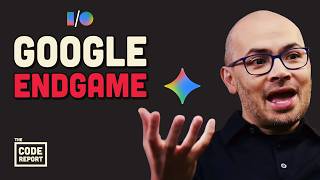
Google's token scaling chart showing the jump from 9.7 trillion to 3.2 quadrillion tokens per month
Watch at 01:45 →
01:45
Google's token scaling chart showing the jump from 9.7 trillion to 3.2 quadrillion tokens per month
Watch at 01:45 →
The product strategy is almost comically simple: take Gemini, append a noun, and ship it. Gemini Spark, Gemini Omni, Gemini Flow — the list keeps growing. But behind the branding blitz are some genuinely ambitious technical moves. Google reported scaling from 9.7 trillion tokens per month just two years ago to a staggering 3.2 quadrillion tokens per month today. Alphabet's capital expenditures have exploded to support this infrastructure, and that number is only going to keep climbing.
What Is Gemini Omni and What Can It Do?
The headline model announcement was Gemini Omni — a multimodal model that accepts any input (text, video, audio) and produces any output. Demis Hassabis, who may genuinely be the smartest person at Google, is clearly all-in on the world model approach. The idea is that models like Gemini Omni don't just generate pixels or text — they develop an understanding of language, physics, motion, and context well enough to simulate reality on demand.
04:10
Gemini Omni demo showing multimodal input and output capabilities with the Neural Expressive design system
Watch at 04:10 →
Alongside the model, Google unveiled a completely new design system for the Gemini app called Neural Expressive. At first glance it looks like a standard glow-up — better icons, smoother gradients. But the deeper play is that it's optimized for generating UI elements dynamically on demand: diagrams, timelines, and even mini apps that didn't exist before you typed your prompt. It's a UI framework built for a world where the interface itself is generated in real time.
How Does Gemini Flash 3.5 Compare to GPT-5.5 and Claude?
On the model side, Google released Gemini Flash 3.5 — the fast-and-cheap tier, not the flagship. According to Google's own benchmarks (take these with appropriate skepticism), Flash 3.5 performs nearly on par with Anthropic's Opus 4.7 and OpenAI's GPT-5.5, but at significantly faster inference speeds. Google's benchmark diagram shows Flash sitting in its own quadrant of speed-versus-intelligence, which is a convenient place to be when you draw the chart yourself.
The catch? Gemini 3.5 Pro, the actual flagship, is still under wraps and won't release until later this summer — which disappointed a lot of people who were hoping for a serious Opus or GPT-5 competitor right now. If you were waiting for the big brain model, you'll have to keep waiting.
07:30
Anti-Gravity IDE live demo: Gemini writing GPU drivers on stage to get Doom running on a from-scratch OS
Watch at 07:30 →
How Much Does Gemini Flash 3.5 Cost Compared to Before?
This is where things get a little uncomfortable. While Gemini Flash 3.5 is still cheaper than Claude, the pricing has jumped significantly. The new version costs three times more than the previous Gemini Flash version, and a whopping 30 times more than Gemini 1.5 Flash. The era of ultra-cheap Google AI tokens appears to be quietly ending. It's still competitive, but the trajectory is clear — prices are moving up as capabilities improve and infrastructure costs balloon.
What Are Google's New TPU-T and TPU-I Chips?
One of the more technically interesting announcements was Google splitting its Tensor Processing Units (TPUs) into two specialized chips. The TPU-T is optimized for training — teaching the model how to think. The TPU-I is optimized for inference — running the model at scale when it generates outputs. In other words, one chip teaches the AI, and another chip deploys it to billions of users. This specialization is how Google plans to maintain its efficiency edge as token volumes keep scaling into the quadrillions.
What Is Google's Anti-Gravity IDE and Why Is It Controversial?
Formerly known as Windserve, Anti-Gravity is Google's AI-powered coding IDE — and it just got a major, somewhat divisive overhaul. The latest version looks a lot like an OpenAI Codex clone, shifting focus away from writing individual lines of code and toward orchestrating AI coding agents. Think less text editor, more agent manager. Old-school programmers aren't thrilled.
But the live demo was hard to dismiss. The team used Anti-Gravity to build a complete operating system from scratch, a process that took about 12 hours and billions of tokens. They then tried to boot Doom on it live on stage — which initially failed due to missing drivers. Gemini was asked to write those drivers on the spot, and within seconds, Doom was running. The raw token generation speed was genuinely jaw-dropping, even if the whole demo felt like a flex rather than a practical workflow for most developers.
What Is the HTML on Canvas API and Why Should Web Devs Care?
If you're a web developer and AI fatigue is setting in, here's the announcement you actually want to know about. Chrome is shipping a new HTML on Canvas API — and it does exactly what the name implies. You can now render native HTML elements directly inside a <canvas> element.
Why does this matter? Previously, building highly interactive UIs with pixel-level control using WebGL or WebGPU meant giving up the convenience of standard HTML elements entirely. You had to choose between full control and developer ergonomics. The HTML on Canvas API changes that equation — you get low-level rendering control and the ability to use familiar HTML components side by side. It opens up new possibilities for creative UIs, data visualizations, games, and interactive tools that previously required painful workarounds or full rewrites.
It's not the flashiest announcement from the week, but for working web developers it might be the most immediately useful thing that came out of Google I/O 2026.
The Big Picture: What Is Google Actually Building?
Step back and the strategy becomes clear. Google isn't just launching AI features — it's attempting a complete platform reinvention under pressure. The token volumes, the specialized chips, the agentic everything, the world models — it all points to a company that knows its legacy search and ads business faces an existential challenge from AI-native competitors.
The agentic Gemini era is Google's bet that it can leverage its distribution advantage — billions of users already inside Gmail, Chrome, Android, and Search — to embed AI deeply enough that switching costs become too high. Whether that works depends on whether Gemini keeps improving fast enough to stay competitive with what OpenAI and Anthropic are building. This summer's Gemini 3.5 Pro release will be a significant test of that thesis.
For now, the roadmap is ambitious, the scale is real, and the HTML on Canvas API is quietly one of the best things web developers got out of the week.