
What Did Google Actually Announce at Google IO 2025?
Google IO 2025 covered a lot of ground: intelligent eyewear partnerships with Warby Parker and Gentle Monster, a new Gemini Flash 3.5 model update, the Genie 3 AI game engine grounded in Street View data, and a very public stumble when the anti-gravity team accidentally flashed a Codex folder in their own launch video. The event was big on demos and product surface area, but the developer community's verdict was largely underwhelming — especially compared to expectations set by Gemini 2.0. Here's a full breakdown of everything that mattered, and a few things that didn't.
Google Smart Glasses vs Meta Ray-Bans: Which Wins?
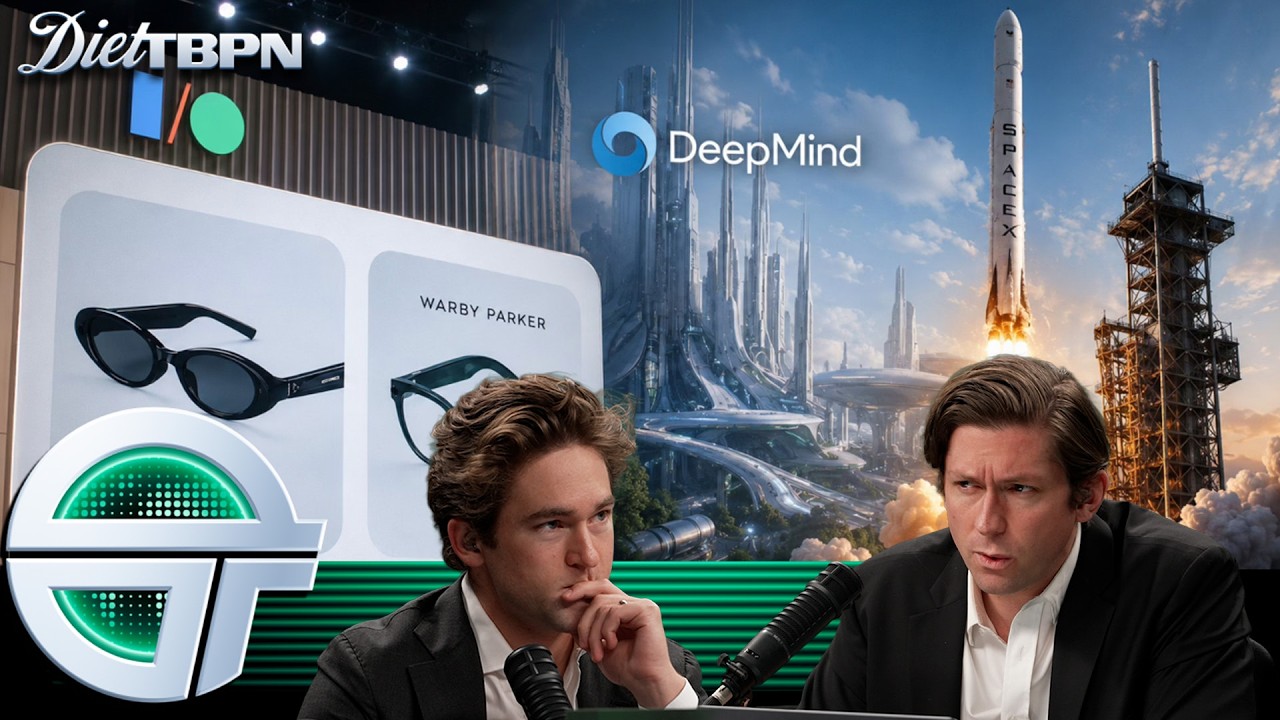
The biggest buzz coming out of IO was Google's smart glasses push. Google announced partnerships with Samsung, Warby Parker, and Gentle Monster to produce intelligent eyewear launching this fall. The glasses work similarly to Meta Ray-Ban smart glasses — camera, microphone, and a Gemini AI integration — but the design language is notably different across the two brands.
The Gentle Monster design is the more interesting story. Its silhouette doesn't scream wearable tech. From a distance, you wouldn't clock it as a face computer, which is a meaningful advantage in a world where people have already been trained to look for the telltale camera bump on Meta Ray-Bans. The Warby Parker version, though? The camera noticeably protrudes from the frames. It's not flush. That's a real design choice that will show up in how light reflects off these in the real world.
Meta has done the hard work of normalizing the category. When you see thick Ray-Ban frames, you now instinctively wonder if you're being recorded. Google's Gentle Monster play tries to sidestep that instinct entirely with a cleaner silhouette. Whether it works depends on whether consumers actually want AI baked into a fashion accessory — or whether they'd rather just clank out fully and commit to the cyberpunk look.
The deeper advantage Google has over Meta in this space isn't the hardware — it's the ecosystem. Gmail, Google Docs, Google Drive. Most people use Google's productivity suite as the central node of their digital life. An AI agent that lives in your glasses and is wired into that entire stack is a much more compelling daily-use case than one that's integrated primarily with WhatsApp and Instagram DMs. That's where Meta's glasses bump up against walled gardens. Google doesn't have that problem.
Why Are Developers Unhappy With Gemini Flash 3.5?
Gemini Flash 3.5 is fast — extremely fast, according to benchmarks. But speed isn't enough when the model underperforms and costs four times more than Composer 2 on Cursor's internal benchmark. Cursor ranked it below their own Composer 2 model, and that data point went everywhere. Is one benchmark the full picture? No. But it's a signal.
The broader complaint is that Gemini 2.0 felt like a real base pre-train. It had what people are calling "big model smell" — that sense that something fundamentally new is happening under the hood. Gemini Flash 3.5 doesn't have that. Developers were expecting Gemini 4 at IO, or at the very least Gemini 3.5 Pro as a new pre-train. What they got felt incremental. And Gemini 3.5 Pro still isn't out.
There's a structural tension here worth acknowledging: Google IO is scheduled roughly two years in advance. Whether a training run finishes in time to ship at a conference is a different kind of problem than shipping when the model is ready. Independent labs — OpenAI, Anthropic, xAI — tend to launch models when they're done, then build the event around that. When you're locked into a date, you ship what you have. Sometimes that looks incremental.
One other detail that went viral: the anti-gravity team's launch video accidentally showed someone using Codex — an OpenAI product — on screen. Nobody caught it before publishing. It's a small thing, but it reinforced the narrative that Google internally uses a wide variety of models, not just their own.
SpaceX IPO 2025: What We Know So Far
The SpaceX IPO prospectus was reportedly incoming as soon as May 20th, with Goldman Sachs as lead left — a notable choice given that Michael Grimes at Morgan Stanley has a long history with Elon Musk. The IPO is shaping up to be one of the largest in history, and the return numbers are staggering.
According to reporting from Katie Roof, Founders Fund and Valor are set to make more than $60 billion in gains. Sequoia is looking at over $20 billion. D1 Capital had already gotten credit earlier in the week for generating roughly $20 billion in returns. These are generational outcomes from investments made in some cases as far back as 2004 and 2010 — before Starlink existed, before anyone was talking about space data centers, when SpaceX was still a rocket company that regularly blew up rockets.
The Starlink narrative, the space infrastructure play, the data center angle — none of that was visible when the early bets were made. The funds that participated were genuine believers, and that conviction is now paying off in a dramatic way.
Nvidia 2025 Earnings: How Much Did They Actually Make?
Jensen Huang's framing at the Nvidia earnings call leaned heavily on the "AI factory" terminology — a phrase that's becoming something of a signature even if it's not everyone's favorite. The numbers behind it, though, are hard to argue with.
Nvidia net income rose to $42.96 billion — almost hitting the $43 billion mark — up from $18.8 billion the year prior. Revenue jumped 85% to $81.62 billion, compared to $44 billion last year. Jensen called the buildout of AI infrastructure "the largest infrastructure expansion in human history." Agentic AI, he said, has arrived: doing productive work, generating real value, scaling rapidly. The stock moved roughly flat on the news, which at this point almost feels like the normal reaction to a historic quarter.
Why Did Warby Parker Drop 14% After the Google Deal?
Warby Parker trading down 14% on the announcement of a Google partnership was one of the more counterintuitive market reactions of the week. The partnership had apparently been in the works for a while, which may explain some of it — the market had already priced in some probability of a deal. The fact that the glasses aren't available yet might also have dampened enthusiasm.
Zooming out, Warby Parker is a surprisingly resilient business. In 2021 it was valued at $6 billion. Today it's around $3 billion — not ideal, but far from the fate of Allbirds (briefly trading at $20 million before the AI rebrand spike) or Everlane, both of which have struggled to build sustainable standalone direct-to-consumer businesses. Warby Parker has real distribution infrastructure and a loyal customer base. The Google partnership gives them a hardware platform play. At $3 billion, the acquisition math isn't crazy — at what point does Google just buy them?
What Is Google Genie 3 and Why Does Street View Matter?
One of the quieter but genuinely interesting announcements was Genie 3, Google's AI game engine that can now simulate real places by grounding experiences in Street View imagery. This is a meaningful data moat that doesn't get discussed enough. YouTube has always been cited as a treasure trove for multimodal AI training. Street View is different — it's a comprehensive, navigable, three-dimensional record of the physical world.
Demis Hassabis, who has a background in games, seemed energized by the demo. The mechanic is what matters in games, not just the graphics — some of the most enduring games have simple 2D visuals but exceptional mechanics. Genie 3 grounded in Street View data opens up a design space that's genuinely new. Whether developers can build on top of it at scale, and whether the interactivity lives up to the demo, remains to be seen. But as a signal of where Google's data advantages might compound into product advantages, it's worth watching closely.