
What Are the Best Open Source Projects of 2026?
The best open source projects of 2026 aren't AI wrappers or markdown files pretending to be software. They're a 3D GPU-powered terminal emulator with a spinning rat cursor, an anonymous Tor-based phone that runs as a shell script, and a SQLite extension that makes Redis look like overkill. While 90% of GitHub is currently AI agents reviewing other AI agents' pull requests, a small band of deeply unhinged developers is quietly shipping some of the most creative, rebellious, and technically impressive tools in years. Here are 10 of them.
This isn't a list of VC-backed developer tools with slick landing pages. These are passion projects, weekend experiments, and decade-long ideas that someone finally snapped and actually shipped. Buckle up.
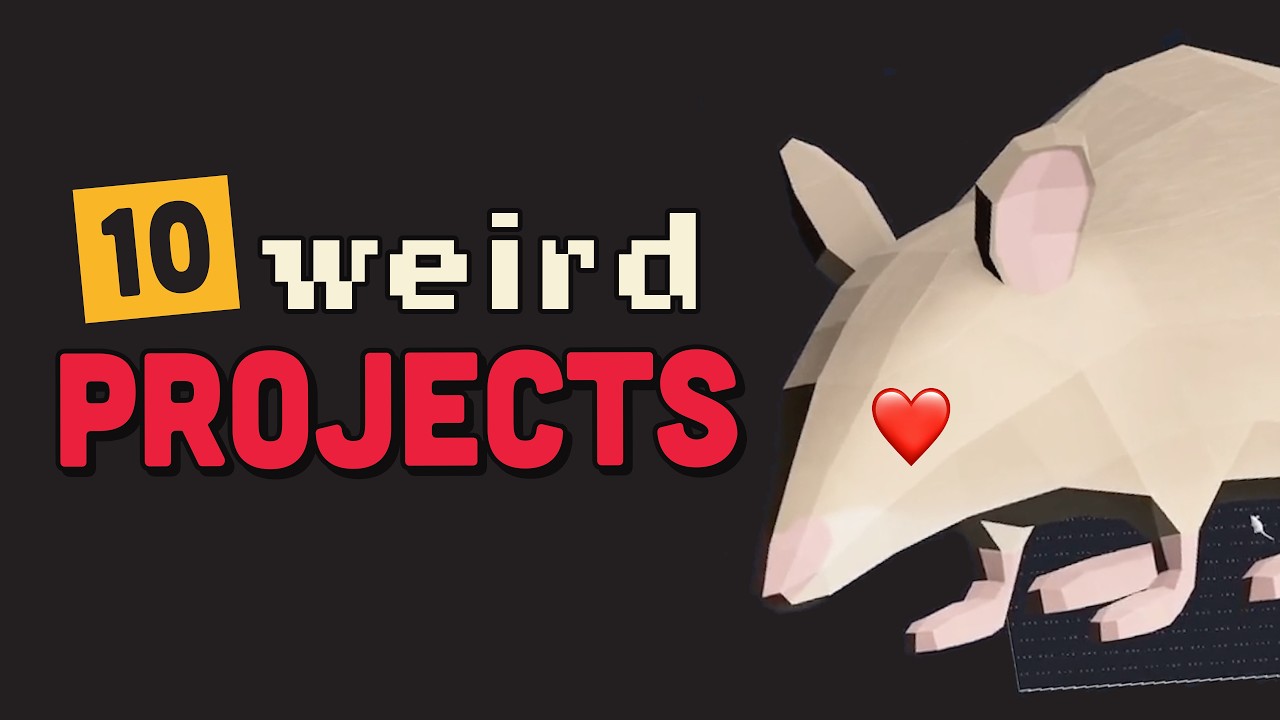
What Is Ratty, the 3D GPU Terminal Emulator in Rust?
Ratty is a terminal emulator built in Rust and inspired by TempleOS. Its most immediate feature: the cursor is a spinning 3D rat. Created by Warren Parmacksis, Ratty doesn't just render text — it renders an entire GPU-accelerated 3D scene powered by the Bevy game engine.
What does that mean practically? You can hit Control-Alt-Enter to physically tilt your terminal in 3D space like you're navigating a PS2 game. You can import custom 3D models from Blender. You can make your command line feel like an artifact from a cyberpunk fever dream. The only catch is a 300MB RAM footprint, which the creator acknowledges with the deadpan quote: "Everything comes at a cost, especially the spinning rat cursor."
Is it practical? Absolutely not. Is it the most important terminal emulator of 2026? Possibly yes.
How Do You Make Anonymous Calls From the Terminal?
Terminal Phone is an open-source, push-to-talk voice and text application that runs entirely over Tor as a shell script. No servers. No accounts. No phone numbers. Your identity is a .onion address, which means every conversation is ephemeral and end-to-end encrypted by default.
The developer shipped this in February with a custom protocol built from scratch. It's the project cypherpunks were promising in 1995, and after 30 years, one determined individual finally delivered it. If you've ever wanted to take a call from inside a tmux session three panes deep, this is your moment.
Can You Write CUDA Kernels in Rust? Meet CUDA Oxide
Writing CUDA kernels — code that runs directly on a GPU — has historically meant carefully crafting C++ and hoping the compiler doesn't segfault. One bad pointer and your $40,000 GPU cluster becomes an expensive paperweight. CUDA Oxide, quietly dropped on GitHub by Nvidia, tries to fix this.
With CUDA Oxide, you annotate a Rust function with #[kernel] and you have GPU-executable code that compiles straight to PTX — no foreign function interface, no C++ in the loop. It's a genuinely significant piece of infrastructure hidden inside what looked like a routine GitHub push from a five-trillion-dollar company. The Rust GPU programming story just got a lot more interesting.
How to Run a Job Queue in SQLite Without Redis
If you've ever reached for Redis just because you needed a job queue on top of SQLite, Honker is the project that will make you feel slightly embarrassed about that decision. Built by developer Russell Romney, Honker is a SQLite extension written in Rust that adds Postgres-style NOTIFY/LISTEN directly into your database file.
- Durable pub/sub messaging
- Task queues
- Event streams
- A cron scheduler
All of it lives inside the same .db file as your application data. No additional infrastructure. No Celery. No message broker. Just SQLite doing things SQLite was never supposed to do, and doing them well. It's a reminder that 99% of developers don't need Kubernetes — they need a $5 VPS and a smarter database layer.
What Is an Ad Blocker That Makes the Web Look Like an 80s Horror Film?
In 1988, John Carpenter made They Live — a film where a man puts on sunglasses and sees that every advertisement on Earth is actually alien mind control propaganda commanding people to obey, consume, marry, and reproduce. Developer David Lawrence had the idea in 2015 that this aesthetic was the most honest way to implement an ad blocker.
He sat on that idea for a decade, then finally shipped it as a fork of uBlock Origin Light. Instead of silently removing ads, it transforms surfing the web into an 80s sci-fi horror experience. Every blocked ad becomes a reminder of what it actually is. It's the most philosophically coherent approach to ad blocking ever created.
How Does Wario Synth Turn Any Song Into a Game Boy Chiptune?
Wario Synth is simple in concept and slightly magical in execution. You paste in a song, and it spits it back out as a Game Boy chiptune. Under the hood, it uses the Web Audio API to resynthesize audio using two pulse waves, one wave channel, and one noise channel — exactly the hardware profile of a 1989 Game Boy.
Everything runs in the browser with zero server-side processing. It sounds exactly like it should: like your favorite song got lost in 1989 and just now found its way out. Enjoy it before Nintendo's legal team makes it disappear.
What Is Xpedia? Wikipedia as a TikTok Feed
Developer Lea Rebain looked at modern social media and asked the only sensible question available: what if doomscrolling was actually good for you? The answer is Xpedia, which is Wikipedia formatted as a TikTok-style infinite scroll feed.
You open the web app, pick a few interest categories, and it downloads 40 megabytes of Simple Wikipedia in the background. Then you scroll. Endlessly. Learning things. The algorithm runs entirely in the browser, it's open source, and it might be the most defensible use of the infinite scroll pattern ever built.
What Is Pyrite? A Full Desktop Environment in the Browser
Pyrite is a self-hostable browser-based desktop environment. Visit pyrite.com and you're greeted with a taskbar, draggable windows, a file manager, and a suite of applications including a notepad, code editor, and terminal. It's the dream of Chrome OS — except it's actually free, genuinely open source, and noticeably fun to use.
It won't replace your local machine, but as a demonstration of what's possible in a browser runtime in 2026, it's a compelling proof of concept and a genuinely usable environment for lightweight tasks.
Why These Projects Matter More Than Another AI Wrapper
Every project on this list exists because someone cared more about the idea than the outcome. No product-market fit analysis. No go-to-market strategy. Just a spinning rat cursor, a decade-old idea about sunglasses, or a SQLite extension that quietly makes an entire category of infrastructure redundant.
The AI tooling gold rush is real, loud, and mostly hollow. But underneath it, developers are still building things that are insane, beautiful, and deeply unnecessary — and that tradition is worth celebrating. These are the projects that remind you why you fell in love with software in the first place.