How Did Napoleon Win His First Campaign in Italy?
Napoleon Bonaparte won his first campaign in Italy in 1796 by doing what no one expected — attacking relentlessly. Given command of a demoralised, undersupplied French army in northern Italy, the young general immediately imposed his personality on the war: speed over caution, concentration of force over broad deployment, and flanking maneuvers over frontal attrition. Within weeks, he had shattered two Austrian armies, driven Field Marshal Wurmser into the besieged city of Mantua, and transformed the entire strategic landscape of the French Revolutionary Wars. This was not luck. It was a masterclass in Napoleonic warfare before the world even knew what that meant.
By August 1796, the broader war was tilting in France's favour. General Hoche had ended the bloody royalist revolt in the Vendée. Jourdan and Moreau were crossing the Rhine toward Vienna. But in Italy, after his victory at Castiglione, Napoleon faced a daunting reset: the Austrians had used the respite to haul away his siege artillery and demolish his siege works around Mantua. Disease — primarily malaria — was ravaging both sides. Even the great Masséna asked to go home. Napoleon refused.
 02:15
The strategic situation in Italy and Germany as of August 1796, showing French and Austrian army positions
Watch at 02:15 →
02:15
The strategic situation in Italy and Germany as of August 1796, showing French and Austrian army positions
Watch at 02:15 →
What Was France's Grand Strategy in Italy in 1796?
The Directory in Paris had an ambitious plan: Napoleon was to smash through the Adige Valley, link up with Moreau's Army of the Rhine at Innsbruck, and together invade Austria itself, forcing Emperor Francis II to sue for peace. It was a grand, coordinated pincer movement designed to end the war in a single sweeping campaign.
Napoleon faced an Austrian force of roughly equal size under Field Marshal von Wurmser. His answer was not to match them man for man, but to concentrate his divisions rapidly and fall on isolated portions of the enemy before they could react. Speed and mass at the point of contact — these were Napoleon's core principles, and the Italian campaign of 1796 was where they were first proven on a grand scale.
Who Was Wurmser and Why Did His Plan Fail?
Austrian Field Marshal von Wurmser was a veteran commander under enormous political pressure to relieve the besieged garrison at Mantua. His staff, convinced that recent fighting had left the French army shattered and incapable of offensive action, encouraged an audacious plan: rather than force his way down the Adige Valley, Wurmser would leave General Davidovich in a defensive holding role while he led a wide flanking march via the Brenta Valley and Bassano, reaching Mantua from the east. Once there, he would link with the garrison — and when Napoleon inevitably marched south to face him, the French would be crushed between two Austrian forces.
05:40
Wurmser's flanking march via the Brenta Valley — the plan that Napoleon turned against him
Watch at 05:40 →
It was a clever plan. It failed for one reason: Napoleon was faster, more decisive, and more willing to tear up his own plans when new information demanded it. When French forces shattered Davidovich's defences at Rovereto and Calliano on 4th September, capturing 3,000 prisoners and 25 guns, Napoleon interrogated prisoners and local informants and immediately understood what Wurmser was doing. He scrapped the march to Innsbruck on the spot and ordered a pursuit down the Brenta Valley instead.
What Happened at the Battle of Bassano in 1796?
The pursuit down the Brenta Valley was a dramatic, high-speed chase. The French Army of Italy, brimming with confidence after Rovereto, moved at a pace the Austrians simply could not match. A small Austrian force at Levico offered token resistance and was brushed aside. The next day, French light infantry routed a 3,000-strong Austrian rearguard at Primolano, capturing most of them before they could retreat.
Wurmser made his last real stand at Bassano, where the narrow valley opened onto flat plains — terrain that seemed to favour a defensive action. It didn't help. With Colonel Lannes leading the charge and Murat's cavalry thundering in pursuit, the Austrians were driven back and chased directly into the town. In the resulting panic and chaos, the French captured another 2,000 prisoners, an Austrian general, and 30 guns. Wurmser was now down to 12,000 men — outnumbered two to one — with part of his force retreating in entirely the wrong direction toward Trieste.
09:10
The Battle of Bassano: Murat's cavalry chasing Austrians into the town amid chaos and blocked roads
Watch at 09:10 →
Why Was Mantua So Important to Napoleon?
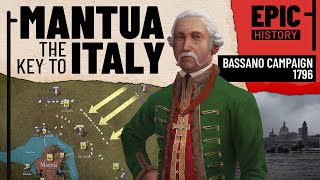
Mantua was known as the 'key to Italy' — and the name was apt. The fortress city sat surrounded by pestilential marshes fed by the Mincio River, making it almost impossible to take by storm. It controlled the principal routes from the Alps into the Po Valley. Whoever held Mantua held strategic dominance over northern Italy. For Austria, it was the anchor of their Italian position. For Napoleon, it was the obstacle he had to eliminate before he could push north toward Vienna.
The problem was taking it. Conventional siege warfare required heavy artillery, time, and healthy troops — all things the French army was short of. Disease tore through both besiegers and besieged alike. The Austrian garrison was being decimated by malaria even before Wurmser arrived with reinforcements. Once Napoleon bottled Wurmser inside the city after the Battle of La Favorita in mid-September, the situation became catastrophic for the Austrians: disease, wounds, and malnutrition killed nearly 100 Austrian soldiers every single day for six weeks. Civilians were reduced to eating rats and horses.
How Did Napoleon Use Speed and Flanking to Win?
Again and again throughout the Italian campaign, Napoleon used the same tactical formula — and it worked every time. When Austrian troops occupied strong defensive positions in the narrow mountain passes, French light infantry would swarm up the valley walls to outflank them while the main force applied pressure along the road. The combination of frontal threat and envelopment gave the Austrians an impossible choice: hold and be surrounded, or retreat and be pursued.
13:25
The siege lines around Mantua tightening after Wurmser's army is trapped inside the city
Watch at 13:25 →
At Calliano, a position Napoleon himself admitted should have been impregnable — sheer mountains flanking a valley floor only a few hundred yards wide, defended by a castle and wall — the French hit the single Austrian regiment defending it with speed and numbers before it had time to prepare. The result was chaos: Austrian troops, wagons, and artillery all jamming the escape route simultaneously as Masséna's men broke through to a camp where soldiers had been preparing their dinner.
This was Napoleon's signature: arrive before the enemy expects you, attack before they are ready, and exploit the resulting confusion without pause. It was an approach that demanded troops capable of extraordinary marching speeds — and the Army of Italy, for all its shortages, consistently delivered.
What Problems Did the French Army Face in Italy in 1796?
The popular image of Napoleon's Italian army is one of unstoppable momentum — and it largely is. But the French forces were fighting against serious disadvantages throughout. Disease, particularly malaria in the marshlands around Mantua, was a constant killer. Equipment shortages were chronic: after Castiglione, Napoleon had to restart his Mantua siege from scratch because the Austrians had dismantled his works and dragged away his heavy guns. Even his best generals were struggling — Masséna himself requested to be relieved due to ill health and exhaustion.
Reinforcements were scarce. When Archduke Charles defeated Jourdan's Army of the Rhine twice in two weeks and forced both Jourdan and Moreau to retreat to the frontier, the strategic pressure on Napoleon intensified enormously. He would receive far fewer fresh troops than he needed. And politically, he was navigating a minefield: the Pope was stirring anti-French sentiment in Rome, Naples threatened to re-enter the war, and whispers in Paris questioned whether this dangerously popular young general might one day become a political threat.
Napoleon's answer to all of it was to keep winning. He concluded a peace treaty with Naples without consulting the Directory — the kind of unilateral action that fed suspicions of his ambition, but secured his southern flank. He sent 22 captured Austrian standards to Paris via his aide-de-camp Marmont, managing his political image as carefully as his military campaigns. The autumn of 1796 would bring a new Austrian relief attempt and Napoleon's most formidable opponent yet — Feldzeugmeister Alvinczi, the first man who would actually defeat him in battle. But that story, and the siege of Mantua's final act, was still to come.