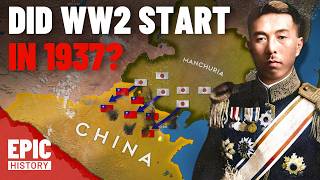
The events that led to World War II did not begin in 1939 — they were already well underway by 1937. That single year saw Stalin's murderous purges gut the Soviet military, Japan launch a savage war against China culminating in the Rape of Nanking, Hitler secretly map out his plans to seize Austria and Czechoslovakia, and the world watch in horror as bombs fell on civilian populations in Spain. While Western democracies clung to neutrality and appeasement, the architecture of the coming global war was being assembled piece by piece. Here is how it all unfolded.
What Events in 1937 Led to World War II?
The year 1937 was a turning point that transformed regional aggression into a genuinely global crisis. The spirit of international disarmament that had defined the early 1930s was now completely shattered. Japan was at war with China. Germany was rearming at breakneck speed. Italy had already swallowed Ethiopia. And the Soviet Union was tearing itself apart from within. What made 1937 so significant was not any single event but the simultaneous collapse of diplomatic hopes across every major theater — Asia, Europe, and the Middle East — all at once. The alliances that would define World War II were crystallizing, the ideological battle lines were hardening, and the major powers were choosing sides. By December 1937, it was increasingly clear to those paying attention that another world war was not a possibility — it was a probability.
 00:45
Soviet NKVD officers arresting suspected political enemies during the height of Stalin's Great Purge in 1937
Watch at 00:45 →
00:45
Soviet NKVD officers arresting suspected political enemies during the height of Stalin's Great Purge in 1937
Watch at 00:45 →
What Really Happened During the Rape of Nanking?
Of all the horrors of 1937, none shocked the world more than what Japanese forces did after capturing Nanking, China's capital, in December. Following a brutal four-day battle, Japanese soldiers entered the city and embarked on six weeks of systematic terror. The violence was staggering in both its scale and its cruelty. An estimated 30,000 Chinese prisoners of war were executed in mass shootings. Civilians were looted, raped, tortured, and murdered. Estimates of the total civilian death toll range from 100,000 to 200,000 people — a range that itself speaks to the chaos and deliberate destruction of evidence.
What made Nanking particularly significant historically was not just the scale of the atrocities but their visibility. The international press was present. The evidence was documented. The League of Nations and the United States both condemned Japan in the strongest terms. And yet, as had become the grim pattern of the era, condemnation was not backed by action. No sanctions were imposed. No military response was mounted. Words were spoken, and the world moved on — a lesson not lost on Hitler, who observed that Japan's conduct confirmed his view that Tokyo would be a valuable and ruthless partner in Asia.
What Was the Marco Polo Bridge Incident?
The war in China did not begin with a grand declaration or a calculated military strike. It started with a missing soldier. On the night of July 7, 1937, a dispute over a Japanese soldier reported absent from his unit led to a firefight between Japanese and Chinese forces near the Marco Polo Bridge outside Beijing. The soldier, it turned out, had simply wandered off. But neither side was willing to de-escalate.
08:12
Japanese troops advancing through the ruins of Shanghai during the three-month battle for China's largest city
Watch at 08:12 →
Japan's military elite, emboldened by the successful conquest of Manchuria, poured reinforcements into the region. China's leader Chiang Kai-shek, under enormous domestic pressure, announced a war of national self-defense and mobilized the country. Within six weeks, nearly 200,000 Japanese troops had swept through northern China, seizing Beijing within a month. Chiang attempted to shift the momentum by attacking the Japanese garrison in Shanghai, drawing the conflict into China's largest and most internationally watched city. The three-month Battle of Shanghai reduced much of the city to ruins, cost both sides enormous casualties, and ended with Chinese forces withdrawing toward Nanking — and catastrophe.
How Many People Died in Stalin's Great Purge?
While Asia descended into war, the Soviet Union was destroying itself. Stalin's Great Purge — already underway for several years — reached its peak of violence in 1937. What had begun as an expression of Stalin's paranoia about political rivals and foreign agents had metastasized into a nationwide moral panic, a witch hunt that swept up the innocent alongside the guilty.
The Soviet secret police, the NKVD, arrested hundreds of thousands of people. Coerced confessions and torture were standard tools. The death toll is estimated at between 600,000 and 700,000 — though no precise figure is possible given the deliberate destruction of records. Beyond those executed, vast numbers were exiled to the Gulag, a network of labor camps so brutal that survival was far from guaranteed.
05:30
The devastation left by Germany's Condor Legion after the bombing of Guernica, April 1937
Watch at 05:30 →
The damage extended far beyond individual suffering. Among the purge's victims were thousands of Red Army officers, including Marshal Mikhail Tukhachevsky, widely regarded as the Soviet Union's most brilliant military theorist. By liquidating so much experienced military leadership on the eve of a potential world war, Stalin had handed his future enemies an enormous strategic gift — one that would cost the Soviet Union dearly in the early years of World War II.
Why Did the Bombing of Guernica Shock the World?
Spain's Civil War had been raging since 1936, with the Republican government holding Madrid against a Nationalist siege. But in April 1937, a single event crystallized the world's fears about what modern warfare had become. Germany's Condor Legion, fighting alongside Franco's Nationalists, bombed the Basque town of Guernica. More than 200 civilians were killed in the attack on a largely undefended town.
The international outcry was immediate and intense. Guernica was seen as a preview of the future — a world in which bombers could reduce any city to rubble, in which civilian populations had no protection from aerial bombardment. Pablo Picasso immortalized the horror in his famous painting. But once again, horror did not translate into action. Britain, France, and the United States all maintained their policy of non-intervention in Spain. The Nationalists, better armed and organized, and backed by Nazi and Fascist support, continued to advance. The Republican victory at Guadalajara in March — routing an Italian-led offensive — proved to be their only major victory of the war.
What Was Hitler's Secret 1937 Plan for Europe?
In November 1937, Hitler convened a private meeting with Germany's most senior military and diplomatic figures — War Minister Field Marshal von Blomberg, Foreign Minister von Neurath, and the heads of the army, navy, and air force. For the first time, he laid out his intentions explicitly: Germany would annex Austria and Czechoslovakia as soon as circumstances allowed. This would provide living space for the German people and drive Germany toward economic self-sufficiency. Hitler acknowledged that these moves might trigger a major war with Britain and France, but calculated that such a conflict would be best fought around 1943 or 1944, once German rearmament was complete.
The meeting was a watershed moment. Hitler was no longer speaking in vague ideological terms — he was outlining a timetable and a strategy. The men in that room knew that war was not a theoretical risk but a planned outcome. Within months, several of them would be pushed out of their positions for failing to match Hitler's appetite for risk.
What Was Chamberlain's Appeasement Policy?
In May 1937, Neville Chamberlain became Britain's new Prime Minister, arriving with a clear worldview: war with Germany could and should be avoided through negotiation and compromise. Chamberlain believed deeply in the value of personal diplomacy — that building direct relationships with Hitler and Mussolini could steer Europe away from conflict. This approach became known as appeasement.
The limitations of that strategy were already visible by the end of 1937. When President Roosevelt floated an ambitious plan to promote world peace — proposing that major powers might agree to disarm in exchange for a fairer share of global resources — Chamberlain quickly dismissed it. He feared Roosevelt's initiative would interfere with his own diplomatic efforts. It was a telling moment: Britain's prime minister was so committed to his bilateral approach that he turned away potential American engagement at precisely the moment it was most needed.
What Was the Anti-Comintern Pact and Why Did It Matter?
November 1937 also saw Italy formally join the Anti-Comintern Pact, the alliance between Germany and Japan originally established the previous year to counter Soviet international influence. On the surface, the pact was largely symbolic — it imposed few concrete obligations. But its significance was unmistakable: the three most aggressive military powers in the world were now formally aligned against the Soviet Union and, by extension, against the liberal democratic order.
One month later, Mussolini announced that Italy would withdraw from the League of Nations entirely, in protest at its refusal to recognize Italy's conquest of Ethiopia. By the close of 1937, the international institutions built after World War I to preserve peace had been exposed as toothless, the democracies had retreated into paralysis and isolation, and the powers that would fight World War II were locked into their opposing camps. The road to global conflict was not just visible — it was being actively paved.