
What Was the Battle of Verdun in World War One?
The Battle of Verdun was one of the longest and deadliest battles of World War One, fought between Germany and France from 21st February to 18th December 1916. Lasting 300 days and consuming roughly a thousand lives every single day, Verdun was not simply a clash of armies — it was a calculated experiment in destruction. Germany's plan was brutally simple: force France into a battle so costly, so relentlessly bloody, that French military will would collapse entirely. The result was a grinding nightmare that shocked even the hardened veterans of the Western Front, and permanently scarred the national memory of both nations.
Fought around the historic fortress-city of Verdun in north-eastern France, the battle opened with one of the most ferocious artillery bombardments in history. Almost a million shells fell on French positions in a single day. What followed over the next ten months was a savage back-and-forth struggle for hills, forts, and shattered villages — a battle that seemed to feed on itself, pulling in more and more troops on both sides with no end in sight.
 01:15
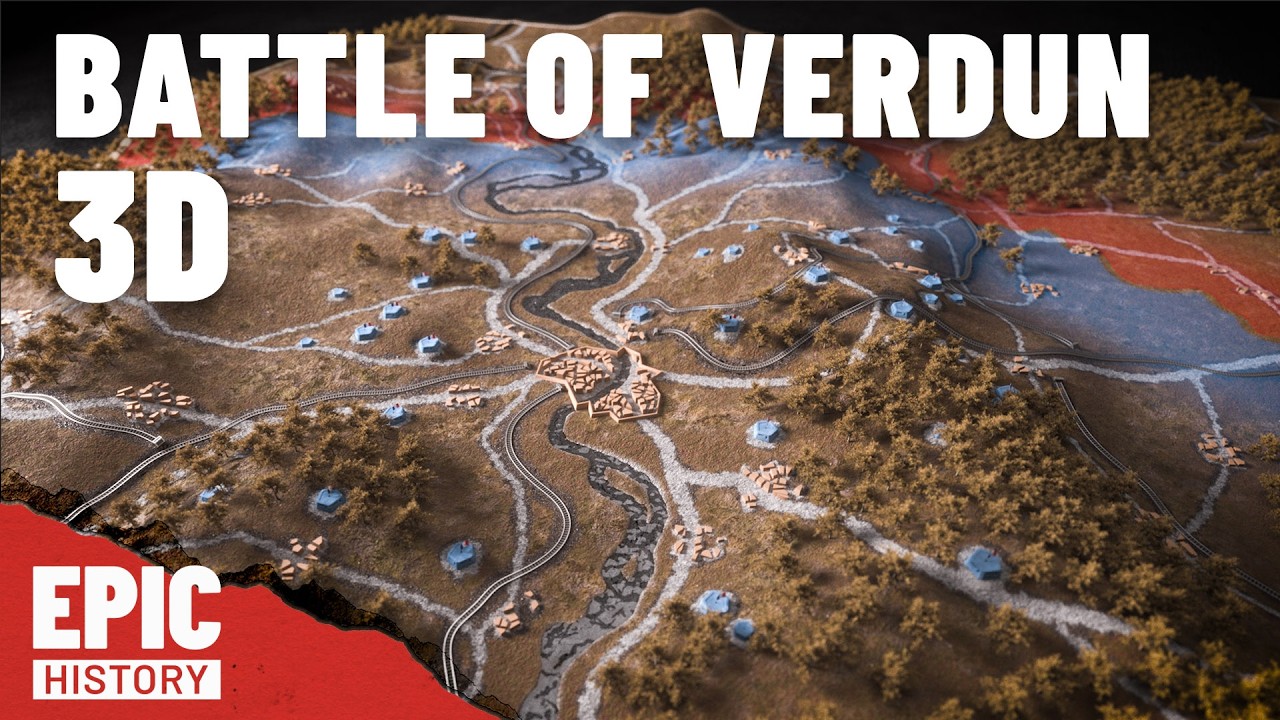
German artillery positions surrounding Verdun — over 1,220 guns assembled on an 8-mile front
Watch at 01:15 →
01:15
German artillery positions surrounding Verdun — over 1,220 guns assembled on an 8-mile front
Watch at 01:15 →
Why Did Germany Choose Verdun as Its Target?
To understand the Battle of Verdun, you have to understand the man who planned it: German commander Erich von Falkenhayn. By late 1915, Falkenhayn had reached a grim conclusion — Germany could not win a decisive military victory against the Allies. Allied resources were simply too vast. His solution was not conquest, but collapse: force the enemy to the negotiating table by making the war unbearably expensive.
He identified France as the weakest link among the Allies, and Verdun as the perfect trap. The city held enormous symbolic importance for France — it was a fortress-city that had guarded France's eastern frontier for centuries. Falkenhayn calculated, correctly, that French generals could never allow Verdun to fall. They would pour men into its defence no matter the cost.
His plan, codenamed Operation Gericht — meaning 'Judgement' — was not primarily aimed at capturing Verdun. It was aimed at killing French soldiers. By seizing the heights surrounding the city, Germany would force France into endless, bloody counterattacks against well-positioned German artillery. As Falkenhayn himself reportedly put it, 'the French Army must be bled white.'
04:30
Map showing Verdun's exposed salient position and the German rail advantage from Metz
Watch at 04:30 →
Verdun's geography made it even more attractive. It sat in an exposed salient, difficult to supply — Verdun could no longer be reached safely by rail and depended on a vulnerable road network. Meanwhile, the Germans enjoyed a major rail hub at Metz, just 25 miles away, with direct lines back to German factories. They could feed shells into the battle almost indefinitely. The French could not.
What Was the Attrition Strategy and Did It Work?
Attrition warfare is the deliberate strategy of wearing down an enemy through continuous losses — men, equipment, and morale — rather than seeking a decisive battlefield victory. At Verdun, this was taken to an extreme rarely seen in military history. The logic was cold and mathematical: kill the enemy faster than you lose your own men, and eventually his will to fight disintegrates.
Artillery was the engine of this strategy. On the Western Front, artillery was already the greatest killer — and Falkenhayn planned to weaponise it on an industrial scale. For the opening assault, the Germans assembled 1,220 guns on an eight-mile front — one gun every twelve yards — backed by 2.5 million shells delivered by 1,300 munitions trains. The bombardment that opened the battle on 21st February 1916 was, at the time, almost beyond imagination.
But attrition, as Verdun brutally demonstrated, is a double-edged sword. Germany suffered catastrophic losses of its own. The battle that was supposed to bleed France white ended up bleeding both armies. By the time fighting wound down in December 1916, France had suffered an estimated 400,000 casualties — and Germany had lost a staggering number itself, in a battle it had designed entirely on its own terms. In that grim sense, the strategy failed. France did not crack.
08:45
Cross-section diagram of Fort Douaumont showing its underground tunnels and armoured turrets
Watch at 08:45 →
How Did the 'Strongest Fort in Europe' Fall Without a Shot?
One of the most astonishing moments of the entire battle came just four days after it began. Fort Douaumont — a steel and concrete fortress reputedly the most powerful in Europe, designed to anchor the entire Verdun defensive system — fell to a small German detachment without a single shot being fired in its defence.
How was this possible? The answer lies in a catastrophic failure of French military thinking. When Belgian forts had been smashed by German heavy artillery in 1914, French commanders lost faith in fixed fortifications. Guns were stripped from Verdun's forts and sent elsewhere on the front. Garrisons were gutted. Fort Douaumont, which had housed 500 soldiers in 1914, was now held by just 56 middle-aged reservists.
The most powerful fort in Europe was, in reality, a paper tiger. When German soldiers approached cautiously on 25th February, they found it almost abandoned. They slipped inside through an unguarded opening and seized it without resistance. A French officer remarked bitterly that its loss would ultimately cost France a hundred thousand lives — an estimate that proved grimly accurate, as the French launched repeated, bloody attempts to recapture it.
Who Was General Pétain and How Did He Save Verdun?
With Fort Douaumont gone and the Germans just six miles from Verdun itself, France faced disaster. Commander-in-chief General Joffre had been slow to respond — reluctant to divert resources from plans for a major Allied summer offensive. But the scale of the crisis could no longer be ignored. Verdun's fall would be both a military catastrophe and a political earthquake.
13:20
General Pétain takes command — the Voie Sacrée supply road keeps Verdun alive
Watch at 13:20 →
Joffre ordered the entire Second Army to reinforce Verdun, placing it under General Philippe Pétain. Within six days of the German attack, Pétain was in overall command of the sector. His impact was immediate and decisive. He halted the costly, improvised counterattacks that were bleeding French units dry, and prioritised building a coherent defence.
Crucially, Pétain understood logistics. Verdun's only reliable supply route was a single road — later immortalised as the Voie Sacrée, the Sacred Way — and he turned it into a military supply artery, running trucks around the clock to keep the garrison fed, armed, and reinforced. By the end of February, the French line had been shored up. The Germans, meanwhile, had advanced beyond the range of their own supporting artillery, which was nightmarishly difficult to haul forward through the thick mud. The advance stalled.
What Were Falkenhayn's Fatal Mistakes at Verdun?
As the battle ground on through spring 1916, Falkenhayn faced growing criticism for two key errors in the opening phase. The first was his failure to attack on both banks of the River Meuse simultaneously. By only striking the east bank initially, he left French artillery on the west bank — at positions like Bois Bourrus, Marre, and Vacherauville — free to pour fire into the flanks of his advancing troops. His own planners had urged him to address this from the start. He finally extended the offensive to the west bank on 6th March, but the element of surprise was long gone.
His second mistake was failing to commit his reserves quickly enough to exploit Germany's early breakthrough. In those first chaotic days, when French defences were shattered and disorganised, a faster, deeper push might have changed everything. Instead, those reserves were held back, the momentum was lost, and France had time to reorganise under Pétain.
There is also a deeper historical controversy around Falkenhayn's true intentions. Some historians argue that he never genuinely planned a battle of pure attrition — that he always hoped to capture Verdun itself, and after the war rewrote history, even allegedly faking a key document, to claim the 'bleeding white' strategy had been his plan all along. Whether cynical revisionism or genuine strategy, it scarcely mattered. The battle had taken on a terrible life of its own.
Was Charles de Gaulle at the Battle of Verdun?
Among the hundreds of thousands of French casualties at Verdun in the spring of 1916 was a young captain who would one day lead France itself: Charles de Gaulle. His battalion was encircled near Fort Douaumont during the ferocious fighting. While attempting to break out of the encirclement, de Gaulle was bayonetted in the thigh and captured by German forces. He remained a prisoner of war for the remainder of the conflict — his Verdun wound a formative experience that would shape his understanding of war, leadership, and French national identity for the rest of his life.
The Battle of Verdun was more than a military engagement. It was a crucible that forged — and destroyed — generations of soldiers, and left an indelible mark on the nations that fought there. And in early 1916, with the Germans stalled but far from defeated, the worst was still to come.