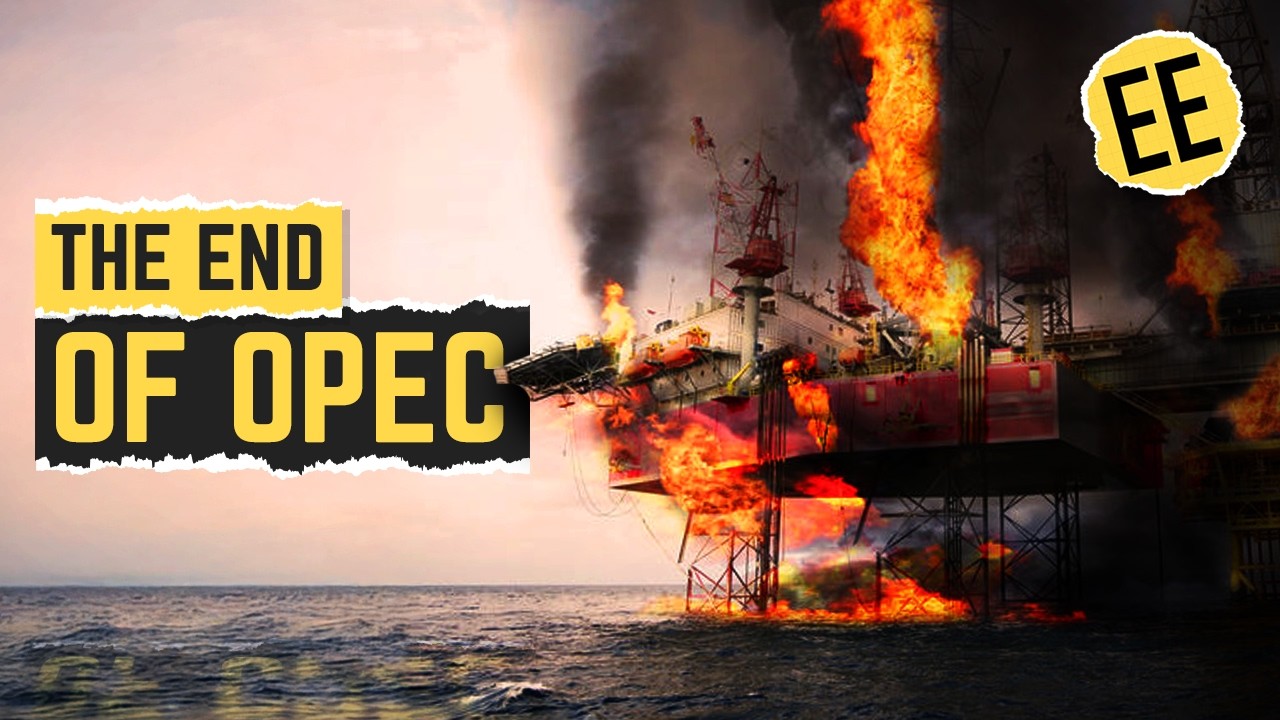

On April 27th, the United Arab Emirates officially announced it was leaving OPEC — the most powerful oil pricing cartel in the world — after more than 60 years of membership. So why did the UAE leave OPEC? Officially, the Emirates cited two reasons: their oil production capacity had far outgrown their artificially capped quota, and they were furious with fellow OPEC members for failing to defend them from Iran during an ongoing conflict. But as with most moves at this level of geopolitics, the real story is considerably more layered than the press release.
Why Did the UAE Leave OPEC in 2025?
The UAE was not just any OPEC member. It was one of the organization's earliest members outside the original founding five, and the fourth-largest oil producer in the group, accounting for roughly 12% of OPEC's total output. Walking away from that kind of arrangement is not a decision made lightly — or purely over a quota dispute.
 01:15
The UAE's official OPEC departure announcement and the stated reasons behind it
Watch at 01:15 →
01:15
The UAE's official OPEC departure announcement and the stated reasons behind it
Watch at 01:15 →
The official production grievance is real enough. Under OPEC's framework, the UAE is capped at around 3.2 million barrels per day. But industry estimates suggest the country could push output toward 5 million barrels per day within a few years if it were free to do so. That's a massive gap between what they're allowed to produce and what they're capable of producing — and every day inside OPEC is another day of leaving serious money on the table.
Then there's the Iran angle. The UAE has been on the receiving end of conflict fallout and has grown increasingly frustrated that fellow OPEC members — many of whom have their own complicated relationships with Tehran — haven't done more in their corner. When your neighbors are either bombing you or staying diplomatically quiet while you take hits, a shared oil cartel starts to feel less like an alliance and more like a cage.
That said, regional analyst Ryan Grim has pointed out an important paradox here: if the UAE's primary motivation were simply to produce and export more oil, this was a strange moment to make the move. A significant portion of its oil infrastructure has been damaged, and exports through the Strait of Hormuz remain disrupted. Pure supply economics don't fully explain the timing, which is why most serious observers think this was primarily a geopolitical statement — a very public way of sticking it to the other members of the group.
How Much Oil Does OPEC Actually Control Today?
To understand why the UAE's departure matters so much, you need to understand just how far OPEC has already fallen from its peak influence. At its height, OPEC controlled more than half of the world's oil supply. Today, that figure has dropped to less than a quarter. The United States alone now produces roughly half of what the entire OPEC bloc puts out.
05:30
Chart showing OPEC's decline from 50% to under 25% of global oil supply
Watch at 05:30 →
This decline wasn't accidental — it was partly self-inflicted. OPEC's entire pricing strategy depends on controlling enough global supply to actually move the market price. When you only control a quarter of global output, cutting your own production doesn't dominate the market the way it once did. Someone outside the cartel simply produces that barrel instead, and you've just given away revenue for nothing.
The shale revolution in North America was the single biggest driver of this shift. For decades, US oil production had been in a long, slow decline. Then in the mid-2000s, prices climbed high enough that horizontal drilling and hydraulic fracking into shale rock became commercially viable. Once that industry was built out, it didn't go away. Saudi conventional crude can be lifted from the ground for as little as $4 per barrel. US shale needs prices closer to $50 to $60 to make sense — but that break-even has come down significantly as the industry has matured, meaning OPEC's old trick of flooding markets to kill off shale competition is increasingly expensive and decreasingly effective.
What Is OPEC+ and Why Hasn't It Solved OPEC's Problems?
Recognizing that it was losing ground, OPEC attempted to claw back influence by launching OPEC+, a broader coalition that brought in major non-member producers like Russia. The logic was simple: more producers coordinating together means more market control. The reality has been messier.
The more national interests you have to balance inside a cartel, the harder coordination becomes. Russia in particular has repeatedly produced above its agreed quota, especially over the past few years, undermining the credibility of the whole arrangement. And because Russia moves a significant chunk of its oil exports through gray markets to avoid sanctions, actually policing compliance is nearly impossible. OPEC+ gave the group a bigger tent, but it also gave them more internal contradictions.
10:45
The prisoner's dilemma breakdown of why OPEC cartels historically collapse
Watch at 10:45 →
What Happens to Oil Prices When OPEC Loses Members?
In the immediate term, the UAE's departure may not dramatically move oil prices. As noted above, actual production increases are constrained right now by damaged infrastructure and Hormuz disruptions. But the medium and long-term picture is a different story.
Once the UAE is free of its quota, it has every incentive to ramp up production toward its full capacity. That's potentially 1.5 to 2 million additional barrels per day hitting global markets from a single country — entirely outside OPEC's coordination. And that new supply arrives at exactly the moment OPEC needs its members to hold back, not expand.
More broadly, lower OPEC market share means that every barrel produced outside the cartel hurts the remaining members more than the last. It's not a linear relationship. Going from 50% to 45% market share damages pricing power far less than going from 25% to 20%. The group is already in territory where cuts are painful and the benefits of coordination are genuinely questionable.
Could the UAE's Exit Trigger a Mass OPEC Exodus?
This is the question that has serious analysts genuinely worried, and it comes down to a classic prisoner's dilemma. A cartel only works if every member believes the collective pricing benefit outweighs the individual cost of holding back production. When OPEC controlled 50% of global supply, that calculation was obvious — the pricing benefit of staying in was enormous. At 25% and shrinking, it's far less clear.
The UAE's departure sends a signal to every other member: you can leave, produce more, and potentially earn more. Countries like Kuwait and Iraq are likely watching closely, particularly because the internal dynamics of OPEC have long favored Saudi Arabia as the swing producer and gatekeeper while smaller Gulf states absorb disproportionate production cuts. That grievance is widely shared, and it's now been validated by the UAE acting on it publicly.
If even one or two more significant producers follow suit, OPEC's pricing influence could collapse quickly. The feedback loop is straightforward and historically consistent with how cartels break down: members leave, the group has less power, the remaining members have less reason to stay, more members leave.
Is the UAE-USA Financial Bailout Deal Connected to This?
Possibly — and it's worth taking seriously. In the weeks before the OPEC announcement, the United States was reportedly in discussions to provide the UAE with a currency swap line, similar to arrangements the US has provided to countries like Argentina. The UAE pegs its currency to the dollar, and with both oil revenues and its business hub economy under pressure from the ongoing conflict, its dollar reserves are under strain. A US swap line would give it access to dollars to defend that peg without burning through its own reserves.
These kinds of arrangements from the US Treasury and the Federal Reserve are rarely purely financial. They come with implicit diplomatic alignment expectations and have historically been used as geopolitical tools as much as economic ones. Leaving an organization the US has been broadly at odds with for decades is a relatively low-cost way for the UAE to signal that alignment — particularly when the structural reasons to leave already existed.
To be clear, the UAE almost certainly didn't leave OPEC purely because of a financial deal with Washington. The quota frustrations, the Saudi Arabia leadership tensions, and the Iran conflict are all real and predate these discussions. But the timing of the announcement, coming alongside active bailout negotiations, is unlikely to be purely coincidental.
Is OPEC Still Relevant in 2025?
OPEC's decline is real, but declaring it dead would be premature. Saudi Arabia alone still carries enormous swing production capacity and can move markets when it chooses to. The group still represents a meaningful bloc of global supply. But the trajectory is hard to argue with: less market share, more internal disagreements, a key member publicly walking out, and a feedback loop that structurally rewards defection over cooperation.
For the rest of the global economy, a weaker OPEC is broadly good news. More diversified supply, more competition, and less ability for a small group of countries to use oil as a geopolitical weapon all point toward lower and more stable prices over time. The uncomfortable caveat is that OPEC, for all its dysfunction, has been one of the few reasons these countries have had to at least pretend to cooperate. A fully fragmented Middle Eastern oil market without even that thin layer of coordination could create its own instability — just of a different kind.