Canada's new Avantis CIBC ETFs are a suite of low-cost, factor-tilted exchange-traded funds that give Canadian investors access to a smarter-than-index approach — all without needing to convert currency, deal with US-listed funds, or juggle a complicated multi-ETF portfolio. In short, they do what VEQT and XEQT do in terms of simplicity, but add decades of financial economics research on top. If you've been holding one of the all-equity EQT funds in your TFSA or RRSP, this is worth your full attention.
What Are the New Avantis CIBC ETFs in Canada?
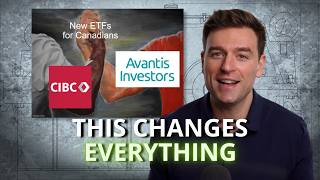
Avantis Investors — a fund company launched in 2019 by former Dimensional Fund Advisors executives, including their former co-CEO and CIO Eduardo Rapedto — has partnered with CIBC to launch a full lineup of Canadian-listed ETFs. This is a significant moment because, until now, Canadians who wanted this type of factor-based investing either needed a financial advisor with access to Dimensional funds or had to cobble together a clunky multi-ETF portfolio that included US-listed funds with all the currency conversion and withholding tax headaches that come with them.
 03:15
Ben Felix explains the full Avantis CIBC ETF lineup and Canadian-listed advantages over US equivalents
Watch at 03:15 →
03:15
Ben Felix explains the full Avantis CIBC ETF lineup and Canadian-listed advantages over US equivalents
Watch at 03:15 →
The new lineup includes funds covering Canadian equities, US large cap value, US all cap, US small cap value, international developed markets, global small cap value, and emerging markets. Each one tilts toward smaller, cheaper, and more profitable stocks relative to its benchmark. The fees are competitive — ranging from 0.19% for the Canadian and US all-cap funds up to 0.39% for small cap value and emerging markets funds. These are not MERs yet since the funds are new, but the final MERs will be only slightly higher once sales tax on the management fee is included.
Crucially, all funds hold securities directly and are listed in Canada, which eliminates the double withholding tax problem that plagued US-listed international ETFs held in TFSAs and RRSPs. Canadian content is also carved out of the international fund, a small but meaningful detail compared to Avantis's US-listed equivalents.
What Is CAEQ and How Does It Work?
The most exciting product in the lineup is CAEQ, the Avantis CIBC All Equity Asset Allocation ETF. Think of it as VEQT — Vanguard's beloved one-ticker global equity fund — but built entirely from the factor-tilted ETFs described above. It provides a globally diversified portfolio with a Canadian home country bias and built-in tilts toward smaller, cheaper, and more profitable companies, all in a single ticker.
CAEQ already has its own subreddit, which tells you something about how seriously Canadian investors are taking it. For anyone who found the previous DIY factor-investing model portfolios too complex to maintain, CAEQ is the solution that removes virtually all of that friction.
09:42
Side-by-side comparison of CAUS vs US market characteristics showing the factor tilts in action
Watch at 09:42 →
Are Index Funds Really the Best Investment Strategy?
Low-cost index funds are still a massive upgrade over the traditional actively managed funds that dominate the Canadian market. Over 80% of Canadian fund assets as of year-end 2024 are still in actively managed products, many of them charging over 1% in annual fees while consistently failing to beat the market over long time horizons. Index funds solve this by keeping costs low and simply capturing the returns of the broad market rather than trying to beat it.
But index funds are not perfect. Most of them are market-cap weighted, meaning they hold more of the biggest stocks and less of the smallest. There is nothing wrong with this in principle — you capture the equity risk premium, which has delivered strong long-term returns historically. The issue is that since index funds were invented in the 1970s, financial economists have identified several other return premiums that cap-weighted index funds simply do not capture.
There is also an implementation cost baked into index funds that most investors overlook. Because index funds must mechanically trade to match their index — buying newly listed IPOs, adjusting for stock buybacks, reacting to index rebalances — research suggests this creates an implicit annual cost of around 0.5%, far exceeding their stated expense ratios.
What Is a Factor Tilt and Why Does It Matter?
A factor tilt means deliberately overweighting certain types of stocks — specifically smaller companies, cheaper companies (by price relative to book value), and more profitable companies — because financial theory and decades of empirical data suggest these stocks have higher expected returns than the broad market.
18:30
Fama-French valuation equation walkthrough — the theoretical foundation for value, profitability, and investment premiums
Watch at 18:30 →
Every Avantis CIBC ETF applies this same logic, just with different levels of aggressiveness. A moderate tilt, like in CAUS (US all-cap), means lower tracking error and a portfolio that behaves fairly close to the index. An aggressive tilt, like in CAUV (US small cap value), means the portfolio looks very different from the market and can diverge significantly in performance over shorter periods — both above and below the index.
The key trade-off is psychological. Tilted portfolios can underperform the market for years at a stretch. The US market over the past decade, dominated by mega-cap growth stocks, is a painful recent example. Investors who couldn't stomach that divergence bailed at exactly the wrong time. Understanding this before you invest is not optional — it's essential.
What Is the Value Premium and Is It Real?
The value premium is the tendency for stocks with low prices relative to their fundamentals — low price-to-book, for example — to outperform more expensive stocks over time. The theoretical foundation comes directly from the dividend discount model. If you hold all else equal, a stock with a lower price must have a higher discount rate applied to its future earnings, which is just another way of saying it has a higher expected return.
Eugene Fama and Ken French formalized this in their famous 1993 and 2015 papers on common risk factors in stock returns. Their valuation equation makes three clear statements: lower relative price implies higher expected return (value premium), higher profitability implies higher expected return (profitability premium), and lower asset growth implies higher expected return (investment premium).
Critically, these premiums should not be chased in isolation. A portfolio targeting only value without controlling for profitability tends to fill up with cheap-for-a-reason stocks — struggling businesses trading at low prices because they deserve to. A portfolio targeting only profitability without controlling for price tends to fill up with expensive growth stocks where you're overpaying for quality. Targeting both simultaneously — finding stocks that are both cheap and profitable — is where the real edge lies. This is exactly what Avantis does.
Should You Still Buy VEQT or XEQT in 2025?
Yes — for many investors, VEQT, XEQT, and the other all-equity EQT funds remain completely sensible options. They are low-cost, broadly diversified, and require virtually no maintenance. If you're not comfortable with the possibility of multi-year underperformance relative to the market, if you don't have a long time horizon, or if the additional complexity of thinking about factor premiums doesn't appeal to you, sticking with a simple cap-weighted index fund is perfectly rational.
That said, VEQT and XEQT do have a real structural limitation heading into 2025 and beyond: they will be forced to buy shares of major IPOs — SpaceX, OpenAI, Anthropic — as soon as those companies list and enter the index. They have no choice. Research consistently shows that index inclusion causes mechanical price increases before index funds are forced to buy, meaning cap-weighted investors often end up buying at a premium. Avantis funds avoid this by only including newly listed companies when there is sufficient financial data and when the price looks attractive relative to fundamentals.
How Do IPOs Like SpaceX Affect Your Index Fund?
When a major private company goes public and joins a major index, index funds must buy its shares to maintain their benchmark alignment. This buying is predictable, which means other market participants can front-run it — purchasing shares before the index fund is forced to, driving up the price. The index fund then buys at an inflated price, effectively transferring value from index fund investors to active traders.
With some of the world's largest private companies — SpaceX, OpenAI, Anthropic — reportedly approaching public markets, this mechanism could become increasingly costly for cap-weighted index fund holders. It is one concrete, near-term reason why understanding the difference between index funds and funds like the Avantis CIBC lineup matters right now, not just in theory.
The Bottom Line on Avantis CIBC ETFs
The launch of the Avantis CIBC ETF lineup is genuinely significant for Canadian investors. For the first time, a complete factor-based investment strategy — backed by serious financial theory and decades of supporting evidence — is available in simple, Canadian-listed, low-cost products accessible to any investor without a financial advisor. Whether you go all-in with CAEQ or build a custom mix of the individual sector funds, the barriers that previously made this approach impractical for most Canadians are largely gone.
Low-cost index funds like VEQT remain a smart choice for most people. But if you're willing to accept tracking error, believe in the long-term evidence for size, value, and profitability premiums, and want a portfolio that captures more than just the single market premium, the Avantis CIBC ETFs deserve serious consideration.