
Is renting better than buying a home in Canada? Based on updated 2025 data across 12 major Canadian cities, the answer is — on average, yes. A hypothetical renter who invested their down payment and monthly savings in a diversified stock portfolio would have built 14% more wealth than an otherwise identical homeowner since January 2005. That's not a narrative or an opinion. That's what the historical data shows through December 31st, 2025.
Is Renting Better Than Buying a Home in Canada?
For decades, the conventional wisdom in Canada has been clear: owning a home is one of the smartest financial decisions you can make. Renting was seen as throwing money away. But a comprehensive analysis using real historical data on home prices, rents, property taxes, maintenance costs, and stock market returns across 12 Canadian cities tells a more complicated story.
 0:45
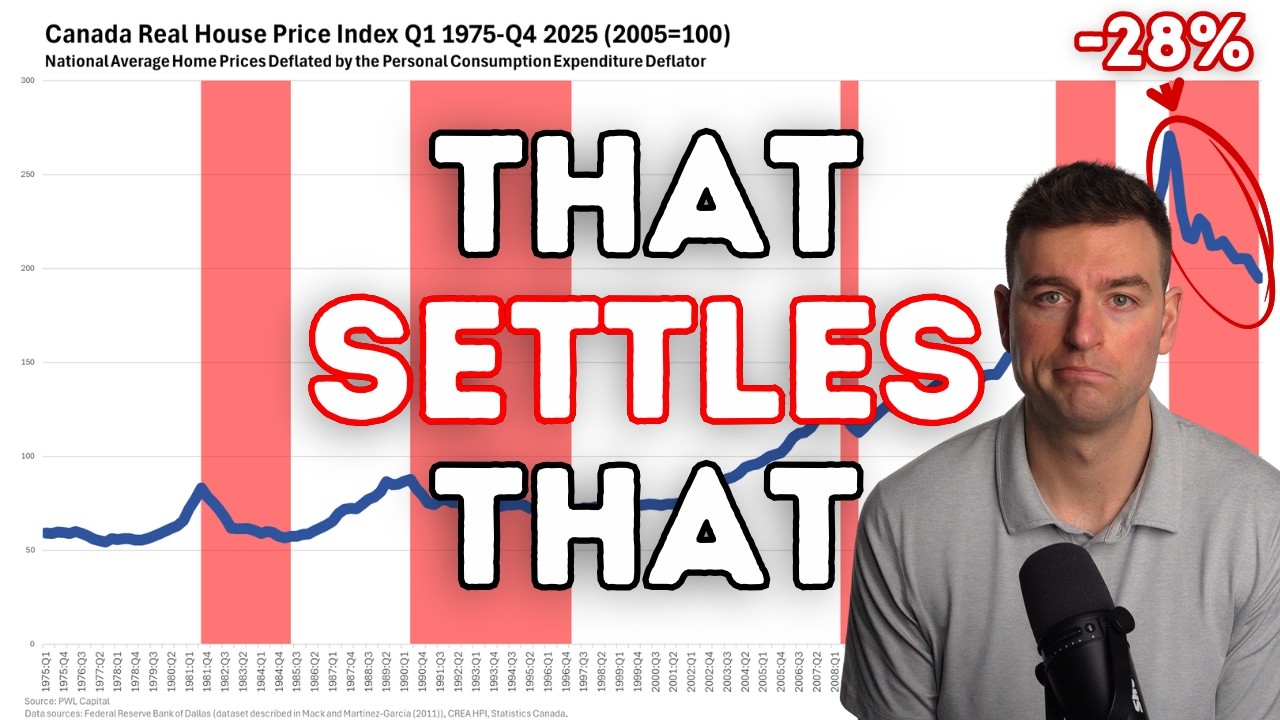
Chart showing Canada's inflation-adjusted home price decline — second worst since 1975 at 28% from peak
Watch at 0:45 →
0:45
Chart showing Canada's inflation-adjusted home price decline — second worst since 1975 at 28% from peak
Watch at 0:45 →
In 2024, when this analysis was last run, renters and homeowners had built essentially equal wealth over the prior 20 years — a statistical tie with a renter-to-owner wealth ratio of 0.99. Then 2025 happened. Real estate prices continued falling across most major Canadian cities while global stock markets stayed strong. By December 31st, 2025, the geometric mean wealth ratio had shifted to 1.14, meaning the average hypothetical renter came out 14% ahead of the average hypothetical homeowner.
This doesn't mean renting is always better. There are real, legitimate reasons to own a home. But the idea that homeownership is a guaranteed financial win over renting? The data doesn't support it — at least not in Canada over this particular 20-year stretch.
How Much Have Canadian Home Prices Actually Dropped?
Canada is currently experiencing the second-worst inflation-adjusted home price decline since 1975. The worst was in the 1980s, which saw a peak-to-trough decline of 31%. The current decline sits at approximately 28% as of December 2025. That's not a rounding error. That's a historically significant correction.
At the peak, Canadian real estate had become some of the most expensive in the world relative to local incomes and rents. A confluence of factors had driven prices to levels that many economists considered unsustainable, and markets — being adaptive systems — eventually responded.
4:20
Renter-to-owner wealth ratio across 12 Canadian cities: 0.99 in 2024 vs 1.14 in 2025
Watch at 4:20 →
Why Did Canadian Real Estate Prices Fall So Hard?
The run-up in Canadian real estate prices wasn't caused by one thing, and neither was the correction. Several forces drove prices to historic highs:
- Ultra-low mortgage rates during the pandemic era allowed buyers to afford much higher purchase prices, pushing demand — and prices — sharply higher.
- Record immigration levels increased competition for a limited housing supply, particularly in major urban centers.
- Foreign investment in residential properties pushed prices beyond what many Canadians could realistically afford.
- Money laundering proceeds flowing into real estate further distorted prices in certain markets.
- Lack of housing supply meant the market couldn't absorb demand increases through new construction fast enough.
When housing affordability became one of the most pressing political issues in the country, policy responses followed. Mortgage rates rose sharply from 2021 lows. Canada's immigration system was restructured to reduce intake numbers. Foreign ownership taxes and temporary bans on foreign purchases of certain residential properties were introduced. And federal initiatives to increase housing supply were launched.
The result: rents and prices have fallen significantly from their peaks. Whether you view that as good news depends heavily on whether you own property or are trying to get into the market.
How Was the Renter vs Homeowner Wealth Comparison Done?
The methodology used here is worth understanding, because the comparison is carefully constructed to be as fair as possible to both sides.
8:15
Model methodology: how monthly cash flow differences between renter and owner are invested over time
Watch at 8:15 →
The model imagines two otherwise identical people in January 2005. Both have saved enough cash for a 20% down payment plus closing costs on an average apartment in one of 12 Canadian cities. One buys. The other keeps renting and invests the down payment in a diversified stock portfolio.
How the homeowner's finances work in the model
The homeowner finances their purchase with a 25-year mortgage at the prevailing rate at the time of purchase. Going forward, they always have just enough cash flow to cover ownership costs: mortgage payments, property taxes, maintenance, condo or strata fees, and insurance. Home prices, property taxes, and other costs are tracked using actual historical data for each city.
How the renter's finances work in the model
The renter pays the historical average rent in their city, which increases annually based on actual recorded rent increases — often substantial ones. The key mechanic: whatever monthly cash flow difference exists between the renter's lower total costs and the homeowner's higher total costs gets invested in the renter's stock portfolio. If renting is cheaper that month, the difference is invested. If owning somehow becomes cheaper, the difference is withdrawn from the portfolio.
The renter's portfolio is allocated 30% Canadian stocks and 70% global stocks with an annual fee of 0.25%, similar to a fund like VEQT. This is a realistic, low-cost index investing approach that any disciplined Canadian investor could implement.
One important caveat: this analysis assumes the renter actually saves and invests the difference. If they don't, they have no chance financially compared to the homeowner. The renter's advantage in this model is entirely contingent on savings discipline and willingness to stay invested in equities.
What Are the Real Financial Benefits of Renting?
The biggest financial advantage renters have is diversification. A homeowner's primary asset is a single piece of real estate in a single city. A renter can own a globally diversified portfolio of thousands of companies across dozens of countries. When Canadian real estate drops 28% in real terms, the renter's portfolio isn't necessarily dragged down with it.
That's exactly what happened over the past few years. Canadian and international stocks performed exceptionally well in 2025, while Canadian real estate continued its decline. The renter's diversified portfolio captured those gains. The homeowner's net worth took a hit.
There's also a flexibility argument. Renters can move at the end of a lease without transaction costs. They're not locked into a single city or neighborhood. As life circumstances change — job changes, family size changes, remote work opportunities — renters can respond quickly and cheaply. Homeowners face real estate commissions, legal fees, land transfer taxes, and the stress of timing a sale.
That said, owning does offer one genuinely valuable hedge: protection against being priced out of a specific area. If you want to stay in Toronto long-term, owning means your asset value rises along with local housing costs. You're insulated from rent increases that could eventually force you to leave. When housing costs fall, your property value falls too — but so does the cost of staying.
Should You Rent or Buy a House in Canada Right Now?
The honest answer is: it depends on your specific numbers and your life situation. There is no universally correct answer.
Owning might make more sense if:
- You want to settle permanently in a specific place and value stability over flexibility.
- You've maxed out registered accounts (RRSP, TFSA, FHSA) and need another tax-efficient vehicle.
- You don't trust yourself to save and invest the monthly cost difference consistently.
- Rental inventory in your area is extremely limited.
Renting might make more sense if:
- You have savings discipline and are comfortable investing in equities.
- Your life circumstances may change in the next few years.
- The purchase price-to-rent ratio in your city is very high, making renting relatively cheap.
- You're not emotionally attached to owning in that specific location.
How Do You Run the Rent vs Own Numbers for Your Situation?
The analysis described in this article is backward-looking — it uses historical data to measure what actually happened. But if you're making the rent-versus-own decision right now, you need forward-looking projections based on your actual rent, the actual purchase price you're considering, your mortgage rate, and your tax situation.
PWL Capital offers a free rent vs own calculator built specifically for Canadians. It lets you toggle Canadian taxes on or off, customizes calculations for your specific province and marginal tax rate, and models both scenarios using inputs you control. It's worth running before making one of the largest financial decisions of your life.
The broader takeaway from all of this data isn't that renting is always better or that owning is always worse. It's that renting combined with savings discipline and stock market investing is a completely legitimate long-term wealth-building strategy — one that has, on average across 12 Canadian cities over 20 years, produced outcomes that match or exceed homeownership. Don't let anyone tell you renting is a mistake. The numbers no longer support that story.