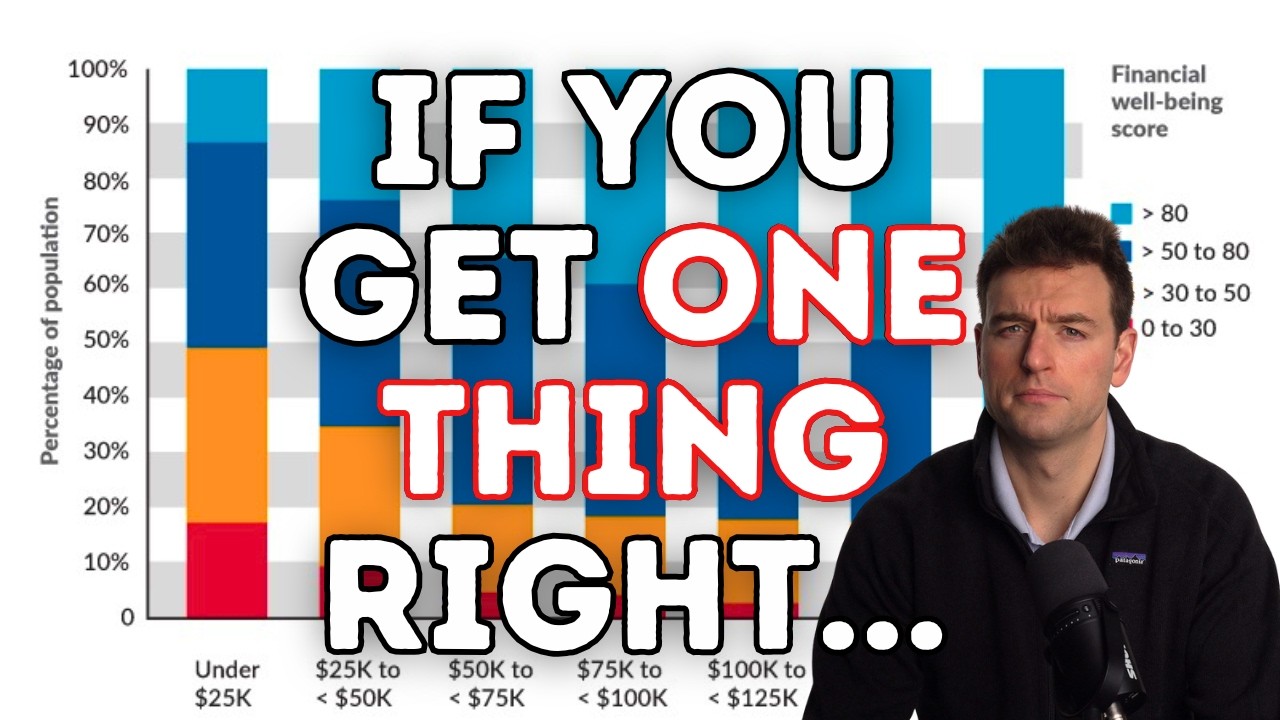

The biggest personal finance mistakes aren't always obvious — and that's exactly what makes them so dangerous. Most people focus on things they can't control, like trying to pick the next hot stock, while completely ignoring the fundamentals that actually determine long-term financial success. According to Ben Felix, Chief Investment Officer at PWL Capital, there are 10 critical mistakes that separate people who thrive financially from those who live paycheck to paycheck for life. Here's what they are and how to avoid every single one.
What Are the Biggest Personal Finance Mistakes?
The biggest personal finance mistakes span everything from not earning enough income to ignoring estate planning. But they share a common thread: they compound over time, quietly eroding your financial future until the damage becomes impossible to ignore. Below is a structured breakdown of all 10, ordered by impact.
Mistake #1: Not Earning Enough Money
This one might sting a little, but it deserves to be said: no amount of frugality can fully compensate for a low income. Your human capital — your ability to earn income through work or business — is often your most valuable asset, especially when you're young.
Investing in education, whether that's a university degree, a trade certification, or a professional designation like a CFA charter, statistically improves your income distribution over a lifetime. Fields like engineering, healthcare, and business have historically offered stronger economic returns. Beyond income, education is also linked to greater happiness, longer lifespan, and better health outcomes. If you have the opportunity to increase your earning potential, it's worth taking seriously.
How Much Should You Really Save for Retirement?
Once your income is solid, the next critical question is: how much should you be saving? The short answer most people have heard is 10% — and research actually backs that up as a reasonable starting point.
A key academic paper found that saving 10% of your income from age 25 to 65, invested in a globally diversified stock portfolio (one-third domestic, two-thirds international), produces average retirement income that exceeds working-year income when combined with Social Security. A 2011 study in the Journal of Financial Planning reinforced this, finding that to work 40 years, retire for 40 years, and replace 70% of your income, you need to save a minimum of 11.28% of your income during your working years.
That number goes up if you want to retire earlier, replace a higher income percentage, or use a more conservative investment portfolio. The exact savings rate you need depends heavily on your personal timeline and goals — which is why working through a financial planning calculator or meeting with a financial planner is so valuable.
Should You Take More Risk With Your Investments?
Here's where the numbers get eye-opening. Not taking enough investment risk is one of the most costly and underappreciated personal finance mistakes people make.
Taking risk by owning stocks rather than bonds or cash in a diversified portfolio leads to meaningfully higher expected returns. To illustrate just how much risk aversion costs you, consider this: to match the expected retirement outcome of someone saving 10% into a 100% globally diversified stock portfolio, you would need to:
- Save 16% of your income if invested in a target-date fund with a growing bond allocation
- Save 19% of your income if in a traditional 60/40 stock-bond portfolio
- Save a staggering 57% of your income if you're just holding a high-interest savings account
Risk sounds frightening, but for a long-term investor who isn't touching their money tomorrow, volatility is not the same as permanent loss. A globally diversified low-cost index fund is extremely unlikely to go to zero. The real risk is avoiding stocks altogether and watching your purchasing power stagnate.
Taking the Wrong Kinds of Risk
Of course, not all risk is created equal. Picking individual stocks, chasing the next cryptocurrency, or trading options are closer to gambling than investing. The distinction matters: gambling has a negative expected return with occasional wins due to luck; investing has a positive expected return with occasional bumps along the way.
The longer you stay in the casino, the more likely you are to lose. The longer you stay invested in a diversified portfolio, the more likely you are to come out ahead. As Daniel Kahneman noted, it's nearly impossible to develop genuine expertise in predicting stock markets because the world simply isn't regular enough for those patterns to reliably repeat.
Why Most People Set the Wrong Financial Goals
Not setting financial goals — or setting the wrong ones — is a surprisingly costly mistake. Without clear goals, financial decisions become reactive and often irrational.
When asked to list their financial goals, most people produce surface-level answers like "I want to retire." But when prompted with a structured framework like the PERMA-V model of well-being — which covers Positive Emotion, Engagement, Relationships, Meaning, Accomplishment, and Vitality — people tend to identify much deeper, more meaningful goals that better reflect what they actually care about.
Research using natural language processing confirmed that people who were introduced to categorical prompts listed goals rooted in their core values rather than financial milestones. A master list of common goals, built from a study of 310 participants, is available on the PWL Capital website and can be a powerful starting point for anyone doing structured goal-setting. Understanding your true goals matters because the financial path to reaching them may look very different from the path to a surface-level goal.
Does Spending More Money Actually Make You Happier?
Overspending on the wrong things is one of the most common and most psychologically interesting personal finance mistakes. Spending money feels good — but the happiness boost from material purchases fades quickly as you adapt to your new circumstances.
Think about a dream purchase like a cottage or a boat. In your mind, you picture sunny weekends and easy relaxation. You don't picture Friday traffic jams, maintenance costs, burst pipes on a Tuesday, or arguments about logistics. People are notoriously bad at predicting what will make them happy in the future — a phenomenon researchers call affective forecasting bias.
What actually drives happiness more sustainably? Time. People who prioritize time over money report higher life satisfaction, more frequent social connections, stronger relationships, and greater job satisfaction. Every dollar you don't spend on things that don't genuinely improve your life is a dollar that buys you more freedom — and more ownership of your own time — in the future.
What Tax Planning Mistakes Are Costing You Money?
Paying taxes is unavoidable, but leaving government-approved tax advantages on the table is a preventable mistake. Unlike investing, many tax planning strategies don't depend on uncertain market returns — they're close to a guaranteed improvement in outcomes.
Key tax planning opportunities include:
- Income splitting with lower-income family members through strategic household expense allocation or prescribed rate loans
- Maximizing registered accounts like RRSPs, TFSAs, and FHSAs in Canada
- Donating appreciated securities instead of cash to eliminate capital gains tax on the donated shares
- Using the principal residence exemption strategically if you've owned multiple properties
Even something as simple as choosing the right tax year to claim an RRSP deduction can have a meaningful financial impact over time. For business owners and incorporated professionals, the opportunities multiply further.
Why Skipping Estate Planning Is a Costly Mistake
Estate planning often gets pushed to "someday" — which for many people means never. But dying without a proper estate plan, or worse, without a will at all, means the government decides how your assets are distributed. Those rules are frequently out of step with what most people would actually want.
Beyond asset distribution, poor estate planning can create tax inefficiency, liquidity problems, and enormous emotional burden for the people you leave behind. With even basic planning in place, you retain full control over these decisions while you're alive — and spare your loved ones unnecessary financial and legal complications during an already difficult time.
Can Marrying the Wrong Person Ruin Your Finances?
Financial incompatibility between spouses is a serious and often overlooked personal finance risk. Research shows that tightwads and spendthrifts are statistically more likely to marry each other than to marry someone with a similar spending style — and the more they differ, the more they fight about money and the less satisfied they are in their marriage.
Financial disagreements are already one of the strongest predictors of divorce, and divorce can be financially devastating. The spending tendencies that bother you about a partner before marriage tend to be stable over time — they don't resolve themselves after the wedding. This is worth considering seriously before making a long-term commitment.
Don't Forget to Insure Against Catastrophe
Finally, underinsuring catastrophic risks is a mistake that can undo years of careful financial planning in an instant. Yes, insurance has a negative expected return — that's how insurers stay in business. But it makes sense to insure risks that you genuinely couldn't recover from financially.
Life insurance is critical when others depend on your income. Disability insurance matters regardless of whether you have dependents, because your income is your most important asset and illness or injury can end it without warning. Nobody wants to think about these scenarios, but failing to plan for them is one of the most expensive mistakes on this list.
The Bottom Line on Personal Finance Mistakes
The common thread across all 10 of these mistakes is that they compound. A low income, a weak savings rate, overspending, avoiding investment risk, and neglecting tax and estate planning don't just hurt you once — they silently multiply into a very different financial future than the one you want. The good news is that most of these are within your control, and awareness is the first step. Consider working through the financial planning process with a qualified advisor who can help you address all six of these areas systematically and avoid the most costly errors before they do lasting damage.