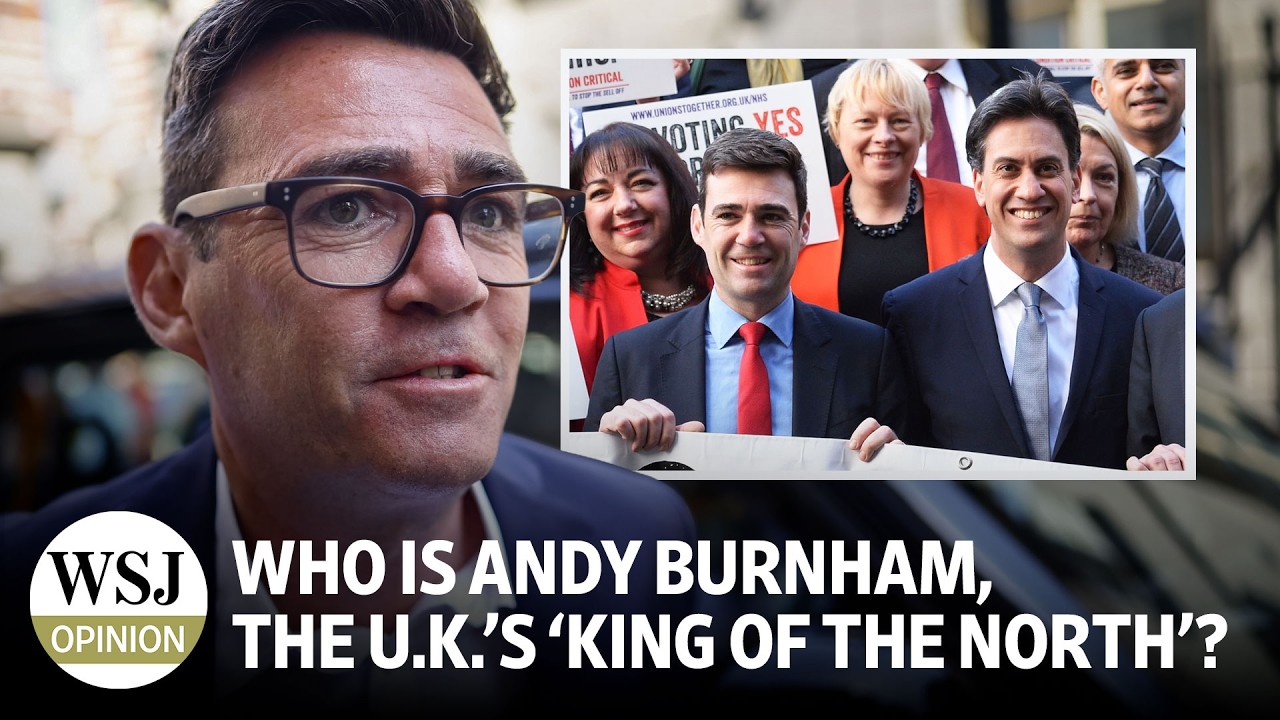

Andy Burnham is running for Prime Minister of the United Kingdom — and this time, the man known as the King of the North is making his most serious bid yet. Within hours of Keir Starmer announcing his resignation as Labour leader, Burnham was being sworn into Parliament as the newly elected MP for Makerfield, a move designed specifically to give him the lawmaker status needed to launch his leadership campaign. If he wins, he'll be the UK's fifth Prime Minister in just four years.
So who exactly is Andy Burnham, and does he have what it takes to go all the way to 10 Downing Street? Let's break it down.
Who Is Andy Burnham and Why Is He Running for PM?
Andy Burnham is a career politician with deep roots in the Labour Party and a decade of executive experience running one of Britain's largest urban regions. He served as a minister under both Tony Blair and Gordon Brown during the New Labour era, then held shadow cabinet positions under Ed Miliband and Jeremy Corbyn. But his most defining chapter came when he was elected Mayor of Greater Manchester in 2017 — a role he held for nearly a decade and won twice by re-election.
Burnham's decision to run for Prime Minister is his third attempt at the Labour leadership. He ran in 2010 following Gordon Brown's resignation, finishing fourth out of five candidates and losing to Ed Miliband. He ran again in 2015, this time finishing second — behind Jeremy Corbyn. Now, with Starmer stepping down, Burnham sees his moment. He won a by-election in Makerfield, a safely Labour constituency in northwest England, specifically to re-enter Westminster and make his move.
His pitch is straightforward: Westminster is broken, and someone who has actually governed at a regional level — not just argued in Parliament — is the person to fix it.
What Is Andy Burnham's Political Career Background?
Burnham's political journey stretches back more than two decades. He entered Parliament as a centrist New Labour figure, working under the Blair and Brown governments as a loyal minister. When Labour lost power in 2010, he moved into opposition roles, serving in the shadow cabinets of both Miliband and Corbyn — two leaders with very different visions for the party.
That ability to work across Labour's internal factions is both a strength and a potential liability. Critics see him as ideologically flexible to the point of inconsistency. Supporters see a pragmatist who knows how to get things done regardless of the political climate.
His most formative experience, however, came not in Westminster but in Manchester. Growing up in the area shaped his worldview profoundly. As he put it himself: "It was growing up in and around these streets that I saw what Thatcher's government did to places like this — the deindustrialisation, the draining away of economic, social, and political power."
Why Is Andy Burnham Called the King of the North?
The nickname "King of the North" wasn't self-appointed — it emerged organically during the COVID-19 pandemic, and it stuck for good reason. When Boris Johnson's government attempted to impose strict lockdown measures on northern England without adequate financial support, Burnham pushed back hard and publicly. He went on television, held press conferences, and refused to accept a deal he believed would devastate Greater Manchester's economy and working people.
The confrontation was dramatic. Burnham stood at a podium and essentially told the national government: not without fair compensation. It was a rare moment of a regional leader genuinely standing up to central government — and it resonated deeply, not just in Manchester, but across the north of England and beyond.
The moment crystallised something important about Burnham's brand: he's willing to fight for the regions that Westminster has long ignored.
What Did Andy Burnham Achieve as Mayor of Greater Manchester?
As Mayor, Burnham led the Greater Manchester Combined Authority — a body made up of 10 local authorities with a combined budget of around £3 billion. Under a 2014 devolution agreement, the mayor held powers over adult education, housing and planning, and transport.
His tenure is often cited as proof that regional devolution can work. He oversaw transport integration, pushed for greater investment in the north, and became a vocal advocate for what he calls "Manchesterism" — a rejection of trickle-down economics and neoliberalism in favour of locally-led economic empowerment.
- Transport: Burnham championed the Bee Network, Greater Manchester's integrated public transport system, aiming to make it easier and cheaper for people to travel across the region.
- Homelessness: He launched initiatives targeting rough sleeping, though results were mixed.
- Economic devolution: He consistently argued for more powers and funding to be moved away from London and into regional hands.
The central question now is whether the skills honed over a decade in Manchester can translate to the national stage — a stage that looks very different to the one he left when he last held government office.
Where Does Andy Burnham Stand on Brexit and Europe?
This is one of the more complicated parts of Burnham's political profile — and potentially one of the most politically sensitive. The seat he now represents, Makerfield, voted 65% in favour of leaving the European Union in the 2016 referendum. Brexit, in other words, is not an abstract concept for his constituents — it was their decision.
Yet Burnham himself campaigned and voted for Remain. In the years following the vote, he was among those calling for a second referendum. And as recently as last year, he stated publicly that he would like to see the UK rejoin the EU at some point in his lifetime.
How he navigates this tension — between his personal views on Europe and the Leave-leaning working-class communities he represents — will be one of the defining tests of his campaign. Getting it wrong could cost him dearly in exactly the seats Labour needs to hold.
Can Andy Burnham Actually Win the Labour Leadership Race?
The political landscape Burnham is entering is turbulent. Reform UK, led by Nigel Farage, is currently leading in national polls and calling for a general election with a fresh democratic mandate. The Conservatives under Kemi Badenoch are already attacking Burnham's allies — most notably Ed Miliband, rumoured to be Burnham's pick for Chancellor. Badenoch skewered Miliband in Parliament as a "failed Labour leader, rejected by the electorate, brought back from the wilderness."
Even within sympathetic commentary, there are warnings. Historian Anthony Seldon, writing in The Times, cautioned that prime ministers often fail when they try to keep doing their last job. Boris Johnson ran the country like he was still Mayor of London. Starmer behaved like a leader of the opposition even after winning power. The worry for some is that Burnham might try to govern Britain as if it were Greater Manchester.
Still, Burnham enters the race with genuine momentum. His regional record gives him a credibility that purely parliamentary figures lack. His personal story — rooted in the same northern, working-class communities that Labour has struggled to reconnect with — gives him an authenticity that's hard to manufacture.
What Challenges Would a Burnham Government Face?
Even if Burnham wins the Labour leadership and navigates a path back to government, the challenges waiting for any incoming Prime Minister are formidable. Since Burnham was last in national office, the UK has:
- Left the European Union
- Endured the COVID-19 pandemic
- Committed to supporting Ukraine in an ongoing war
- Faced a weak economy with stubborn inflation
- Grappled with what many perceive as an immigration crisis
His supporters argue that a politician with real executive experience — someone who has actually managed budgets, delivered services, and made tough calls under pressure — is exactly what the moment demands. His critics argue that managing a regional authority, however well, is a different beast entirely from running a G7 nation on the world stage.
One thing is certain: Andy Burnham's return to Westminster has shaken up British politics in a way that few saw coming. Whether he becomes the UK's fifth Prime Minister in four years — or a footnote in Labour's complicated history — remains to be seen. But the King of the North is back, and he's not coming quietly.