
Why Is Saudi Arabia's Vision 2030 Failing?
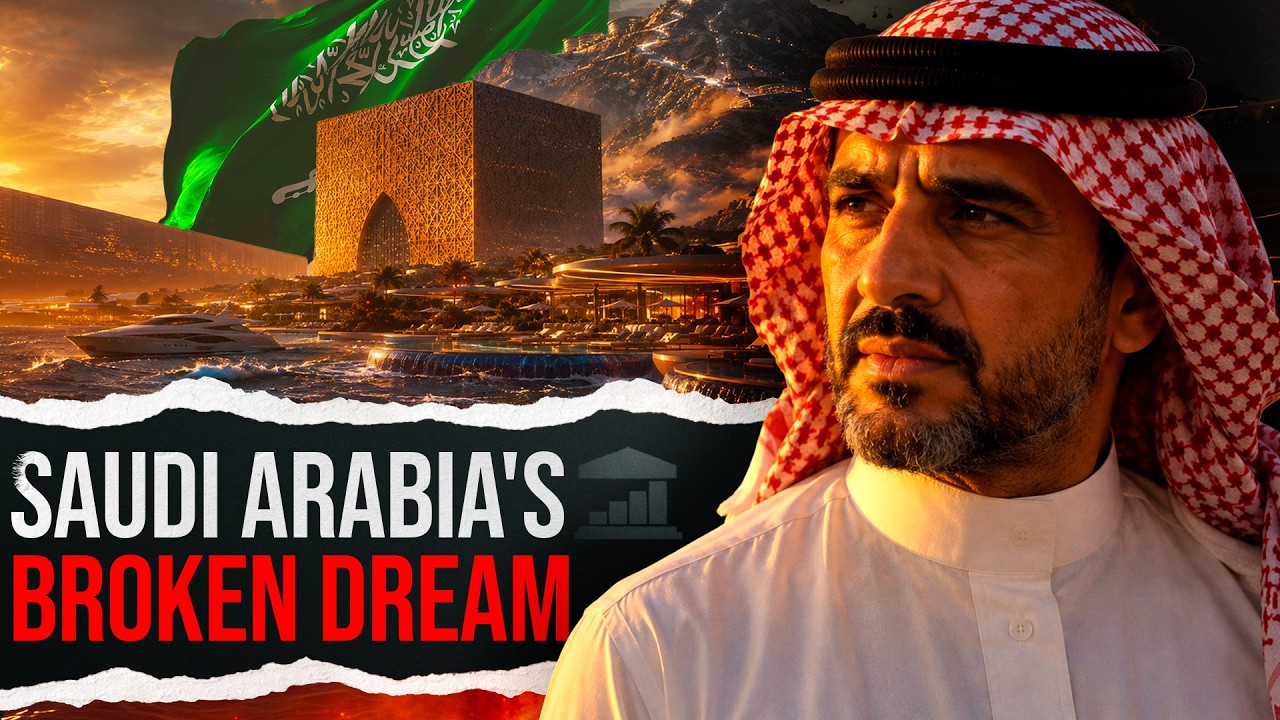
Saudi Arabia's Vision 2030 is failing because the plan was built on a fundamental contradiction: using oil money to escape oil dependency, while burying tens of billions into vanity megaprojects that have no real market demand. What was supposed to be the greatest economic transformation in history has, by 2026, produced 2.4 kilometers of a 170-kilometer city, a ski resort in the desert that hasn't opened, and a sovereign wealth fund under severe financial strain. The dream didn't die overnight — it collapsed under three compounding failures: falling oil revenues, runaway cost overruns, and deeply distorted accounting that kept the money flowing long after the numbers stopped making sense.
What Happened to The Line Megaproject?
The Line was the crown jewel of Vision 2030 — a 170-kilometer straight-line city in the Saudi desert, enclosed by two half-kilometer-high mirrored walls, designed to house nine million people with zero cars, zero emissions, and world-class amenities. When Mohammed bin Salman unveiled it in 2021, it was framed as a rival to Miami, Singapore, and Dubai. The reality, four years later, is almost painful to recount.
 01:45
Aerial concept renders of The Line megaproject — 170km of mirrored walls cutting through the Saudi desert
Watch at 01:45 →
01:45
Aerial concept renders of The Line megaproject — 170km of mirrored walls cutting through the Saudi desert
Watch at 01:45 →
In September 2025, the Saudi Public Investment Fund (PIF) suspended construction of The Line until further notice. Drilling rigs and piling equipment sat stranded in the desert. Workers were laid off. Of the 170 kilometers promised, just 2.4 kilometers — roughly 1.4% — had been built. The target population for the first phase collapsed from 1.5 million residents to fewer than 300,000. By November 2025, the Financial Times reported that the project's own architects had begun to doubt whether it was even viable.
This wasn't a sudden shock. The Line was already partially canceled in 2024. Costs had skyrocketed far beyond any reasonable projection. The foreign investment Riyadh expected to co-fund the project never arrived. And internal estimates of hotel room revenue had ballooned from $489 per room in early projections to $1,800 — a number so disconnected from reality that it reveals just how distorted the planning process had become. When the numbers don't add up, you inflate the forecasts until they do. That's the accounting trick that kept The Line alive far longer than it should have been.
What Is NEOM and Why Is It Being Abandoned?
NEOM is the $500 billion megaproject that contains The Line, along with several other flagship developments. The full constellation includes Trojena — a ski resort in the Saudi desert slated to host the 2029 Asian Winter Games — Sindalah, an ultra-exclusive Red Sea island resort, and The Mukaab, a 400-meter-tall cubic skyscraper intended to anchor the gleaming New Murabba district in Riyadh.
05:10
Construction halted: drilling rigs abandoned in the desert after the PIF suspended The Line in September 2025
Watch at 05:10 →
NEOM hasn't been officially canceled, but it has effectively faded from the center of Saudi Arabia's official discourse. The scale of ambition hasn't been matched by the scale of execution. Construction delays stretch far beyond original estimates, and the financial model — which assumed both government funding and a wave of foreign private investment — has only delivered on one side of that equation. The foreign capital never came in the volumes promised, leaving the Saudi state to carry a burden it is increasingly unable to sustain on its own.
History, it turns out, has a sense of irony. Back in 2005 and 2006, Saudi Arabia launched a similar initiative called the Economic Cities Program. The only project ever completed, King Abdullah Economic City, struggled deeply to attract residents. Vision 2030 was explicitly designed to learn from those mistakes. Ten years later, the same pattern has reasserted itself.
How Does the Saudi PIF Fund Vision 2030?
To understand why Vision 2030 is struggling financially, you need to understand where the money comes from. Saudi Arabia owns Aramco, the most profitable state-owned oil company on the planet. Aramco generates over $180 billion in revenue annually, pays enormous taxes and royalties to the government, and distributes a large portion of its profits as dividends. Since the Saudi state controls the majority of the company, most of those dividends flow back to the government — and a significant portion feeds directly into the PIF, the Public Investment Fund that bankrolls Vision 2030.
The PIF directly controls 16% of Aramco. In total, more than half of Saudi Arabia's entire budget revenue comes, directly or indirectly, from Aramco. The plan to end oil dependency is, in other words, entirely funded by oil. That's not necessarily a fatal flaw — you have to start somewhere — but it creates a critical vulnerability: when oil prices fall, the entire investment machine slows down.
Over the past two years, that is exactly what happened. Oil prices haven't boomed, revenues have shrunk, and the resources available to fund multi-decade infrastructure projects have tightened. Meanwhile, the IMF sounded the alarm in July 2025 over the Saudi government's growing deficit. The plan needed oil to pay for the transition away from oil, and oil wasn't cooperating.
09:30
Dubai's skyline and the DIFC financial hub — the institutional model Saudi Arabia chose not to follow
Watch at 09:30 →
What Has Vision 2030 Actually Achieved So Far?
It would be unfair to call Vision 2030 a total failure — because in the social sphere, the results are genuinely striking. Women's participation in the labor market has nearly doubled, climbing from 19.7% in 2018 to 36.3% by early 2025, far exceeding the original 30% target. Unemployment fell from 12.3% in 2016 to 7.2%. Tourism reached 122 million visitors in 2025, surpassing the goal of 100 million — seven years ahead of schedule.
Concerts and movie theaters have returned to Saudi Arabia for the first time in 35 years. Women can now drive. Theme parks, new airlines, Red Sea resorts, and metro lines in Riyadh have all become reality. By Gulf standards, the pace of social change has been dizzying.
The problem is that the social goals were always the easier half. The economic goals — ending oil dependency, building a diversified private sector, attracting international capital and talent — have proven far more resistant. And those are the goals that actually matter if Saudi Arabia is to remain solvent in a post-oil world.
How Did Dubai Actually Diversify Away From Oil?
The most instructive comparison isn't flattering to Riyadh. Thirty years ago, Dubai was a desert port with modest oil reserves and limited prospects. Today, it's the leading financial center between Europe and Asia, one of the world's top tourist destinations, and a logistics hub connecting three continents. Oil accounts for just 1.4% of Dubai's GDP. In Saudi Arabia, it still represents nearly 43%.
So how did Dubai do it? The answer is institutions, not skyscrapers. Dubai began by creating free zones — areas where foreign companies could operate with 100% ownership, zero corporate taxes, minimal bureaucracy, and the unrestricted ability to repatriate profits. Then it went further. It built Special Economic Zones with their own legislation, their own courts staffed by international judges, operating in English under Anglo-Saxon common law — parallel to, but independent from, the broader Emirati legal system.
The Dubai International Financial Centre is the best example. Today it hosts over 7,700 active companies and nearly 48,000 professionals. Assets managed from the DIFC have reached approximately $700 billion. These evolved free zones account for nearly half of Dubai's companies and close to 40% of its trade. Dubai chose the rules. Saudi Arabia chose the renderings.
Why the difference? Politics. Mohammed bin Salman's entire legitimacy is built around the narrative of personal transformation — the idea that he is the visionary leader who changed the country. Ceding institutional autonomy to independent courts that could rule against the state's own interests is not compatible with that narrative. In a system this centralized, institutions are not just slow and boring — they are a political threat. And so Saudi Arabia gambled on concrete instead.
What Is Humain — Saudi Arabia's New AI Bet?
With The Line fading into the background, Saudi Arabia's new flagship is Humain — an artificial intelligence company launched by the PIF in 2026 with ambitions to become the region's dominant technology player. According to the PIF's strategy for 2026–2030, Humain has effectively replaced The Line as the headline project. Where there were once mirrored walls half a kilometer high, there are now data centers, AI infrastructure corridors, and tech investment frameworks.
To be fair, there is a genuine logic here that The Line never had. Saudi Arabia possesses one real competitive advantage for the AI era: extremely cheap energy. State-of-the-art data centers are extraordinarily energy-intensive, and if Riyadh can attract AI infrastructure on the back of low energy costs, it could plausibly build the foundations of a tech ecosystem.
But the underlying problem hasn't changed. Data centers are infrastructure, not institutions. They don't generate capital markets, don't attract international law firms, and don't build communities of tech founders who choose to stay. Without the institutional framework that Dubai painstakingly constructed — the legal certainty, the regulatory autonomy, the predictable rules — Saudi Arabia risks repeating the same mistake with a different name. Spectacular projects without the boring foundations that make them real.
The question hanging over Saudi Arabia's next decade is whether it can finally make that shift — from glossy renderings to genuine institution-building. Only time will tell.