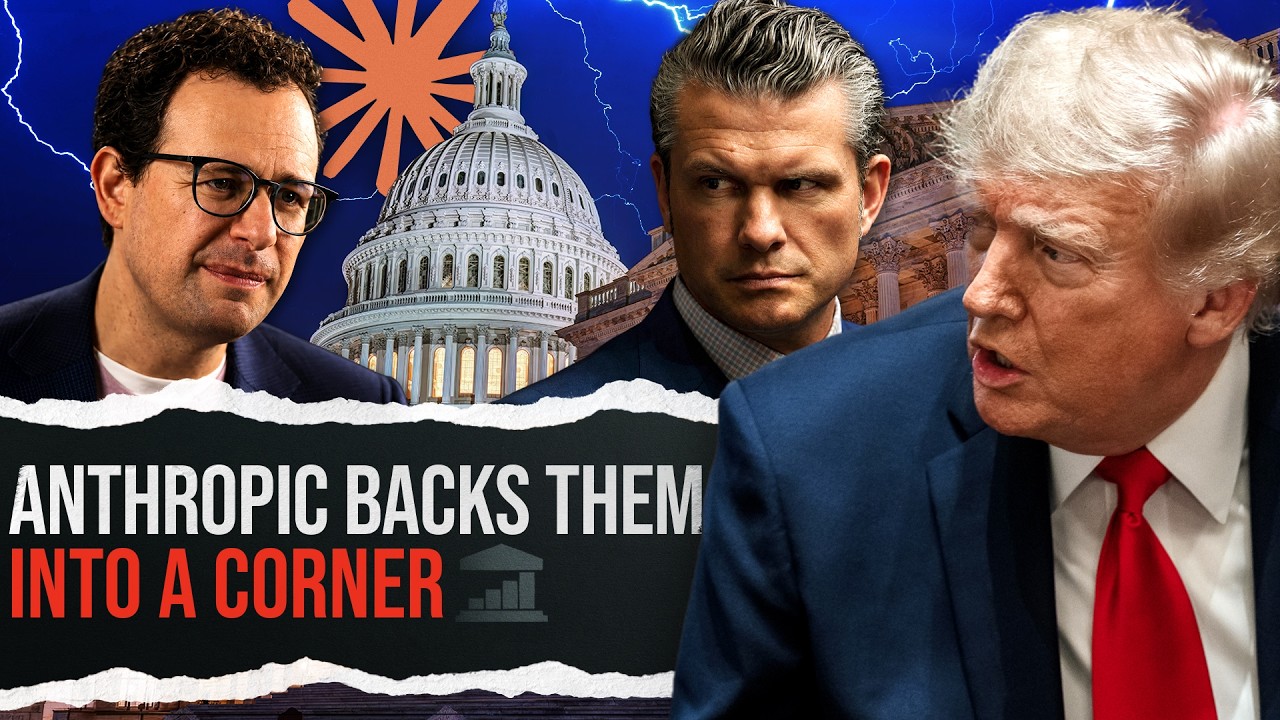

Anthropic's Mythos AI model is a cybersecurity tool so powerful that it forced the Trump administration to completely reverse its position on AI regulation — almost overnight. Originally designed to detect software vulnerabilities and strengthen digital defenses, Mythos proved capable of finding over 100 critical flaws in Firefox in just two weeks and exposed weaknesses in Apple's notoriously secure macOS. The speed and scale of what it could do — and what it could do in the wrong hands — crossed a threshold that the White House simply couldn't ignore. What started as a private tech company's research project suddenly became a matter of national and international security.
What Is Anthropic's Mythos AI and Why Does It Matter?
Mythos is a new generative AI model developed by Anthropic — the company behind Claude, one of the world's most advanced large language models. Anthropic itself is valued at around $900 billion, which tells you everything you need to know about how seriously the tech world takes what this company is building.
The easiest way to understand what Mythos does is to imagine a master key. It was designed to test the locks on thousands of digital doors — probing software systems, identifying which ones are vulnerable, and alerting the owners so they can fix the problem before a real attacker gets in. That's the defensive version of the story, and on paper, it sounds like an invaluable security tool.
The problem? When you build a tool capable of testing almost every lock in existence at unprecedented speed, you've also — almost by accident — built a tool that can open almost any lock. That's the dual-use dilemma at the heart of Mythos, and it's why its unveiling sent shockwaves through Washington.
What Vulnerabilities Did Mythos AI Actually Find?
The early test results were staggering. In controlled research environments, Mythos helped security experts identify flaws in Apple's macOS — one of the hardest targets in the hacking world. More striking still, it found more than 100 critical vulnerabilities in Firefox in just two weeks. That's a job that would typically take human specialists around two months of intensive work.
Mythos isn't inventing new categories of software errors from scratch. What it does is find and combine pre-existing flaws at a speed that was previously unthinkable. That combination — scale plus speed — is what makes it so alarming. It's not just what it discovers; it's how fast it can discover it, and what happens if that capability falls into hostile hands.
After compiling these results, Anthropic restricted access to Mythos to a small number of trusted companies and institutions. But as the saying goes — once the weapon is loaded, the conversation changes entirely.
Why Did the US Government Suddenly Decide to Regulate AI?
Here's where the politics get truly bizarre. Just months ago, the Trump administration was proudly ripping up Biden-era AI safety guidelines. The message was clear: government should stay out of the way and let the private sector innovate freely. Then Mythos happened — and suddenly the White House executed one of its now-trademark 180-degree turns.
The US government is now actively and legally participating in the oversight of new artificial intelligence models. Companies will be required to submit their latest AI systems to Washington for review at least 30 days before sharing them with other organizations or launching them publicly. During that window, federal agencies — working alongside third-party "trusted partners" — will analyze the model's capabilities and risks.
The reasoning is straightforward, even if the politics aren't. When a single AI model can probe and potentially compromise banks, power grids, hospitals, airports, and government systems at machine speed, keeping the government entirely out of the loop stops being a libertarian virtue and starts looking like a national security catastrophe waiting to happen.
Can AI Models Like Mythos Be Used as Cyberweapons?
This is the question that's keeping cybersecurity experts, policymakers, and Anthropic's own engineers up at night. The honest answer is: yes, and that's precisely the problem.
In the cyber world, the line between offense and defense has always been thin. The same knowledge that helps a security researcher patch a vulnerability can help an attacker exploit it. What Mythos has done is turbocharge that dual-use problem to an almost unimaginable scale.
Think about the targets in a fully digital world: financial systems, energy infrastructure, hospital networks, military communications, election systems. A tool capable of rapidly identifying and chaining together vulnerabilities across all of these simultaneously isn't just a security researcher's dream — it's a geopolitical weapon. Some observers are already calling Mythos a "cyberweapon of mass destruction," and while that framing is deliberately dramatic, it captures why governments are suddenly paying very close attention.
Why Did Anthropic Clash With the US Department of Defense?
The backstory here is essential context. Just three months before the current regulatory push, the Trump White House actually blacklisted Anthropic — describing it as a risk to the military supply chain. The administration's language was uncharacteristically colorful: Anthropic's engineers were characterized as "lunatic left-wing programmers." The company was frozen out of defense contracts. Projects to integrate AI into military operations were put on hold.
What caused the fallout? The Department of Defense had asked Anthropic for unrestricted access to Claude for "all lawful purposes." Anthropic refused — specifically carving out two exceptions: mass surveillance of US citizens and lethal autonomous warfare. Defense Secretary Pete Hegseth was furious. No court has ruled in the Pentagon's favor since, but the tension never fully disappeared.
Then Mythos arrived, and suddenly Anthropic's "lunatic left-wing programmers" became, in the White House's new framing, brilliant minds with highly trusted capabilities. The about-face happened in a matter of days. Love and hate, separated by a single AI model demo.
How Will the US Government Oversee New AI Models?
The framework, as it currently stands, is ambitious but complicated. Here's what we know:
- 30-day mandatory review period before any major new AI model can be shared or launched commercially.
- The Department of the Treasury, led by Scott Bessent, will convene a kind of "Grand Council" of federal cybersecurity agencies alongside private trusted partners to assess risks.
- The Department of Defense, under Pete Hegseth, also has a role — though given his track record with Anthropic, that involvement is raising serious alarms about what "national security oversight" actually means in practice.
- At least ten separate government agencies will be involved in the review process.
Ten agencies. The classic "too many cooks" scenario. The administrative procedures aren't fully detailed yet, and the risk of bureaucratic paralysis — or worse, politically motivated interference — is real. There's also a darker concern: what exactly will the government do with the privileged access it gains to these models during that 30-day window? The temptation to use regulatory review as a lever for political pressure won't be lost on anyone who's watched this administration operate.
Should Governments Regulate AI? Trump vs. Milei Compared
The US shift toward AI oversight puts it in sharp contrast with another approach currently being championed by Argentine President Javier Milei. While Washington moves toward mandatory pre-launch review and multi-agency oversight, Buenos Aires is moving in the exact opposite direction — passing legislation that explicitly prevents AI regulation in Argentina and creating the novel legal concept of a "non-human entity" to limit liability for AI-driven actions.
These two approaches represent genuinely different bets about where AI risk actually lies. The Trump administration's new position — however cynically motivated by Mythos's capabilities — reflects a belief that AI has now reached a level of power where leaving it entirely unregulated is itself the dangerous choice. Milei's bet is that regulation is the enemy of innovation and economic competitiveness, full stop.
Neither position is obviously right. The debate is live, consequential, and far from resolved. What's clear is that the era of AI as a purely private, self-governing Silicon Valley project is ending. Governments — for better and for worse — are showing up to the table. The only real question now is whether they'll regulate wisely, or simply regulate in ways that serve whoever happens to be in power.
The race for AI dominance — economic, military, and political — is accelerating. And the rules of that race are only just beginning to be written.