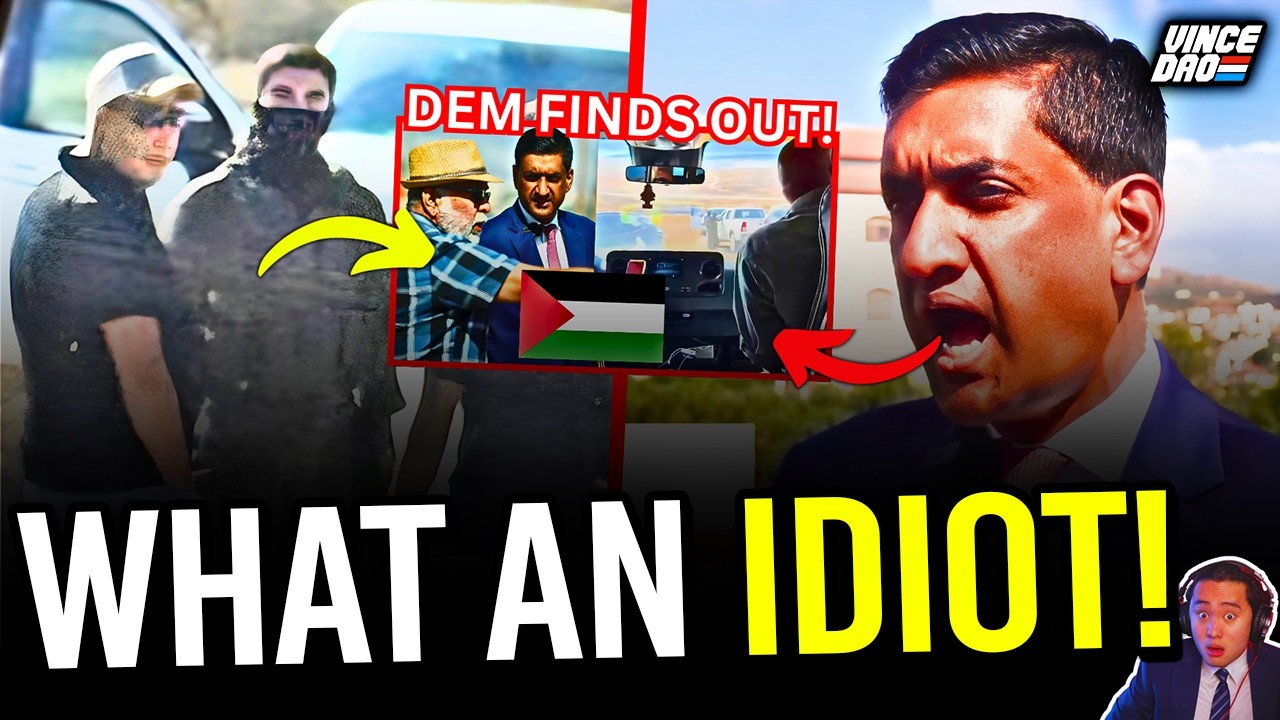

Congressman Ro Khanna was detained in the West Bank by armed Israeli settlers for over an hour — and he came back furious. Khanna and a staffer were stopped while visiting the destroyed village of Zenuta and the site of a burned EU-funded school. Israeli settlers carrying American-made rifles intercepted them, the IDF showed up, and the whole ordeal lasted about 60 minutes before they were released. Khanna immediately took to the cameras to blast Israel, describe the "arrogance" in the settlers' eyes, and frame the whole thing as an outrage against American dignity. But there's a lot more to unpack here — including whether any of this was actually as dramatic as he's making it sound.
 0:42
Ro Khanna describes the arrogance he saw in the eyes of Israeli settlers during his West Bank detainment
Watch at 0:42 →
0:42
Ro Khanna describes the arrogance he saw in the eyes of Israeli settlers during his West Bank detainment
Watch at 0:42 →
What Actually Happened When Ro Khanna Was Detained?
According to Khanna's own campaign staffer Cameron Kaskey, the two crossed into the West Bank without coordinating with Israeli authorities and were intercepted by settlers wielding American-made rifles. The IDF then arrived and took the settlers' side, questioning the Americans about what they were doing in a sensitive military security zone. After roughly an hour, the Americans were released without any charges, injuries, or formal incident.
Khanna described the experience as being detained at gunpoint, pointing to the "arrogance" of 21 and 22-year-old soldiers who reportedly laughed when told they were detaining an American congressman. He framed it as evidence of a toxic culture of impunity created by unchecked Israeli power — funded, he stressed, by American tax dollars.
Critics, however, pointed out the obvious: nothing actually happened to him. He was questioned, held briefly, and released. No violence, no injuries, no formal arrest. For a region that's routinely described by Palestine activists as the site of an active genocide, the most dangerous thing that happened to Ro Khanna was that some soldiers laughed at him.
4:15
Khanna's staffer Cameron Kaskey describes being intercepted and captured by settlers with American-made rifles
Watch at 4:15 →
Why Did Israeli Settlers Stop an American Congressman?
The West Bank is one of the most geopolitically sensitive border zones on Earth. It's a divided territory with active military presence, frequent clashes, and strict crossing protocols. When two unannounced foreigners start poking around a disputed area without coordination with Israeli authorities, getting stopped and questioned is not an aberration — it's standard procedure.
By most accounts, Khanna and his staffer did not coordinate with the Israeli government before making this crossing. That alone explains why they were stopped. Think of it this way: if a foreign politician showed up unannounced and started wandering around the DMZ between North and South Korea without authorization, South Korean or American military personnel would absolutely stop and question them. That's not fascism — that's basic border security.
The IDF, notably, probably had little interest in creating an international incident with an American congressman. The most likely scenario? They were trying to get him out of a dangerous area as quickly and quietly as possible — which is exactly what happened.
Was Ro Khanna Really Detained at Gunpoint?
This is where the story gets slippery. Khanna and his team have leaned heavily into the phrase "detained at gunpoint," which conjures images of rifles aimed at a diplomat's head. But the settlers and IDF soldiers were armed — as military and security personnel in a conflict zone routinely are. Being in the presence of armed personnel in a sensitive security zone is categorically different from having a weapon pointed at your face.
7:30
Khanna speaks on camera about the IDF soldiers laughing when told an American congressman was on the bus
Watch at 7:30 →
There's no verified account, video, or testimony that a gun was ever aimed directly at Khanna. The settlers were armed. The IDF was armed. That's true. But "armed Israeli settlers questioned us at the border" doesn't generate the same headline as "detained at gunpoint," does it?
For a man claiming to document an ongoing genocide, the fact that the worst thing that happened to him was an hour-long delay and some soldiers chuckling at him is — to put it mildly — revealing.
Was the Entire West Bank Trip a Staged Political Stunt?
Here's the cynical-but-plausible read: Khanna may have known exactly what was going to happen. Walk into a sensitive military zone without authorization, bring a staffer to document everything, and wait for the IDF to show up. Then take the footage and the story back to American media and say, "Look what Israel did to me — an American congressman."
It's the same playbook Greta Thunberg used when she tried to sail her boat into Gaza — an active war zone — and was predictably turned away by the military. The goal isn't to actually accomplish anything on the ground. The goal is the headline. The optics. The talking point.
And it almost worked — except that if you spend more than thirty seconds thinking about it, the story collapses. He wasn't hurt. He wasn't charged. He was told to leave a military security zone he entered without permission, and he left. That's it.
Israel First vs. Palestine First vs. America First: What's the Difference?
Khanna tried to frame his West Bank trip as an act of American patriotism — after all, US tax dollars fund the Israeli military, so Americans have a right to scrutinize how that money is used. It's a clever argument, but it falls apart under examination.
If Khanna were truly motivated by American interests, he'd be at the Lebanon border checking whether Israel is honoring the US-brokered ceasefire deal with Hezbollah. Or in Gaza, verifying whether Israel is abiding by the American peace framework. Instead, he went to the West Bank — the one part of the Israel-Palestine situation that the United States has the least direct stake in.
That's not America first. That's Palestine first — prioritizing a foreign ideological cause over any genuine American interest or leverage point.
There's also an important distinction to make on the right side of this debate. The legitimate America First critique of certain pro-Israel factions has never been that Israel is an apartheid state or a settler-colonial project — that's straight-up Marxist framing dating back to Soviet-era propaganda from the 1950s. The real historical criticism has been about double standards: organizations like the ADL championing Israeli border sovereignty while simultaneously labeling American immigration restrictionists as bigots. That hypocrisy is worth calling out. Adopting leftist language about colonialism and genocide is not.
Why Are Some Right-Wingers Becoming Skeptical of Israel?
Israel skepticism has been growing on the right for several years now, and some of that skepticism is legitimate. Questions about foreign aid levels, the influence of lobbying organizations in American domestic politics, and whether certain neoconservative foreign policy decisions served American interests — these are fair conversations to have.
What's less defensible is when right-wingers essentially become mirror images of left-wing Palestine activists, adopting phrases like "settler colonial apartheid state" and treating Palestinian losses in a war they started as evidence of genocide. That's not a right-wing position — historically, it's a Marxist one.
The consistent right-wing position would be this: Israel has every right to defend its borders aggressively, turn away subversive foreign activists, and maintain a strong national identity. And so does America. And so does Europe. The goal isn't to tear Israel down for doing what we wish our own governments would do — it's to demand the same standard be applied at home.
The Bottom Line on the Ro Khanna West Bank Incident
Ro Khanna walked into a sensitive military security zone without authorization, got questioned by armed security forces for about an hour, was released without harm, and then went on camera to deliver an impassioned speech about arrogance and impunity. The IDF probably just wanted him out of a dangerous area without an international incident — and they succeeded.
Whether it was breathtaking naivety or a calculated propaganda stunt, the result is the same: an American congressman who claims to be advocating for his constituents spent his time snooping around a foreign military zone that has nothing to do with American interests, got briefly inconvenienced, and returned home to turn it into a fundraising moment.
The soldiers laughed. Honestly? Hard to blame them.