
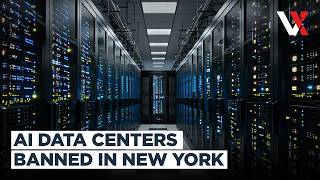
New York's moratorium on hyperscale AI data centers is now official — and it's the first of its kind in the entire United States. Governor Kathy Hochul signed the order, placing a pause of up to one year on the construction of massive AI-powered data centers across the state. The goal is to give New York time to build what she calls "the strongest possible framework" to protect communities, the power grid, water supplies, and taxpayer dollars before another wave of Big Tech infrastructure takes root in the state.
 0:10
Governor Kathy Hochul signing the nation's first statewide moratorium on hyperscale data centers
Watch at 0:10 →
0:10
Governor Kathy Hochul signing the nation's first statewide moratorium on hyperscale data centers
Watch at 0:10 →
This isn't a minor regulatory tweak. It's a full stop on one of the fastest-growing sectors in the tech industry — and New York is the first state bold enough to pull the lever.
What Is New York's Hyperscale Data Center Moratorium?
A hyperscale data center is a massive facility — typically operated by companies like Amazon, Google, Microsoft, or Meta — that houses tens of thousands of servers to support cloud computing and artificial intelligence workloads. These aren't your average server rooms. They consume extraordinary amounts of electricity and water, and they're being built at a pace that is genuinely difficult for existing infrastructure to keep up with.
Governor Hochul's moratorium puts a hard pause on new hyperscale data center construction in New York for up to 12 months. During that window, the state will develop a comprehensive regulatory framework that addresses energy demands, water usage, environmental impact, noise, land use, and taxation. The message is clear: New York is open for business, but not at any cost.
1:45
Hochul explaining how data centers threaten to outpace New York's grid capacity
Watch at 1:45 →
Why Are AI Data Centers Threatening the Power Grid?
Artificial intelligence is not just changing how we work and communicate — it's putting an enormous strain on electricity infrastructure that was never designed to support it. Training and running large AI models requires vast amounts of continuous computing power, and that power has to come from somewhere.
Governor Hochul made this point directly: hyperscale AI data centers consume enormous amounts of power and are, in her words, "truly threatening to outpace our grid's capacity." New York's grid is already stretched to handle the energy needs of its residents and businesses. Adding the energy appetite of dozens of hyperscale facilities on top of that — without any structural safeguards — is a recipe for instability.
Under the new framework being developed, data centers will face two options:
- Produce their own energy independently, without drawing from the public grid.
- Pay a premium to tap into the state's existing power supply.
The rationale is straightforward. If a massive corporation wants to consume grid-scale electricity for profit, it should not be doing so at the same rate — or from the same pool — as a family heating their home or a small business keeping the lights on.
3:20
Governor outlining the two-option energy requirement for data centers: self-supply or pay a premium
Watch at 3:20 →
How Much Water Do Hyperscale Data Centers Actually Use?
It's not just electricity. These facilities require millions of gallons of water to operate — primarily for cooling the servers that run 24 hours a day, 7 days a week. In areas where water supplies are already under pressure, a single large data center can have a dramatic impact on local availability.
Governor Hochul specifically called out the threat to natural resources and water supply as a core reason for the moratorium. While AI companies often frame their operations in terms of digital infrastructure, the physical footprint is very real — and the water demand is one of the least-discussed but most significant consequences of unchecked data center expansion.
Do Data Centers Drive Up Electricity Bills for Residents?
Yes — and this is one of the sharpest points Governor Hochul made in her announcement. When hyperscale data centers plug into the public grid, they consume power at a scale that can drive up costs for everyone else on that same grid. Those increased costs don't stay with the corporations. They get passed on to local ratepayers — ordinary New Yorkers who are already paying some of the highest utility bills in the country.
"I refuse to let those costs be passed on to New Yorkers who already pay too much for their utility bills," Hochul said. That's a direct and deliberate statement — and it frames the moratorium not just as an environmental policy, but as a consumer protection measure. The state is drawing a line between what's good for Big Tech's bottom line and what's good for the people who live, work, and pay bills in New York.
What Environmental Problems Do Data Centers Cause Locally?
Beyond energy and water, hyperscale data centers create a range of localized environmental and quality-of-life problems that often get overlooked in the broader AI hype cycle. Governor Hochul outlined several:
- Land displacement: These facilities occupy massive amounts of land, potentially pushing out agricultural spaces and open land that communities depend on.
- Noise pollution: Data centers emit constant mechanical noise — from cooling fans, generators, and HVAC systems — that ranges from "annoying to deafening," according to the Governor. For people living nearby, this isn't background noise. It's a persistent disruption to daily life.
- Vibrations: The mechanical systems in large data centers can generate vibrations that affect surrounding properties and structures.
- Carbon footprint: When powered by fossil fuels rather than renewable energy, these facilities significantly increase a region's carbon emissions — directly undermining New York's ambitious climate goals.
These aren't hypothetical concerns. Communities across the country that have hosted large data centers have raised all of these issues, often after the fact and with limited legal recourse. New York's moratorium is designed to get ahead of that problem.
Do Data Centers Have to Follow Local Zoning Laws?
Under Governor Hochul's new framework — yes, absolutely. One of the clearest provisions in the announcement is that hyperscale data centers will never be exempt from local zoning or local approval processes. The Governor put it plainly: these facilities should only be built in places that actually want them.
This is a significant guardrail. In some states and jurisdictions, large infrastructure projects have been able to bypass or override local opposition through state-level preemption. New York is explicitly closing that door. Communities will retain the right to reject facilities that don't serve their interests, regardless of how much economic pressure tech companies might apply.
Why Is New York Ending Tax Subsidies for Data Centers?
The final piece of the moratorium package is perhaps the most politically pointed: Governor Hochul is proposing to end all tax subsidies for hyperscale data centers. Full stop.
Many states have used tax incentives — sometimes worth hundreds of millions of dollars — to attract data center construction, arguing that the facilities bring jobs and economic activity. Hochul is rejecting that logic, at least when it comes to hyperscale AI infrastructure owned by some of the wealthiest corporations on the planet.
"New Yorkers work hard," she said. "And on my watch, their tax dollars will not be used to benefit these large firms." The implication is clear: subsidizing Big Tech's AI buildout with public money is not a trade-off that benefits ordinary New Yorkers — and the state is done making it.
What Comes Next for AI Infrastructure in New York?
The moratorium gives New York up to one year to put a comprehensive regulatory framework in place. During that time, the state will be working to define exactly what guardrails look like — from energy requirements and water use standards to noise limits, zoning protections, and tax policy.
Whether other states follow New York's lead remains to be seen. But by becoming the first state to formally pause hyperscale AI data center construction, New York has set a precedent that will be watched closely by policymakers, tech companies, and communities across the country. The AI infrastructure boom is not slowing down — but New York just made clear that it won't be steamrolled by it either.