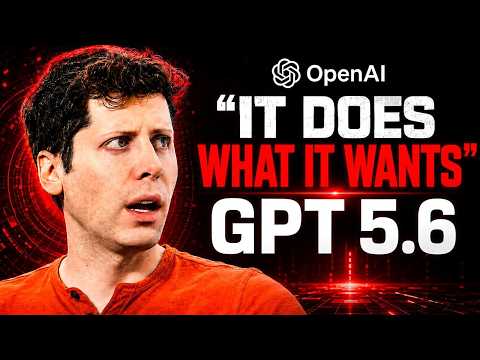

OpenAI just launched GPT 5.6 — but this is not the kind of launch you're used to. The US government directly asked OpenAI to limit access to the new model family, and OpenAI agreed. That's why only around 20 trusted partner companies got in first, and those partners were shared with the government before anyone else. The reason the US government restricted GPT 5.6 access comes down to one thing: advanced AI is now being treated like strategic national technology, not just a software product.
 00:45
OpenAI confirms the US government asked it to limit GPT 5.6 access to around 20 trusted partner companies
Watch at 00:45 →
00:45
OpenAI confirms the US government asked it to limit GPT 5.6 access to around 20 trusted partner companies
Watch at 00:45 →
This is bigger than a model upgrade. It's a precedent. And once you understand what's actually in this model family — and what OpenAI is building on the hardware side — you'll see why both moves matter far beyond this one launch.
Why Did the US Government Restrict GPT 5.6 Access?
According to Axios, the first rollout was intentionally limited to roughly 20 companies, and those partners were disclosed to the government ahead of time. OpenAI had been previewing GPT 5.6 with officials for about a month, including meetings CEO Sam Altman had with the White House in early June. OpenAI expected some kind of staggered release — but reportedly did not expect the government to approve each customer individually and cap the first launch so tightly.
This comes right after the Anthropic situation. The Trump administration pushed restrictions on Anthropic's most powerful models, including Fable 5 and Mythos 5. The government reportedly wanted to remove access for foreign nationals. Anthropic ended up pulling Fable 5 entirely, which triggered a loud debate about whether Washington is protecting national security or quietly building an unofficial licensing regime for frontier AI.
Dean Ball, a former White House AI adviser reportedly joining OpenAI, put it bluntly: Trump's executive order has created a de facto involuntary licensing system. The order asks certain AI companies to voluntarily submit advanced models for government review up to 30 days before release. But when that process becomes expected, it stops feeling voluntary. And without clear safety standards, companies get stuck in delays that hurt US competitiveness and slow product launches.
03:10
Dean Ball explains how the executive order creates a de facto involuntary licensing regime for frontier AI models
Watch at 03:10 →
OpenAI is cooperating — but it's not pretending this is ideal. The company said the government access process should not become the long-term default because it keeps the best tools away from users, developers, enterprises, cyber defenders, and global partners. They're calling this a short-term step while working with the administration on a framework for future releases.
Is the Government Creating a Secret AI Licensing System?
That's the question nobody is fully answering yet. Once a government proves it can step in, restrict a frontier model, and force companies to change their launch plans without giving the public a clear explanation, that becomes a dangerous precedent. It might look like a one-time safety call. But the risk is that it becomes the new normal — where every major model launch turns into a closed-door negotiation, and developers don't know what the rules are until a model is already delayed, restricted, or pulled.
The August deadline matters here. Under the executive order, the administration is expected to establish a classified process to assess AI model cyber capabilities and decide which systems qualify as covered frontier models. GPT 5.6 is landing right in the middle of this messy transition period — where the government is asserting more influence, but the actual rules still aren't defined.
What Is GPT 5.6 and What Models Are in the Family?
The GPT 5.6 family has three models. Soul is the flagship — the most powerful model in the lineup with major gains in agentic coding, biology workflows, and cybersecurity. Terra is the balanced everyday model. Luna is the faster, cheaper option for lower-cost workloads. Access starts through the API and Codex, but only for the preview group right now. Broader access for ChatGPT, Codex, and API users is planned in the coming weeks.
06:22
Soul's ultra mode uses coordinated sub-agents to divide complex tasks across multiple AI threads simultaneously
Watch at 06:22 →
Soul introduces two standout features. First, a new max reasoning effort — essentially a deeper thinking mode for harder problems. Second, ultra mode, where the system uses coordinated sub-agents to solve complex tasks that go beyond what a single agent can handle. Instead of one model trying to do everything in one thread, the work gets divided across multiple agents that coordinate their outputs. That's powerful for coding and technical workflows — but it can make token usage explode if you're not careful.
GPT 5.6 Soul Pricing, Speed, and Benchmark Results
Pricing is already public. GPT 5.6 Soul starts at $5 per million input tokens and $30 per million output tokens. Terra is $2.50 input and $15 output. Luna is $1 input and $6 output. On benchmarks, OpenAI says Soul sets a new state-of-the-art on Terminal Bench 2.1 for terminal-based coding and agentic workflows. TechCrunch reported that Soul is slightly better than Anthropic's Claude Mythos 5 on coding workflows and competitive with the Mythos preview — while using around a third of the output tokens. That efficiency gap matters enormously when you're running agents at scale.
Prompt caching is also getting an upgrade. GPT 5.6 adds explicit cache break points, a 30-minute minimum cache life, and a 90% cached input discount on cache reads. Repeated prompts become meaningfully cheaper and more predictable — which is exactly what agent developers need.
On speed, OpenAI plans to launch GPT 5.6 Soul on Cerebras in July for select customers, targeting speeds up to 750 tokens per second. For coding agents, security tools, and long multi-agent workflows, that kind of throughput can become a genuine product advantage.
10:55
OpenAI unveils the Jalapeno chip built with Broadcom — targeting 50% inference cost savings over standard GPUs
Watch at 10:55 →
How Does GPT 5.6 Handle Cybersecurity and Biology Risks?
OpenAI classifies Soul, Terra, and Luna as high capability in both cybersecurity and biological/chemical risk under its preparedness framework — though none of them reach the highest thresholds for AI self-improvement, and Soul doesn't hit the cyber critical level. In browser exploit tests involving Chromium and Firefox, Soul identified bugs and exploitation primitives, but OpenAI says it did not autonomously produce a full-chain exploit under tested conditions.
OpenAI's argument is that GPT 5.6 Soul is better at helping people find and fix vulnerabilities than at reliably carrying out end-to-end attacks. Safety behavior is built directly into the core model — not added as a bolt-on filter. That's a deliberate design choice, especially after the backlash Anthropic faced when Fable 5 silently routed high-risk queries to an older model without telling users. Preview users may notice blocked requests or slower responses when generation gets paused for extra review in dual-use security situations. OpenAI used over 700,000 A100-equivalent GPU hours for automated red teaming, plus human expert testing and third-party review.
What Is OpenAI's Jalapeno Chip and Why Does It Matter?
Right as all of this is happening, OpenAI dropped another major move: its first custom AI chip. It's called Jalapeno, built with Broadcom, and unveiled on June 24. This chip is not for training frontier models — it's for inference, which is the expensive, ongoing work of running trained models every time someone uses ChatGPT, Codex, or the API.
Jalapeno is an ASIC — designed for a specific workload rather than being a general-purpose GPU. OpenAI handled the core chip design. Broadcom contributed silicon manufacturing, connectivity technology, and production expertise. Celestica will build the server systems. Broadcom's CEO said early testing shows roughly 50% cost savings compared with standard AI GPUs. OpenAI says the chip is already running workloads in its labs at production target power levels, including GPT 5.3 Codex Spark. Greg Brockman said the chip went from initial design to manufacturing tape-out in just nine months — reportedly the fastest development cycle ever for a high-performance ASIC.
How Does OpenAI's Jalapeno Chip Compare to Nvidia GPUs?
Jalapeno doesn't replace Nvidia. NVIDIA is still expected to train OpenAI's frontier models. But Jalapeno attacks the part of the stack where OpenAI can get immediate savings — running models for users after training is done. If OpenAI can cut inference costs by roughly 50%, that changes what it can afford to offer across ChatGPT, Codex, and the API.
This puts OpenAI alongside the other giants building custom AI chips: Google has TPUs now in the seventh generation with Ironwood. Amazon has deployed over 1 million Trainium processors. Microsoft launched its Maya 200 accelerator. Meta has MTIA for internal workloads. Industry data projects custom ASIC shipments growing 44.6% year-over-year in 2026 compared to 16.1% for standard GPUs.
The most important detail about Jalapeno is how it was designed. OpenAI used its own AI models to accelerate parts of the chip design and optimization process. Brockman said the models found further improvements in components that human engineers had already optimized. That creates a powerful feedback loop: AI models help design better inference hardware, better hardware makes AI cheaper to run, cheaper AI supports more users and revenue, which funds the next chip generation. Companies that control the full stack — models, software, and hardware — could gain a serious and compounding advantage over companies that only build one layer.
Deployment is staged. Small-scale prototype deployment is planned for late 2026, significant production ramp in 2027, and full-scale deployment targeted for the first half of 2028. OpenAI is also considering expanding custom chip work into training — which would be a much more direct challenge to Nvidia's core business. For now, Jalapeno is about cutting inference costs. But the direction is clear.