June 6, 1944 — the date of the D-Day landings at Normandy — was not chosen by coincidence or pure military calculation. It was, as history would reveal, the only day in the entire month of June 1944 on which the Allied invasion of France could have succeeded. Why was D-Day on June 6? The answer comes down to a narrow 36-hour gap in catastrophic weather, identified by one unlikely British meteorologist working under almost impossible pressure. Had the invasion launched two weeks later, it would have sailed directly into the worst storm in 40 years. The story of how that date was chosen is one of the most dramatic — and least told — chapters of the Second World War.
 01:45
Allied landing craft navigating rough seas on D-Day, June 6, 1944 — conditions that were survivable only because of Stagg's narrow weather window
Watch at 01:45 →
01:45
Allied landing craft navigating rough seas on D-Day, June 6, 1944 — conditions that were survivable only because of Stagg's narrow weather window
Watch at 01:45 →
Why Was D-Day Specifically on June 6, 1944?
Operation Overlord — the Allied plan to liberate Western Europe — had originally been targeted for May 1, 1944. When Generals Eisenhower and Montgomery revised the invasion plan to include five seaborne divisions instead of three, more landing craft were needed, and the operation had to be pushed back by a full month. That delay would prove fateful. May 1944 saw near-perfect weather conditions across the English Channel. Early June would be a very different story.
The date was ultimately set for June 5, 1944. But as the invasion fleet began to move, a violent storm system rolled in from the North Atlantic. Eisenhower was forced to issue a provisional 24-hour postponement — an agonizing decision that required warships to turn around mid-sail and landing craft to be shepherded back to port. The window for launching the invasion was closing fast. If conditions didn't improve within 48 hours, the entire operation would have to be pushed back two weeks until tidal conditions aligned again.
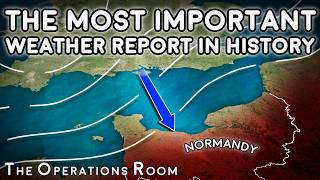
Then came the breakthrough. Chief Meteorological Officer Group Captain James Stagg identified a narrow gap in the storm system — a brief clearing expected to begin on the evening of June 5 and last up to 36 hours. It would not be ideal weather. But it would be enough. Eisenhower gave the order to go. The rest is history.
05:20
Southwick House, the nerve center of Allied planning where Stagg briefed Eisenhower on the critical weather forecast
Watch at 05:20 →
What Were the Weather Requirements for the D-Day Invasion?
Allied planners had established a strict set of meteorological conditions that needed to be met before the invasion could launch. These weren't arbitrary preferences — each condition addressed a critical tactical need:
- A full moon to illuminate nighttime airborne operations and produce the highest and lowest possible tides.
- Low winds and calm seas to allow landing craft and Duplex Drive swimming tanks to reach the shore without capsizing.
- Clear skies to enable Allied aircraft to provide close air support and carry out pre-invasion aerial bombardment.
- 17 hours of daylight to maximize the number of troops that could come ashore safely.
- An inshore wind to blow smoke away from bombardment zones.
As the invasion of Normandy unfolded on June 6, almost none of these conditions were perfectly met. Seas were rough, skies were overcast, and close air support was hampered. Yet the Allies pushed forward — because Stagg's forecast had confirmed that conditions, while poor, were survivable. And critically, he had warned that waiting for perfect weather might mean never launching at all.
Who Was James Stagg, the Man Who Forecast D-Day?
Group Captain James Stagg of the Royal Air Force was, by his own admission, not a soldier and not a meteorologist by training. Before the war, he had worked as a geophysicist. He was given his RAF rank specifically to lend him the military authority needed to brief generals and admirals. Eisenhower himself described Stagg as a "dour but canny Scot" who fully understood the weight of his responsibilities.
09:10
Group Captain James Stagg, the RAF meteorologist whose forecast determined the fate of Operation Overlord
Watch at 09:10 →
Working from Southwick House — the nerve center of Supreme Headquarters Allied Expeditionary Force — Stagg spent months analyzing weather data collected from stations scattered across the Atlantic Ocean. In the weeks leading up to D-Day, Eisenhower had been testing Stagg's team with three-day forecasts, which were then checked against actual conditions. They had passed every test. But nothing had prepared Stagg for the impossible task that awaited him in the first days of June 1944.
His position was made more difficult by the fact that his British and American meteorological colleagues could not agree on what the incoming data meant. As Stagg later recalled: "No two of the expert participants in the discussion could agree on the likely weather even for the next 24 hours." Yet he was expected to present a unified five-day forecast to the Supreme Commander within half an hour. The pressure was almost unimaginable.
Why Was the Normandy Invasion Delayed to June?
The delay from May to June 1944 stemmed directly from a strategic disagreement at the top of the Allied command. General Frederick Morgan's original Operation Neptune plan called for three seaborne divisions and two airborne divisions to lead the assault. Eisenhower and Montgomery considered this dangerously insufficient. They expanded the plan to five seaborne and three airborne divisions — a decision that required more landing craft and pushed the launch date back by a full month.
The irony was painful. May 1944 offered almost perfect invasion conditions. The extra month of preparation traded away ideal weather for extra firepower. It was a reasonable trade-off on paper, but it placed the fate of the entire operation at the mercy of the notoriously unpredictable early June weather in the English Channel.
What Happened Inside Southwick House Before the Invasion?
The days leading up to June 6 inside Southwick House were characterized by tension, disagreement, and nerve-shredding uncertainty. On the afternoon of June 1, as embarkation was already underway, Stagg told Eisenhower's assistant chief of staff that the weather situation was "difficult and complex." The response he received captured the mood perfectly: "For heaven's sake, Stagg, get it sorted out by tomorrow morning. General Eisenhower is a very worried man."
At the June 2 evening conference, Stagg delivered a bleak forecast to the assembled Allied leadership — many of whom glanced out the window at a picture-perfect summer evening and struggled to believe what they were hearing. Eisenhower asked whether conditions might improve on June 6 or 7. Stagg's reply was characteristically precise: "If I answered that, sir, I would be guessing, not behaving as your meteorological adviser."
The storm arrived as predicted on June 4, battering Southwick House with rain and high winds. But at the 9:30 p.m. conference that same night, Stagg delivered his pivotal forecast: a gap in the storm system was coming. It would last perhaps 36 hours. It was the news everyone had been waiting for — even if it came wrapped in caution.
How Did Eisenhower Decide to Launch Despite Bad Weather?
The final decision was taken in the early hours of June 5. With wind and rain still lashing Southwick House, Eisenhower polled his commanders one final time. Montgomery was impatient: "Go." Admiral Ramsay deferred. Air Chief Marshal Leigh-Mallory remained uneasy about bomber visibility but said he was willing to proceed. Eisenhower paused, then spoke: "Okay, let's go."
The room erupted. Aides sprinted from the building to relay orders across the invasion fleet. A relieved James Stagg returned to his bedroom to sleep. Months earlier, General Morgan had joked with him: "Good luck, Stagg. May all your depressions be nice little ones — but remember, we'll string you up from the nearest lamp post if you don't read the omens right." He had read them right.
What If D-Day Had Been Postponed Two More Weeks?
This is the most chilling footnote in the entire story. Had Eisenhower canceled the June 5–6 window and waited for the next viable tidal period — between June 18 and 22 — the invasion fleet would have sailed directly into the worst storm to strike the Normandy coast in 40 years. The surge and winds were so severe that they destroyed one of the two artificial harbors built to supply the invasion.
New Zealand meteorologist Lieutenant Commander Lawrence Hogben, one of Stagg's own team, later recalled that on June 17, all six forecasters predicted near-perfect conditions for June 19 — and were catastrophically wrong. "The invasion would have been a complete catastrophe," he said.
June 6, 1944 was not simply the date the Allies chose. It was, as the evidence conclusively shows, the only date in June on which D-Day could have been launched and won. One meteorologist's gut instinct — delivered under pressure no forecast briefing should ever carry — changed the outcome of the Second World War.