
Yes, induction woks exist — and they work. If you've ever pushed back on induction cooking because "but what about woks?" it turns out that's no longer a valid objection. A purpose-built induction wok base with a bowl-shaped coil can heat a round-bottom carbon steel wok to nearly 500°F in under 30 seconds. The technology has arrived, and it's available right now for around $200.
Do Induction Woks Actually Exist?
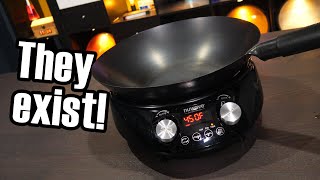
They do, and the design is elegantly simple. Instead of a flat induction coil under a flat glass surface, an induction wok unit shapes the coil into a bowl — matching the natural curve of a traditional round-bottom wok. You drop the wok in, and suddenly you have a round-bottom wok heating via electromagnetic induction rather than a gas flame.
 2:15
The bowl-shaped induction base with round-bottom carbon steel wok seated inside it
Watch at 2:15 →
2:15
The bowl-shaped induction base with round-bottom carbon steel wok seated inside it
Watch at 2:15 →
The one tested here is a carbon steel round-bottom wok paired with a purpose-built induction base. It plugs into a standard North American wall outlet, draws 1,500 watts, and retails for roughly $200. That's not pocket change for a kitchen gadget, but it's a reasonable price for what is genuinely a novel piece of cooking technology — especially when you consider that the core limitation people cite against induction (no wok support) is now solved.
The wok heats with startling speed. After just 10 seconds of power, water dropped onto the surface reacts dramatically. Oil starts smoking at around the 30-second mark during seasoning. That's a hot wok, fast — without a single BTU of open flame.
How Does Induction Cooking Actually Work?
To understand why an induction wok is so effective, it helps to understand what makes induction cooking fundamentally different from every other method of applying heat to food.
Every other cooking technology — gas burners, wood stoves, traditional electric coils, radiant glass-top stoves — works the same basic way: produce a lot of heat beneath the cookware, then transfer that heat into the cookware, which eventually transfers it into food. The cookware is a passive recipient of heat.
4:10
Water droplets reacting violently on the wok surface after only 10 seconds of induction heating
Watch at 4:10 →
Induction flips the script entirely. Power electronics push a high-frequency alternating current through coils of wire beneath the cooking surface. That alternating current creates a rapidly changing electromagnetic field. When compatible metal cookware is placed on top of those coils, the changing field induces electrical currents directly inside the metal of the cookware itself. Those induced currents, traveling through the metal's resistance, generate heat through a process called joule heating.
The result: the cookware is the heating element. Heat isn't being transferred from a hot surface into the pan — the pan is generating its own heat from the inside out. It's similar in principle to wireless phone charging, just at dramatically higher power levels.
- Instant response: Because the cookware generates its own heat, there's no warm-up lag. Turn it on and it's on immediately — just like gas.
- Instant shutoff: Stop the induction field and the cookware stops producing heat instantly. No residual glow like an electric coil.
- Cool surface: The glass cooking surface only gets as warm as the bottom of the cookware sitting on it. Spills don't bake on. Kids are safer.
- No waste heat: Almost every watt pulled from the wall becomes heat inside the cookware — not heat radiating into your kitchen.
Can You Use a Round-Bottom Wok on Induction?
On a standard flat induction cooktop, no — not effectively. Traditional induction relies on the cookware being close to the flat coils beneath the surface. A round-bottom wok sitting on a flat surface barely touches it, and the induction field doesn't project far enough to heat the wok meaningfully. Flat-bottom woks exist as a compromise, but purists correctly argue that a flat bottom changes the cooking dynamics significantly, especially for stir-frying.
The bowl-shaped induction wok base solves this completely. By curving the induction coil to match the wok's geometry, the cookware sits correctly within the field and heats the way a round-bottom wok is supposed to heat. A thermal camera confirms that heat concentrates primarily in the center of the wok — which is exactly where you want it for most wok cooking techniques. And because the wok has a round bottom, you can tilt and rotate it within the bowl to shift which area receives the most direct induction heating, mimicking some of the manual control you'd have over an open gas burner.
7:45
Thermal camera footage showing heat distribution pattern — hottest ring around the center of the wok
Watch at 7:45 →
One real limitation: tossing the wok. When you lift the wok away from the induction base, the heating stops (the same physics that makes induction work also means no cookware contact means no induction). The unit also enters an error state after about 10 seconds without the wok in place and requires a reset — which is genuinely annoying for a cooking style where tossing food is a core technique. It's a fixable problem, but current units haven't fixed it yet.
Induction vs Gas: Which Is Actually Better?
The BTU comparison that often comes up in this debate is misleading. A proper wok burner can pump out 30,000 BTUs. A plug-in induction wok unit maxes out at around 1,500 watts, which converts to roughly 5,000 BTU/hr. On paper, gas wins in a landslide.
Except that's not how heat actually works in practice. A large proportion of those 30,000 BTUs from a gas burner travels around the wok, not into it — heating your kitchen, your exhaust fan, and the air above the stove. Induction, by contrast, delivers essentially every watt directly into the cookware. The real-world cooking power gap between a 30,000 BTU gas wok burner and a 1,500-watt induction wok is much smaller than those numbers suggest.
That said, a plug-in unit limited to a standard 120V North American outlet is genuinely power-constrained compared to what's possible. A proper built-in induction cooktop with a bowl-shaped burner, running on 240V, could push significantly more power into the wok. The plug-in unit is a proof of concept. The fully realized version — built into a range the way traditional burners are — hasn't widely appeared yet, but it logically should.
Beyond raw power, induction beats gas on several quality-of-life fronts: no combustion byproducts indoors, dramatically less waste heat in the kitchen, a cooler cooking surface, and easier cleanup since spills don't instantly carbonize onto a scorching hot surface.
What Cookware Is Compatible With Induction?
The quickest test: hold a magnet to the bottom of the cookware. If it sticks, the pan is almost certainly induction-compatible. If it slides right off, that piece of cookware won't work on an induction cooktop — full stop.
Induction requires ferromagnetic metals in the cookware — cast iron and carbon steel work exceptionally well. Many stainless steel pans work, depending on their specific alloy. Aluminum, copper, and most non-magnetic stainless pans do not. For the induction wok specifically, carbon steel is the natural and traditional wok material, which makes it an ideal match for induction technology.
Are Budget Plug-In Induction Cooktops Worth It?
For most people curious about induction, a $50–$80 plug-in single-burner unit is a perfectly reasonable way to test the technology before committing to a full cooktop replacement. They're built to a price point, so expect some compromises: limited power level selections, touch controls that are clunkier than physical knobs, fan noise from the internal cooling system, and occasionally some high-frequency ringing from cookware vibrating in the induction field.
That said, even a budget unit dramatically outperforms a traditional electric coil at boiling water — particularly in smaller pots. It's fast enough to replace an electric kettle, and the near-instant heat response makes it genuinely useful as a supplement to an existing conventional stove.
Induction Wok Burner: Real Pros and Honest Cons
To be clear about what the current generation of induction wok units gets right and where they still need work:
- Pro: Round-bottom wok compatibility — the core problem is actually solved.
- Pro: Extremely fast heat-up time, approaching 500°F in 30 seconds.
- Pro: Nearly all input power goes directly into the wok, not into your kitchen.
- Pro: Safe cool-touch exterior surface during cooking.
- Con: Annoying error state when wok is lifted for tossing — 10-second timeout is too short.
- Con: Only three power levels (600W, 900W, 1,500W) on current plug-in units — a physical knob with more granularity would be far better.
- Con: Temperature-based thermostat mode adds complexity without obvious benefit for most cooks.
- Con: Default 20-minute auto-shutoff timer is a nuisance.
- Con: Carbon steel wok requires hand-washing and seasoning maintenance — not for everyone.
- Con: Power is limited by the standard North American 120V outlet to ~1,500W.
The verdict: induction woks are not a gimmick, and woks are not a valid argument against induction cooking anymore. The technology works. The current products have rough edges. Future built-in cooktops with bowl-shaped burners — or dual-voltage plug-in units capable of 3kW on a 240V outlet — will close the remaining gap. The proof of concept is sound, the direction is clear, and it really might just be a wok in the park from here.