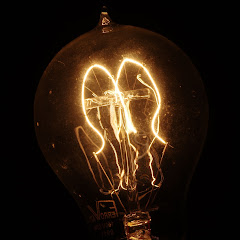
The Balafire light bulb creates its flame effect through an almost laughably simple trick: a small permanent magnet suspended inside the bulb interacts with the magnetic field generated by its own filament, causing the filament to physically move. Because household electricity is alternating current — reversing direction 50 to 60 times per second — the filament doesn't just twitch once. It vibrates continuously, flying around inside the globe in a way that looks remarkably like a small fire trapped inside glass. No LEDs, no microcontrollers, no programming. Just magnets, physics, and a bit of glassblowing creativity from the late 1960s.
How Does the Balafire Bulb Create a Realistic Flame?
Crack open a clear version of the Balafire's predecessor — the Gas Glo bulb, also made by Kyp-Go — and the mechanism is immediately obvious. The filament is unusually long and hangs loosely, extending up into the tip of a vaguely flame-shaped glass envelope. Right in the middle of that filament sits a small black chunk on a stick: a permanent magnet.
 02:45
Close-up of the clear Gas Glo bulb showing the free-hanging filament and permanent magnet on a stick before being switched on
Watch at 02:45 →
02:45
Close-up of the clear Gas Glo bulb showing the free-hanging filament and permanent magnet on a stick before being switched on
Watch at 02:45 →
When current flows through a wire, it generates a magnetic field. In the Balafire, the filament is that wire, so the moment you switch it on, a magnetic field forms around the filament and interacts with the static magnet. Depending on the direction of the current, the resulting force is either attractive or repulsive — pulling the filament toward the magnet or pushing it away. With AC power flipping that direction dozens of times per second, the filament oscillates rapidly back and forth.
04:10
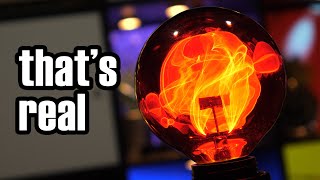
The Balafire bulb switched on — filament flying freely inside the large glass globe, creating a fire-like effect
Watch at 04:10 →
In the Gas Glo bulb, the flame-shaped glass constrains that movement. The filament can only swing a little before it touches the sides, keeping the effect subtle — a gentle, realistic flicker similar to an actual oil lamp. But the Balafire changed the formula in 1968 by replacing the tight flame-shaped envelope with a large, open sphere. With nothing to stop it, the filament whips around in all directions, producing a genuinely wild, fire-like display that borders on hypnotic.
What Is a Flicker Flame Light Bulb and How Does It Work?
Flicker flame light bulbs are novelty bulbs designed to mimic the appearance of a real flame using electrical components rather than actual combustion. They've existed in various forms since at least the 1960s, and the technology behind them varies considerably.
- Magnet-and-filament bulbs (like the Balafire and Gas Glo): Use AC-induced electromagnetic forces to physically move the filament.
- Neon flicker flame lamps: Use ionized gas and internal electrodes to produce a reddish, flickering glow with essentially no useful illumination output.
- Modern LED flicker bulbs: Use amber-colored diodes and microcontrollers to simulate a flame pattern. Cheap, but often unconvincing — the amber color produces unpleasant light and a perceptive eye can usually spot the repeating pattern.
- SimFlame dimmers: A clever alternative — a plug-in device that randomly and subtly varies the brightness of a standard incandescent bulb. Because incandescent filaments shift warmer in color as they dim, and because the light source itself is hidden behind frosted glass, the effect can be remarkably convincing.
Of all these approaches, the Balafire's mechanical method remains the most visually distinctive. The light source is physically moving, which changes the directionality of light output in real time — something no LED pattern can fully replicate.
01:20
Side-by-side comparison of modern LED flame bulbs, the Gas Glo, and the Balafire showing the difference in flame realism
Watch at 01:20 →
Which Fake Flame Bulb Looks Most Realistic in Antique Fixtures?
It depends on what you're going for. For a subtle, convincing oil-lamp effect — the kind where someone across the room genuinely isn't sure if there's a real flame in that lantern — the Gas Glo bulb or a SimFlame dimmer paired with a frosted incandescent bulb is probably your best bet. The Gas Glo's constrained filament movement closely mirrors the gentle, barely-there flicker of a real burning oil lamp.
For pure spectacle — a centerpiece, a conversation starter, something you just want to stare at — nothing tops the Balafire. The filament's uninhibited motion inside that mirrored red globe is genuinely unlike anything else. It reads less like a lamp and more like a contained fire, and it absolutely earns its place as a display object rather than a light source.
Modern LED flame bulbs are fine for casual decorative use, but if you have the budget and interest for vintage options, the older mechanical bulbs win on authenticity every time.
What Was the Gas Glo Bulb — and Who Made It?
The Gas Glo was the direct predecessor to the Balafire, introduced in 1964 by Kyp-Go Incorporated, a Chicago-area company founded in 1950 by Bob Kyp. Kyp was dedicated to preserving the look and character of carbon filament light bulbs — the kind that predated modern tungsten incandescents — and spent years manufacturing reproductions of antique bulb designs.
The Gas Glo was his attempt to push that concept further: not just a bulb that looked old, but one that actively simulated the behavior of a flame. It used the same magnet-in-filament mechanism that the Balafire would later inherit, but housed it in a tightly shaped glass envelope that kept the flickering effect gentle and lamp-like.
The Balafire followed in 1968, essentially the same internal mechanism set free inside a larger sphere — same filament design, same magnet, same physics, dramatically different result. Kyp-Go produced both bulbs through the early 1970s, and shortly before Bob Kyp's death in 2011, the company revived the Balafire in a limited run using standard A19-shaped glass rather than the original mirrored red sphere.
How Long Do Novelty Filament Bulbs Actually Last?
The Balafire's original packaging claimed a rated life of 500 hours, which sounds pessimistic until you realize the filament is mechanically vibrating the entire time it's on. That's a lot of stress on a very thin piece of metal. The cause of death for these bulbs isn't the typical tungsten evaporation that kills a standard light bulb after hundreds of hours at high temperature — it's metal fatigue. The filament eventually cracks from the constant mechanical flexing.
That said, there are anecdotal reports of individual Balafire bulbs lasting many thousands of hours. Because the filament runs at such low brightness and temperature, tungsten evaporation is almost negligible. A bulb that happens to have a particularly sturdy filament can last a surprisingly long time — it's just a matter of luck in manufacturing tolerances.
The patent itself notes that pre-aging the filament (running it at higher-than-normal voltage briefly before normal use) helps build resilience. For the gentler Gas Glo variant, long life is more plausible since the constrained movement puts less mechanical stress on the filament.
Did Disney Really Use Special Bulbs in Their Theme Parks?
Yes — and the connection is closer than you'd expect. Kyp-Go Incorporated, the same company that made the Gas Glo and the Balafire, was also a supplier of antique-reproduction carbon filament bulbs used in Disney theme parks and various attractions. That warm, slightly flickering glow that made old-fashioned park lanterns look like they actually contained flames? That was Kyp-Go's work.
The SimFlame dimmer mentioned earlier also has a rumored Disney connection — it's believed to be related to or inspired by the same technology Disney used to animate those lanterns convincingly. Whether or not that lineage is direct, the effect is the same: a randomly-varying incandescent dimmer makes frosted glass look like it's hiding a real flame.
Are Reproduction Carbon Filament Bulbs Actually Worth Buying?
A small but important clarification first: most reproduction "Edison" or "carbon filament" bulbs currently on the market — and most that have been sold for the past couple of decades — use tungsten filaments, not actual carbon. They're simply run at a lower voltage and wattage than standard incandescents, which keeps them dim, extremely warm in color temperature, and operating well below the filament's stress limits.
The result is a bulb that lasts much longer than its wattage would suggest (it's essentially running on a permanent low-dim setting), glows a beautiful deep amber-orange, and looks absolutely stunning in the right decorative context. Companies like FerroWatt pushed this aesthetic before the Edison bulb trend exploded commercially, and produced some of the most convincing reproductions available — including genuine glass-tip designs.
The downside is efficiency: these bulbs are terrible at actually lighting a room. They're purely decorative. For a single pendant over a bar cart, a vintage-style sconce in a hallway, or a display fixture showing off a Balafire bulb, they're hard to beat. For anything requiring actual illumination, look elsewhere.
The Balafire and Gas Glo bulbs now trade as collectibles at around $100 each. If you ever find one at an estate sale, don't leave without it.