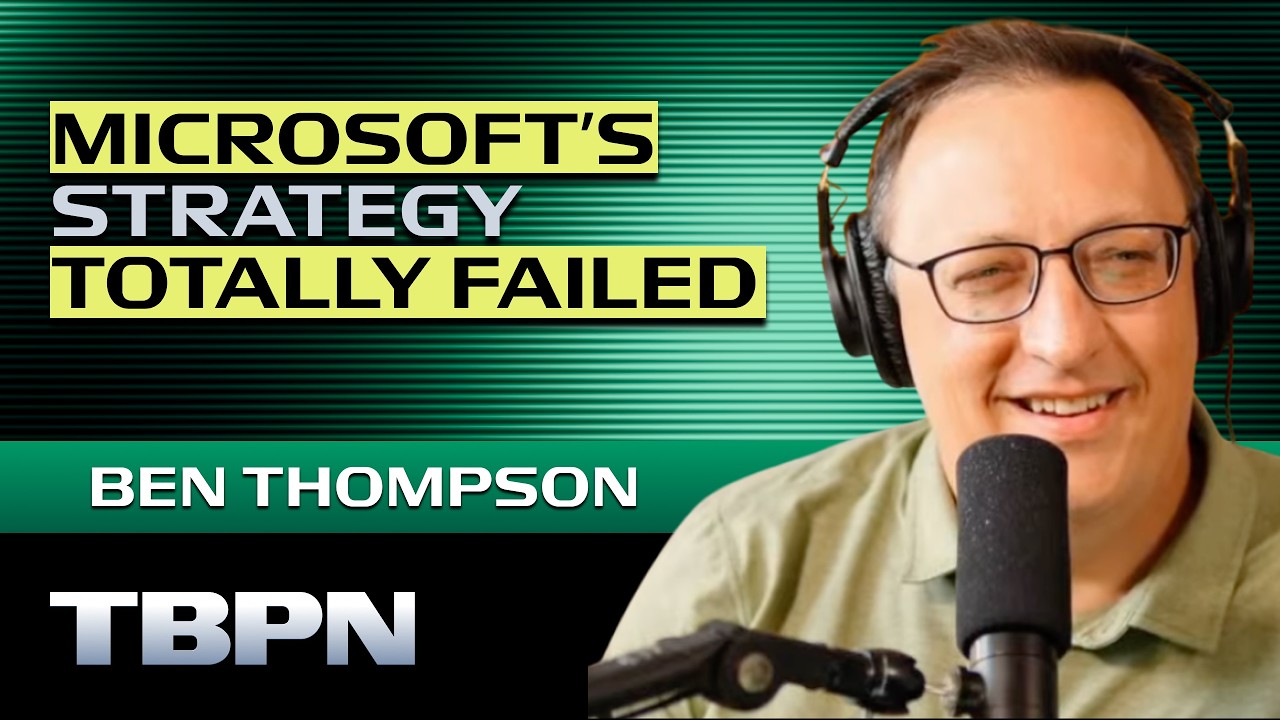

Xbox Game Pass failed because it cannibalized Microsoft's existing revenue without expanding the gaming market. Instead of luring PlayStation gamers over to Xbox, Game Pass simply let people who already owned Xboxes pay far less for games they would have bought at full price anyway. Microsoft expected 75 million subscribers by 2025 — they got roughly 30 million, and that number is declining. That's the short answer. The full story is one of the most fascinating strategic disasters in modern tech history.
Why Did Xbox Game Pass Fail So Badly?
The logic behind Game Pass seemed sound on paper. Instead of charging $60–$80 per game, Microsoft would offer unlimited access to a library of titles for a flat monthly fee. It was the Spotify model applied to gaming. The bet was that lower friction would bring in entirely new gamers, and volume would more than compensate for lower per-unit revenue.
 18:30
Ben Thompson explaining why no independent publisher would participate in Game Pass — they make money upfront from superfans, not over time from subscribers
Watch at 18:30 →
18:30
Ben Thompson explaining why no independent publisher would participate in Game Pass — they make money upfront from superfans, not over time from subscribers
Watch at 18:30 →
It didn't work for a fundamental reason: no major independent publisher wanted to participate. When you sell a game, you make the bulk of your revenue upfront from your most passionate fans — the people who pre-order and buy on day one. Putting that game on a subscription service on launch day destroys that model. So Microsoft had to rely on its own first-party studios, which meant it needed to own a lot of studios producing a lot of high-quality games constantly.
That's why the acquisition spree began. Microsoft bought Bethesda, ZeniMax, and eventually Activision Blizzard. But here's the trap they walked into: each studio they acquired had an existing business built on selling individual copies of games across all platforms. The moment Microsoft pulled those games toward Game Pass, it was essentially writing off billions in existing revenue and hoping new subscribers would make it up. They didn't. The Series S — a cheaper, less powerful console bundled with Game Pass — was supposed to expand the market. Instead it caused developers to build to the lower hardware ceiling, neutering the more powerful Series X. Microsoft ended up with a weaker console lineup, fewer subscribers than projected, and a strategy that had no clear exit.
Why Did Microsoft Buy Activision for $69 Billion?
Activision was the one acquisition that actually made strategic sense within the Game Pass framework — because Activision, unlike Bethesda or other studios, releases massive titles like Call of Duty on a near-annual cadence. That's the kind of consistent, high-profile content that could theoretically anchor a subscription service the way NFL games anchor a sports streaming package.
But the acquisition raised an obvious question that regulators and competitors immediately asked: would Microsoft make Call of Duty an Xbox exclusive? Microsoft repeatedly promised it wouldn't — partly because the FTC was already scrutinizing the deal, and partly because pulling Call of Duty from PlayStation would have been an enormous short-term revenue sacrifice. Sony's PlayStation holds around 80% of the console gaming market in most categories. Walking away from that install base, even to drive Xbox adoption, is an extraordinarily risky bet.
32:15
The Sony PS4 strategy breakdown — generic hardware plus exclusive first-party games versus Microsoft's subscription gamble
Watch at 32:15 →
Ironically, some analysts now argue that going exclusive might have been the only logical move — a real-world pricing test of how much a AAA franchise is actually worth in terms of driving hardware sales. If millions of Call of Duty players bought an Xbox rather than go without the game, that would reveal the true value of the franchise in a way no spreadsheet can. Microsoft never made that bet, and now they're sitting on a $69 billion acquisition inside a strategy that isn't working.
How Did PlayStation Beat Xbox So Completely?
To understand the current crisis, you have to go back to the PlayStation 3 era. Sony made a massive misstep with the PS3 — they built a bespoke, expensive processor called the Cell, tried to use the console to push Blu-ray adoption, and launched at a price that alienated consumers. It was a case of corporate priorities hijacking a gaming product.
Sony learned from that mistake. By the time they were designing the PS4, their strategy had crystallized: build generic, easy-to-develop-for hardware, and differentiate through exclusive games. They acquired smaller studios and pushed them hard to build flagship titles for the PS4 launch window. The results were transformative — franchises like The Last of Us and Spider-Man became cultural touchstones that PlayStation players simply couldn't get anywhere else.
08:45
The original Xbox 'three screens and a cloud' corporate strategy that set the stage for decades of gaming missteps
Watch at 08:45 →
Meanwhile, Microsoft was doing the opposite. The Xbox One launched with a mandatory Kinect camera bundled in, driving the price up and signaling that Microsoft still cared more about owning the living room than winning gamers. It was the same mistake they'd been making for over a decade. Sony annihilated them in the PS4 generation, and that momentum carried straight into the PS5 era.
Why Did Microsoft Build the Xbox in the First Place?
The Xbox was never really about gaming. That's the original sin that explains almost everything that followed. Back in the early 2000s, Microsoft's corporate strategy revolved around what they called "three screens and a cloud" — the PC, the phone, and the living room. They already dominated the desktop. They were trying to get into mobile. And the living room was the third frontier.
The thinking went: people plug consoles into their TVs, so if we own the console, we own the gateway to the living room. Build a gaming console, earn permission to be in people's homes, and use that as the beachhead for internet services. It was a reasonable theory. It was just completely wrong in execution, because people buy consoles to play games — not to access the internet. The people who wanted a living room internet device weren't going to buy a $400 gaming console to get it. That space was eventually filled by the Fire Stick, Roku, Chromecast, and Apple TV.
What made it especially painful was that this strategic mismatch didn't just fail to achieve the original goal — it actively poisoned the gaming product. Every time Microsoft tried to use Xbox to accomplish something beyond gaming, it made the console worse for gamers. The Xbox One is the clearest example, but the pattern repeated throughout the product line's history.
What Really Happened to Phil Spencer at Xbox?
Phil Spencer was officially "retired" from his role leading Xbox. As Ben Thompson bluntly put it: when someone at that level of a major corporation is "retired," they were almost certainly pushed out. The Game Pass strategy was Spencer's vision, and by any measurable outcome, it failed to deliver. Subscriber targets were missed by a massive margin. The Activision acquisition hasn't moved the needle on subscriptions. And the underlying console business continued to lose ground to PlayStation.
New leadership has come in, layoffs of around 1,600 people have been announced, and Microsoft says game development will continue. But the wave of cuts has created a brutal morale problem — everyone still at Xbox is waiting to see if another round is coming. The strategic clarity that Microsoft needs is still absent. Are they a console company? A subscription service? A multiplatform publisher? Right now, they're uncomfortably stuck between all three.
Should Microsoft Spin Out Xbox to Save It?
Ben Thompson has argued for years — before Game Pass, during it, and now after its failure — that Microsoft should spin Xbox out as a separate entity. The case is straightforward: Xbox has never achieved the corporate goals Microsoft set for it, and its existence inside Microsoft has created a kind of organizational inertia where it continues operating simply because it already exists and has cultural cachet among employees.
A spun-out Xbox would have to make hard decisions without the safety net of Microsoft's balance sheet. It would have to choose a lane — whether that's exclusive premium gaming, a scaled-back subscription model, or becoming a pure software and services publisher on other platforms. Inside Microsoft, those decisions keep getting delayed because the downside is always manageable relative to the overall company. The spin-out argument isn't just about efficiency. It's about forcing the kind of existential clarity that the current structure actively prevents.
Why Did the Getty Images and Shutterstock Merger Collapse?
UK regulators blocked the Getty Images and Shutterstock merger unless the companies divested the editorial photography business — a condition that made the deal economics unworkable. The companies walked away. What makes this frustrating from a strategic standpoint is that both companies are under severe existential pressure from generative AI, which can produce stock imagery at near-zero marginal cost. Consolidation was arguably the only rational defensive play available to them.
But this is a pattern that repeats across industries: the moment companies in a declining or threatened sector try to consolidate, regulators block them. The irony is that regulators are most passive precisely when companies are growing and potentially building monopolistic power, and most aggressive when companies are contracting and trying to survive. The Getty-Shutterstock deal was easy to block because both companies are established, their financials are knowable, and a traditional antitrust analysis flags market concentration. The fact that the combined entity would still be fighting for survival against AI-generated imagery doesn't factor neatly into that framework. The result is that two companies that might have had a better chance together will instead face an existential threat separately.