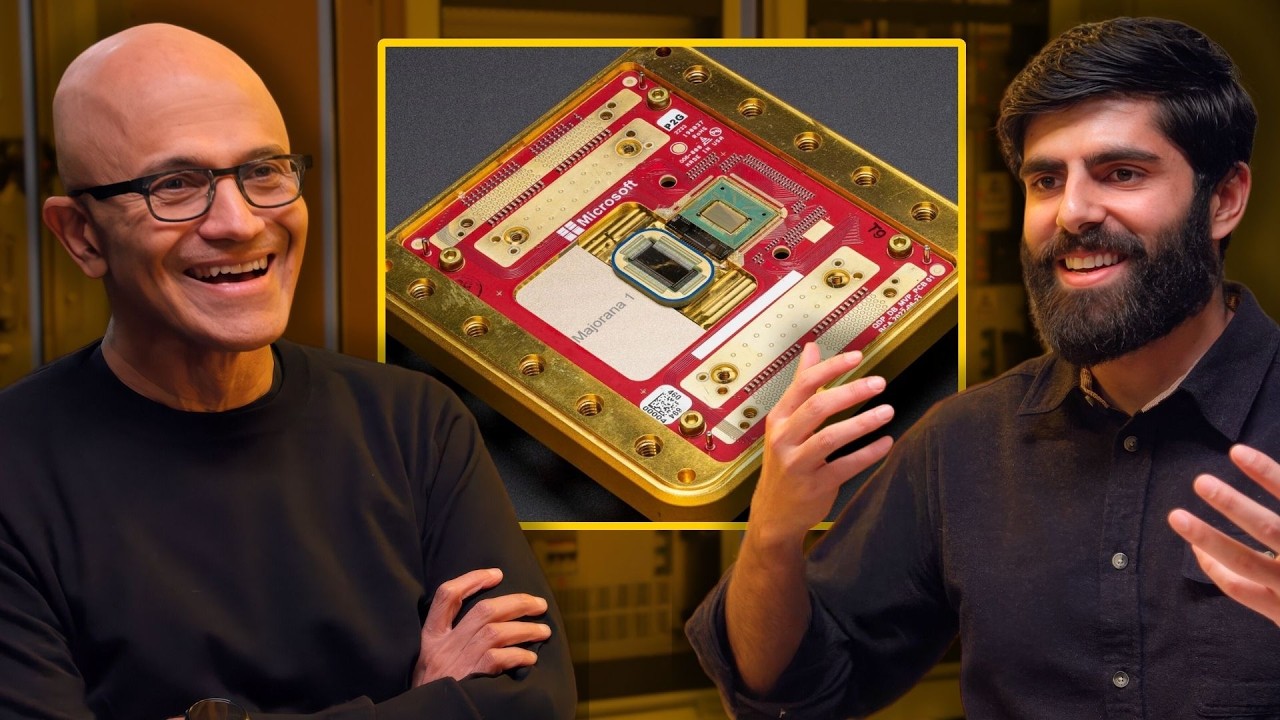

What Is Microsoft's Quantum Computing Breakthrough?
Microsoft has just achieved what insiders are calling the transistor moment of quantum computing. The company confirmed a landmark physics and fabrication breakthrough — the creation of stable Majorana zero modes in a new phase of matter called the topological phase. The result? A path to fitting one million qubits onto a single chip roughly the size of a standard processor. That's the kind of leap that transforms quantum computing from a fascinating science experiment into a genuine utility-scale technology.
For years, the central problem with quantum computers has been noise — qubits are fragile, error-prone, and notoriously difficult to scale. Microsoft's bet was always that you don't fix noise by brute force engineering. You fix it by finding a physical property that is fundamentally more reliable by nature. That search led them to Majorana zero modes, first theorized in the 1930s, and now — finally — physically fabricated in the lab.
 00:45
The team points to the hardware housing what they claim is a million-qubit-capable topological quantum processor in a compact form factor
Watch at 00:45 →
00:45
The team points to the hardware housing what they claim is a million-qubit-capable topological quantum processor in a compact form factor
Watch at 00:45 →
What Are Topological Qubits and Why Do They Matter?
Most quantum computers today use superconducting qubits or trapped ions — both of which are highly sensitive to environmental interference. A single vibration, a stray electromagnetic field, or even a temperature fluctuation can destroy the quantum state you're trying to compute with. This is why today's quantum machines require enormous error-correction overhead and why scaling them up has been so painfully slow.
Topological qubits work differently. Instead of storing quantum information in a fragile physical state, they encode it in the topology of the system — essentially in the shape of the quantum state rather than its exact position or energy. This makes the information dramatically harder to accidentally disturb. Think of it like writing a message in the knot of a rope rather than in ink on paper — even if the rope gets jostled, the knot stays intact.
This is why Microsoft's team is so energized. By achieving a new topological phase of matter using Majorana zero modes, they can now reliably hide quantum information, measure it, and fabricate the structures that make it possible — all three of which are required before you can build anything practical.
What Are Majorana Zero Modes and How Do They Work?
Majorana zero modes are a type of quasiparticle — not a traditional particle, but an emergent quantum phenomenon that appears at the boundary of certain superconducting materials. They were theorized by physicist Ettore Majorana in the 1930s, and their most remarkable property is that they are their own antiparticles, which makes them extraordinarily stable compared to conventional quantum states.
02:30
Explanation of how Majorana zero modes encode quantum information in topological phase rather than fragile physical states
Watch at 02:30 →
The challenge has always been: can you actually build them? For decades, the answer was uncertain. Fabricating structures precise enough to reliably host Majorana zero modes pushed the limits of materials science and nanofabrication. Microsoft's announcement is essentially an existence proof — they've demonstrated that yes, you can fabricate these things, and yes, they behave the way theory predicted.
This is the core unlock. With fabrication now proven, the team believes they can move from single Majorana gates to a full Majorana chip — dubbed Majorana One — capable of housing a million physical qubits and thousands of error-corrected logical qubits on a single piece of silicon-scale hardware.
When Will Microsoft Have a Working Quantum Computer?
According to the team, the timeline is more concrete than ever. With the physics breakthrough and fabrication technique now confirmed, the next step is integrating Majorana gates into a full integrated circuit — and then building that into a real, fault-tolerant quantum computer.
The estimated window: 2027 to 2029.
04:15
Timeline breakdown: from first Majorana gate to utility-scale quantum computer by 2027-2029
Watch at 04:15 →
That's a remarkably near-term target for something that seemed decades away just a few years ago. The comparison to Moore's Law is apt — once you have the transistor, the rest of the scaling curve becomes a question of engineering, not fundamental science. Microsoft is essentially saying: we have the transistor. Now we build the chip.
- 2025-2026: Build Majorana One chip with first integrated Majorana gates
- 2027-2028: First fault-tolerant quantum computer with thousands of logical qubits
- 2028-2029: Utility-scale quantum computer accessible via cloud API
Interestingly, the team noted a somewhat recursive ambition: one of the first things a working quantum computer will help with is building better quantum computers, by simulating atom-by-atom construction of next-generation quantum gates. The technology will help accelerate its own development.
What Can a Million-Qubit Quantum Computer Actually Do?
The distinction between physical qubits and logical qubits matters enormously here. Physical qubits are the raw hardware — a million of them sounds impressive, but they're still subject to error. Logical qubits are error-corrected groups of physical qubits that behave reliably enough for real computation. Microsoft's Majorana One target of thousands of logical qubits would be enough to run algorithms that are genuinely impossible for classical supercomputers.
What kinds of problems? The team was clear about where quantum has a natural edge:
- Molecular simulation: Modeling chemical reactions at the quantum level for drug discovery and materials science
- Quantum chemistry: Designing new catalysts, batteries, or semiconductors by simulating electron behavior
- Biology: Protein folding, enzyme mechanisms, and genomic simulations at atomic precision
- Physics research: Exploring quantum phenomena that are computationally intractable today
Crucially, quantum computing is not expected to replace classical computing. The vision is complementary: quantum excels at problems that are data-light but involve exponentially large state spaces — exploration problems, not data-crunching problems. Classical computers remain superior for heavy data workloads. The future is a hybrid stack.
How Will Quantum Computing and AI Work Together?
One of the most forward-looking parts of Microsoft's vision is the integration of quantum computing, AI, and high-performance classical computing (HPC) into a unified stack. And the interplay between quantum and AI is particularly fascinating.
Here's the key insight: AI can act as an emulator for quantum simulation. Even before fault-tolerant quantum hardware is ready, you can use quantum systems to generate synthetic training data — data that captures quantum mechanical behavior — and then use that data to train AI models that understand chemistry, physics, or biology at a level current models cannot reach.
In other words, quantum computers generate the ground truth. AI learns from it. Classical HPC handles the heavy data lifting. Together, the three form a system more powerful than any one of them alone.
Microsoft has already started moving in this direction, using the combination of HPC and AI as a near-term stand-in for quantum, with plans to progressively replace HPC components with quantum processors as the hardware matures. It's a pragmatic, layered approach — and it means the benefits of quantum computing may start flowing through AI applications well before fault-tolerant hardware is fully deployed.
The Bottom Line: Why This Moment Changes Everything
The history of computing has a handful of genuine inflection points — the vacuum tube, the transistor, the integrated circuit, the microprocessor. Microsoft is making a serious claim that the topological qubit is the next one. Not an incremental improvement on existing quantum hardware, but a fundamentally different physical approach that solves the noise problem at its root.
After 30 years of research, the fabrication is real. The physics is proven. The chip roadmap is in motion. And if the 2027-2029 timeline holds, we may be only a few years away from the first computer that can simulate nature itself — and in doing so, accelerate discovery in medicine, materials, energy, and beyond in ways we're only beginning to imagine.