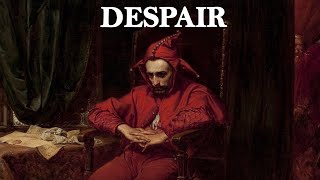
The philosophy of despair sounds, at first, like a contradiction — why would anyone build a worldview on hopelessness? But for the Russian-Jewish existentialist philosopher Lev Shestov, despair was not an endpoint. It was a doorway. Shestov argued that the deepest philosophy doesn't begin with curiosity or rational inquiry — it begins with the shattering moment when the ground gives way beneath your feet. And if you've ever lived through a tragedy that made the world feel utterly unstable, Shestov was speaking directly to you.
 00:45
The ancient fable of Thales falling into a well — philosophy disconnected from lived experience
Watch at 00:45 →
00:45
The ancient fable of Thales falling into a well — philosophy disconnected from lived experience
Watch at 00:45 →
Though largely overlooked in mainstream philosophical circles, Shestov was a towering and deeply original thinker whose ideas are arguably more urgent today than ever before. His friend and fellow philosopher Nikolai Berdyaev described him as someone who "philosophised with his whole being, for whom philosophy was not an academic specialty but a matter of life and death." This was not a man shuffling around abstract ideas in an ivory tower — this was a thinker forged in genuine existential fire.
What Is the Philosophy of Despair?
Shestov's so-called philosophy of despair — sometimes called his philosophy of tragedy — holds that the most important philosophical truths emerge not from calm, rational reflection, but from suffering, crisis, and the confrontation with meaninglessness. Where most Western philosophers had treated reason as the highest faculty of human beings, Shestov saw something dangerous and limiting in that assumption.
For Shestov, the sources of philosophy were "the human tragedy, the horrors and sufferings of human life and the sense of hopelessness." This is a radical claim. It means that textbook philosophy — the kind argued in lecture halls with tidy logical systems — fundamentally misses the point. Real philosophy must be earned through lived experience. It cannot be taught. It can only be transmitted by going through the same kind of intensive, personal struggle yourself.
03:20
Shestov's concept of groundlessness — when the world falls apart beneath your feet
Watch at 03:20 →
He introduced the concept of penultimate knowledge — a necessary, preliminary knowledge born from despair. Before you can reach something higher, you must first acknowledge the abyss. Despair is not the destination; it is the threshold.
Who Was Lev Shestov and What Did He Believe?
Lev Shestov (1866–1938) was a Ukrainian-born, Russian-Jewish philosopher who spent much of his later life in Paris. He is often grouped with the existentialists — alongside Kierkegaard, Nietzsche, and Dostoevsky — though he predates the formal movement by decades in some respects, and his conclusions are uniquely his own. Shestov was actually the first thinker to link Kierkegaard, Nietzsche, and Dostoevsky together, recognising in all three a shared obsession with the meaning of life, human suffering, and the tragedy of existence.
He agreed with Nietzsche that "every great philosophy is a confession and unconscious autobiography of the deepest kind." His own philosophy was no different. He underwent what he called a "pilgrimage through the souls" of great minds, and he experienced his own profound personal crisis — a nervous breakdown he described as a "rupture of time" — that fundamentally reshaped his thinking.
06:55
Dostoevsky before the firing squad — how near-death became philosophical awakening
Watch at 06:55 →
His most celebrated works include All Things Are Possible (originally titled The Apotheosis of Groundlessness) and his final masterpiece, Athens and Jerusalem, in which he explored the eternal tension between reason and faith.
How Does Existentialism Connect Suffering to Meaning?
This is perhaps the most universally relevant question Shestov raises, and it connects him deeply to the broader existentialist tradition. Existentialism and suffering are inseparable — the movement as a whole is preoccupied with how human beings find meaning in a world that offers no ready-made answers.
Shestov goes further than most. He insists that inner development almost always requires going through suffering. This is not a passive resignation to pain — it is an active philosophical claim. Suffering strips away the comfortable illusions we build around our lives. It forces us into a state of raw, unmediated confrontation with reality. And it is precisely in that confrontation, Shestov believed, that real philosophical thinking — and real spiritual growth — becomes possible.
- Kierkegaard taught that faith is the leap beyond rational despair.
- Nietzsche insisted we must look unflinchingly into the abyss.
- Dostoevsky dramatised the underground man's descent as a form of liberation.
- Shestov synthesised all three and pointed toward God as the ultimate horizon beyond reason.
What Is Groundlessness and Why Does It Matter?
One of Shestov's most powerful and original concepts is groundlessness — a word that captures the experience of having the certainties of your life collapse beneath you. In his first major work, he describes it as the uncertainty of our experience of the world, that terrifying moment when everything you believed to be stable suddenly isn't.
Most people, when they hit this moment, look for a new system to stand on — a new ideology, a new relationship, a new rational framework. Shestov's radical suggestion is: don't. Stay in the groundlessness. Let it do its work on you. Because it is only from that unmoored, vertiginous place that genuine transformation — what he calls a "second birth" — becomes possible.
This idea speaks directly to anyone who has lived through a major loss, a breakdown, or a life crisis. Shestov isn't offering comfort in the conventional sense. He's offering something rarer: the possibility that your worst moment might also be your most philosophically alive moment.
Athens vs Jerusalem: Reason vs Faith Explained
The culmination of Shestov's life's work is the great opposition he drew between Athens and Jerusalem. Athens represents the tradition of Greek rational philosophy — logic, system-building, the belief that reason can master reality. Jerusalem represents the biblical tradition of faith — the belief in a God who transcends all rational categories and for whom all things are possible.
Shestov was scathing toward philosophers who tried to merge the two. He criticised Kant for arguing that religion must stay within the limits of reason alone, and Hegel for his famous proclamation that "what is rational is real and what is real is rational." In both cases, he argued, abstract systems swallow up the individual human being and ignore the fundamental questions of life.
Crucially, Shestov was not anti-science. He had no objection to reason in its proper domain — everyday problem-solving, scientific inquiry, practical life. His target was scientism and rationalism — the arrogant belief that rational systems can answer every question, including the deepest ones about meaning, suffering, and death. As Dostoevsky warned: when you reduce human nature to a mathematical formula, you exclude it entirely.
Why Did Dostoevsky's Near-Death Change Everything?
Shestov was deeply fascinated by the moment Dostoevsky stood before a firing squad — and was released at the very last second. This twisted psychological torture, followed by years in a Siberian labour camp, gave the great novelist what Shestov called "new eyes" for life.
The transformation is visible in Dostoevsky's writing. Works like Notes from Underground and The House of the Dead carry a rawness and spiritual intensity that his earlier work lacked. In The Idiot, he described with haunting precision what a man thinks in his final five minutes before execution — how every ray of light becomes infinite, how time dilates into eternity, how the awareness of death makes each moment unbearably precious.
For Shestov, this was not merely literary biography. It was philosophical evidence: the encounter with death cracks open a dimension of experience that ordinary waking life keeps firmly shut. It is the ultimate form of awakening.
What Does It Mean to Truly Awaken to Life?
The motif of awakening runs through all of Shestov's philosophy. He believed that most of us are, in a very real sense, sleepwalkers — going through the motions of life without ever truly confronting its depth or its terror. We distract ourselves, we build systems, we stay comfortable. We flee from the thought of death precisely because thinking about death might wake us up.
Shestov wrote: "The ancients, to awake from life, turned to death. The moderns flee from death in order not to awake." This is a striking diagnosis of modern society — one that feels even more accurate in an age of infinite digital distraction. Awakening, for Shestov, means turning toward death, toward despair, toward the abyss — not to be destroyed by them, but to be transformed.
Is Faith or Reason the Better Guide Through Life?
Shestov's answer is unambiguous: faith — but not faith as blind comfort or intellectual surrender. Faith, in Shestov's sense, is the courageous act of reaching beyond the limits of reason toward God, toward unlimited possibility, toward the freedom that no rational system can grant. It is, following Kierkegaard, the only true escape from the despair of groundlessness.
Reason, Shestov acknowledged, is indispensable in daily life. But it is silent on the questions that matter most. "Reason tells us nothing in which we can explore the problems of the human condition," he wrote, "it is as if we are thrown into a dark cave without light. Faith, on the other hand, gives us light in order to find our way out of the darkness."
Shestov's philosophy is, in the end, profoundly life-affirming. His fight for the individual's right to freedom, creative transformation, and meaning — in the very face of despair and death — is a philosophy for anyone who has ever felt the ground give way. He does not promise easy answers. He promises something better: the possibility that your darkest moment is the beginning, not the end, of something real.