Kid Rock didn't set out to topple one of America's biggest beer brands. He grabbed a machine gun, shot up some cases of Bud Light on camera, and accidentally became the defining image of a consumer revolt that cost Anheuser-Busch billions. Speaking candidly on The Rogan Experience, he walked through what really happened — from the moment of frustration that sparked it all, to a private sit-down with the company's CEO, to where his head is at now.
The Moment That Started It
By his own account, Kid Rock wasn't plotting a campaign. He was angry, grabbed a machine gun, and filmed himself destroying cases of Bud Light on his property. The footage went viral and he became, in his words, "the face of it."
"I was just having fun, to be honest with you," he said. "I was pissed, but it wasn't like it was going to wreck my day, let alone my life. I was just kind of like — what the hell are they doing?"
He's clear that he doesn't see himself as a movement leader. He wasn't trying to organize a boycott. He acted on instinct, the video caught fire, and the backlash had already been building. He just gave it a face.
The specific issue that pushed him over the edge wasn't the transgender partnership with Dylan Mulvaney in isolation — it was what he saw as a broader signal about transgender athletes in women's sports. "They want to let guys play girl sports — that was the end. That was really it." He frames the Bud Light moment as the culmination of a longer frustration, not a calculated stance.
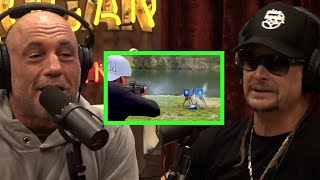 02:10
Kid Rock describing the machine gun video and the Bud Light cases on his property
Watch at 02:10 →
02:10
Kid Rock describing the machine gun video and the Bud Light cases on his property
Watch at 02:10 →
The Private Meeting With Anheuser-Busch's CEO
What hasn't been widely reported is that Kid Rock eventually sat down face-to-face with the CEO of Anheuser-Busch — an encounter that began in Dana White's green room at a UFC event, with Donald Trump in the room.
"I go to Trump, I go — see that dude behind me? That's the CEO of Bud Light. And Trump's like, you want to go talk to him?" Kid Rock says he went over immediately. The conversation ran long. The CEO explained how he'd first seen the viral video — he was down in Texas on a hunting trip when it surfaced. Kid Rock says he came away impressed: "After five minutes of talking to him, I'm like, dude, you seem like somebody I'd be friends with."
That meeting led to a follow-up in Nashville. The CEO brought his top team, they had dinner, and Anheuser-Busch floated the idea of a partnership. Kid Rock listened, threw out some ideas he describes as having scared the room, and ultimately walked away from the money entirely.
"There's not a penny on earth that could make me change who I am or have people look at me differently," he said. "I don't feel right taking your money. I don't want any corporate deals."
He's careful to add that he genuinely likes the people running the company. His issue was never with Anheuser-Busch as an institution — he did research and found their charitable work substantial. The problem was a specific marketing decision, and once the company absorbed the consequences, he felt the point had been made.
On Boycotts, Cancel Culture, and Knowing When to Stop
Kid Rock is uncomfortable being cast as a cancel culture warrior, because he says he's opposed to cancel culture on principle. He draws a distinction between sending a message and trying to destroy something permanently.
"I'm not someone who holds a grudge his whole life," he said. "I told them — you got smacked on the ass pretty hard. But I don't want to hold your head underwater and drown this company. Put people out of work. You got the message."
What visibly bothered him more than the marketing decision itself was the downstream effect on working people — truck drivers, distributors, bartenders. He knew people whose livelihoods were directly hit when bars stopped carrying the product and customers turned hostile toward anyone still drinking it.
"That's dumb as hell," he said of the social pressure directed at ordinary consumers. "And by the way, I'm not into boycotts and cancel culture. We sent them a message. But if you're still spending time on this, you're clearly bored. Find something better to do."
He's also pointed about the selective nature of consumer outrage. He thinks the same energy applied to Bud Light should be available for companies that genuinely target children with ideological messaging — and he names Starbucks, Target, and Ben & Jerry's as examples — but he's skeptical of people who make boycotting a lifestyle.
Where Things Actually Stand Now
The relationship between Kid Rock and Anheuser-Busch has quietly normalized. For his birthday, the company sent him a hundred cases of Bud Light. A truck showed up at his house unannounced.
"My friends have been bringing it over and shoving it in my golf bags since machine-gun-gate," he said. "They've been messing with me at everything I go to." He's been giving cases away after pickleball games, watching his friends react with genuine confusion when he hands them Bud Light and says it's a long story.
He credits comedian Shane Gillis — who never stopped drinking it — with doing more to rehabilitate the brand's image than any corporate campaign could. "Shane brought it back a lot. He never stopped drinking it." The UFC sponsorship, he thinks, has also helped.
18:45
Kid Rock and podcast host cracking open Bud Lights on camera during the interview
Watch at 18:45 →
His final word on the whole episode is less triumphant than practical. Brands have target markets. If you know who buys your product, market to them — and don't publicly signal contempt for that same audience. "If you're in business and you have a clear market, you might want to focus on that market." It's not a complicated lesson, but it cost Anheuser-Busch a historic amount of money to learn it.