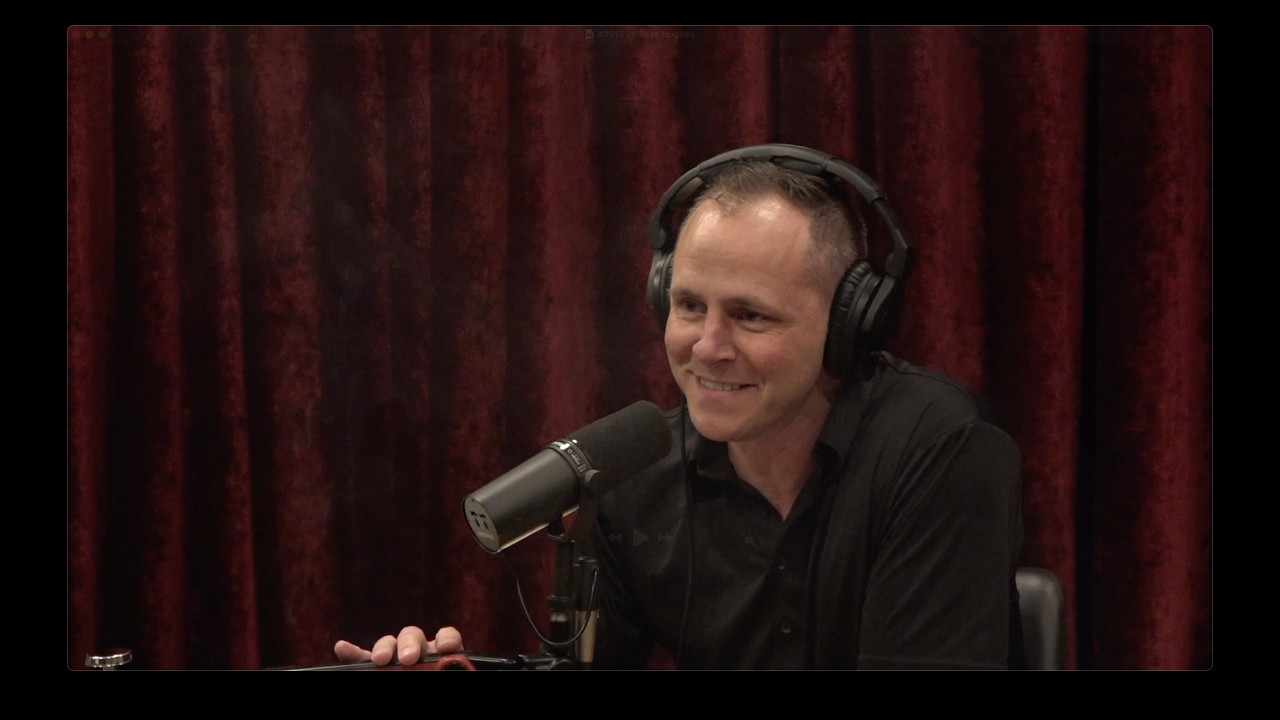

What happens when you spend five and a half hours in a continuous DMT state — not from a pipe or a vape, but from an anesthesia pump calibrated to hold you at peak altitude for the entire duration? That is the question that brought behavioral expert and body language analyst Chase Hughes onto the Joe Rogan Experience, and what followed was one of the more wide-ranging conversations about consciousness, manipulation, medicine, and the nature of reality to emerge from the podcast in recent memory.
The Intravenous DMT Experience
Hughes described a process in which pharmaceutical-grade DMT is loaded into an anesthesia pump — the kind used in operating rooms — allowing the dose to be adjusted in real time. Participants lie in a carefully prepared space with calming music, and crucially, they can request to go higher, come down for a break, or be brought back to full intensity at will.
"The cool thing about this pump is that you can adjust your altitude," Hughes explained. "You could be in the middle of this and say, 'I need to go up more.' If you need a pee break, they'll pull you down, you go, and then you launch right back up as high as you want to go, as fast as you want to go."
Hughes noted that he asked on camera whether he was dead 39 times during the journey — not out of fear, but out of genuine confusion about what constituted reality. Coming back, he said, required consciously reassembling some form of ego just to return to normal consciousness, a process he found profoundly sad.
"It felt like I had to wrap myself in some kind of ego in order to just return back here. And it made me so sad coming back that I just didn't want to come back at all."
He compared the feeling to what therapists began calling Avatar depression after James Cameron's film — the documented phenomenon of viewers becoming clinically depressed upon returning to a reality that felt diminished by comparison. Except, Hughes said, the DMT version was exponentially more intense.
Perhaps most striking was an account involving his wife, Michelle. The night before the session, she was asked by the DMT maker if she wanted to pray over the vial she had chosen. She did so privately, asking that the experience heal Chase's heart condition and a brain disease — mesial temporal sclerosis — that had caused seizures. Without knowing about the prayer, Hughes's first experience inside the DMT space involved entities pinning him down and surgically opening his chest from pelvis to neck, followed by a drill entering through his nose to the back of his skull. When he described this to Michelle afterward, she said: "That's exactly what I asked them to do."
 08:30
Chase Hughes describing the intravenous DMT pump setup and the entities performing surgical procedures during his journey
Watch at 08:30 →
08:30
Chase Hughes describing the intravenous DMT pump setup and the entities performing surgical procedures during his journey
Watch at 08:30 →
Is This Reality a Dream? The Consciousness Argument
Hughes offered a thought experiment to illustrate the philosophical implications of the DMT state. Imagine you are dreaming right now. In that dream, if asked how far away a flying saucer is, you would say eight feet. You would say it is made of aluminum. But there is no aluminum inside your brain. There are no photons bouncing off objects in your dream. Your eyes are fabricated. The eight feet of distance does not actually exist inside your skull — the distance is zero.
"Everything that you would do in waking reality to prove that something is real, you could do identically in a dream," Hughes argued. "The distance between you and that thing is made out of consciousness and doesn't exist."
Rogan pointed to a striking image — a side-by-side comparison of the known universe and human neural tissue — as visual support for this idea.
22:45
Side-by-side image comparing large-scale structure of the universe with human neural tissue, showing near-identical branching patterns
Watch at 22:45 →
The visual correspondence led both men into a discussion of infinite recursion: if the universe resembles a brain cell, what if it is a brain cell — inside a creature that exists in its own infinite universe, which is itself a brain cell, and so on without end? Rogan framed it cleanly: "Real infinity isn't a universe that just keeps going in one direction. It might be that the entire infinite universe is actually part of a cell inside another being in an infinite universe that is itself part of a cell. And it goes on and on and on."
The theory gained additional texture from the observation that every known galaxy contains a supermassive black hole at its center, and that physicists increasingly believe those black holes may be passageways to entirely new universes. The fractal structure implied by this — universes within brains within universes — is not purely speculative. It echoes the work of physicist Roger Penrose, who appeared on the podcast previously and argued that the Big Bang is not the beginning of the universe but one in a never-ending series of cycles.
Psychedelics as Medicine — and as History
Hughes has studied every documented method of changing human behavior and considers therapeutic psychedelics the fastest and most effective approach by a wide margin. His framework: psychedelics perform a massive perspective shift on memory. They snatch your vantage point from ground level and move it somewhere else entirely, revealing a view of your own life you could not otherwise access.
This is what cognitive behavioral therapy attempts over years of sessions. Psychedelics, he argued, can accomplish something similar in a single experience — and the compounds involved are non-addictive and non-toxic.
Ibogaine, derived from the African shrub Tabernanthe iboga, came up as a particularly compelling case. Unlike psilocybin or DMT, ibogaine has zero recreational appeal. The experience involves vomiting, 24 hours of psychological difficulty, and what Hughes described plainly as an ordeal. But the outcomes are striking. Former Texas governor Rick Perry — a Republican who previously opposed marijuana and psychedelics — underwent ibogaine treatment for age-related brain atrophy. A follow-up brain scan showed 25 percent improvement. Six months later, his atrophy was gone entirely. Perry has since declared promoting psychedelic medicine his life's mission.
Hughes also cited a recent case of a woman with advanced dementia — non-verbal, unable to dress or walk — who took five grams of psilocybin mushrooms, slept for 19 hours, and woke up communicating, making eye contact, and moving independently. Subsequent doses produced further improvement.
The conversation turned to history. Hughes connected the intricate geometric ceiling art of ancient mosques to the visual signature of the DMT experience, raising the question of whether psychedelic ritual was embedded in early religious practice and later suppressed.
112:00
Images of ornate geometric ceiling patterns inside Iranian mosques compared with psychedelic visual art by Alex Grey
Watch at 112:00 →
The Sacred Mushroom and the Cross, written by Dead Sea Scrolls scholar John Marco Allegro, was cited as making the case that early Christianity was built around psychedelic mushroom use and fertility cults. The Adam and Eve fresco in France — in which the tree of knowledge is depicted as mushrooms, not an apple — was offered as visual evidence. Hughes noted that the Amanita muscaria, the red mushroom associated with shamanic traditions, has long been confused linguistically with an apple, and that the Christmas tree tradition, Santa Claus, and the reindeer myth all trace back to Siberian shamanic use of this same mushroom.
"It's like what did we forget? How much did we forget? What's been revised?" Rogan asked.
Behavioral Manipulation, SCOPS, and the Architecture of Influence
Hughes trains military and intelligence personnel in behavioral science and has developed what he calls a SCOPS index — a scoring tool, presented as a PDF, that rates any given event or narrative on a scale of one to 100 for the likelihood that it is a coordinated influence operation. The framework looks for pre-ignition signals such as manufactured moral panic, operational indicators like concurrent military drills, regulatory anomalies like late-night bill passage, and media alignment — identical phrasing appearing across unrelated outlets simultaneously.
Hughes noted that the invasion of Iraq, run through the index, scores approximately 98 out of 100.
He argued that the single most reliable signal — even without memorizing the full framework — is the absence of nuance. When a complex issue is presented as a clean binary choice with a pre-packaged villain, you are almost certainly being manipulated. He also described the mechanism by which this manipulation is sustained: it is not primarily about convincing people of false facts. It is about triggering a need for social belonging. Name-calling from authority figures creates a category. Once a category exists, the brain assigns permissions. Disagreement allows for one set of responses. Threat allows for another. War allows for another still.
He introduced the CIA method of elicitation — extracting sensitive information not through questions but through statements. A provocative recap of what someone has said will prompt them to elaborate. A deliberately incorrect statement will trigger an instinct to correct the record. Expressed disbelief will cause someone to over-explain. Rogan noted he already uses all three techniques instinctively when interviewing guests he suspects of pushing a narrative.
The Loneliness Pandemic and the Cost of Performance
Underlying the conversation was a diagnosis of modern social life that Hughes summarized as a pandemic of performed identity. Because social media has scaled the audience for personal failure from 20 people to 20 million, humans have become extraordinarily skilled at concealing shame. The result is a world in which nearly everyone is performing a version of themselves while privately believing they are the only one doing so.
"In the back of your mind, you know you're performing. And because of that, you believe no one has ever actually seen you. So they can't really like you. They can't love you. Because that's not me."
Hughes called this the disease of specialness — the silent belief that everyone else has it figured out and that you alone are concealing something. The loneliness this produces is not fixed by being around more people. It is fixed only by being genuinely seen, which requires the willingness to receive social injury — his phrase for the courage to say something real in public and accept the consequences.
The conversation returned to where it began: DMT, and the observation that the experience removes the ego's claim on identity with a finality that nothing else quite matches. Hughes described it as a control-alt-delete for the brain. When the system reboots, there is one folder. It is labeled my old self. You can choose how much of it to reinstall.
"You're not your ideas," Hughes said. "As soon as you defend them and connect your identity to them, you're in a trap. Most people don't want to admit defeat. They look at it as a battle for their existential existence. Their entire being is tied to their belief system."
Both men agreed that what the dying consistently report — that they regret time spent impressing people who did not care about them, and time not spent with the people who did — is probably the most reliable available guide to how to live. The clarity available at the end of life, Hughes suggested, is the same clarity available during a DMT experience. The difference is that one is reversible.