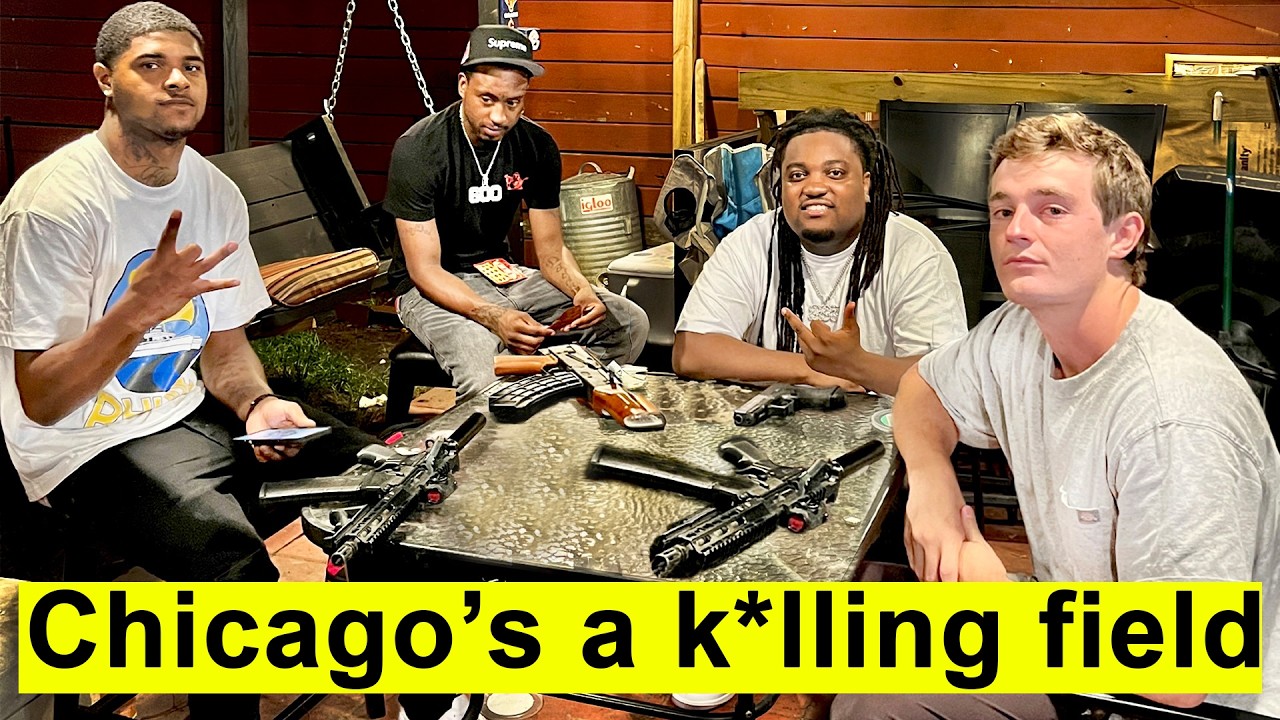

Chicago is so dangerous because of a deeply entrenched cycle of gang violence, generational trauma, and street culture that has persisted for decades — and shows few signs of stopping. For an astonishing 13 consecutive years, Chicago has recorded more homicides than any other city in the United States. In 2024 alone, 573 people were murdered. Among cities with over a million residents, Chicago has held the highest murder rate for seven straight years. To understand why, we headed to the west side of Chicago to talk directly with gang members and local rappers living inside the violence every single day.
Why Is Chicago So Dangerous?
The answer to why Chicago is so dangerous isn't simple — it's a layered mix of poverty, gang infrastructure, retaliation cycles, and a street code that has been passed down through generations. Rapper and west side local Chief Spaz explained it plainly: "It's a lot of trauma. You kill someone close to me, I want to go kill someone close to you. This is a cycle, bro. That ain't going to ever stop."
What makes Chicago uniquely deadly is the sheer density of rival gang factions operating in close geographic proximity. Entire city blocks can be claimed by one crew, and the wrong turn can put you in enemy territory within seconds. As Chief Spaz warned during our ride-through: "Bullets ain't got no name. You can be at the wrong place, wrong time." He was so cautious about being identified that he made us delete any footage that accidentally captured his car's mirror — a small but telling sign of just how high the stakes are on these streets.
How Many People Are Shot in Chicago Every Year?
The numbers are staggering. In 2024, Chicago recorded 573 murders. Since 2010, nearly 10,000 people have died from gun violence in the city. On particularly violent weekends, local news reports of 35 to 43 people shot in a single weekend are not uncommon. The situation has grown serious enough that President Trump threatened to send the National Guard to Chicago, and national media has repeatedly labeled it a "modern-day American battlefield."
Mass shooting weekends have become a grim recurring headline. Multiple shootings, multiple fatalities, and a body count that keeps climbing year after year. Certain neighborhoods have even attempted organized ceasefires — asking gang members to pledge no violence between 9 a.m. and 9 p.m. daily — but the results have been mixed at best.
What Is Gang Violence Really Like in Chicago?
From the outside, it's easy to see Chicago's gang violence as random chaos. From the inside, it operates with its own brutal logic. One young man we spoke with lost his twin brother to gun violence. He described the killing as senseless — done for street credibility. "N****s just be trying to get a name for themselves now. Like, street credibility. That ain't really nothing."
But even knowing the killing was pointless didn't make him want to stop the cycle. When asked if his brother's death made him want gun violence to end, his answer was blunt: "Hell no." The pain of loss doesn't create peace — it creates more retaliation. As another gang member put it: "It doesn't discourage anybody from gun violence. It just encourages more."
The gas station we visited on the west side — what locals call the "C Station" — illustrated this perfectly. Multiple people had been shot and killed at that single location. Chief Spaz recounted losing two close friends there. Yet it remains a daily gathering spot because, as he said, "This our gas station. This where we come." The private security guard on site acknowledged that armed customers come in regularly but described them as "respectful" — a surreal normalization of an armed daily reality.
What Gangs Control Chicago's West Side?
On the west side of Chicago, one of the dominant factions operating in the area is the Conservative Vice Lords (CVL) — a branch of the larger Vice Lords gang that has roots going back decades in Chicago. Chief Spaz referenced them during our night ride through the neighborhood. Beyond the CVL, the west side is carved up by numerous smaller crews and cliques, many of which have beef with one another that stretches back years — sometimes generations.
The gang landscape in Chicago is not as simple as two or three big organizations. It's fragmented into dozens of hyper-local sets, which is part of what makes the violence so unpredictable. Beef isn't just south side vs. west side — it's block by block, crew by crew, and it shifts constantly. "It's a whole bunch of clicking up out here," Chief Spaz explained. "You got from up out south, over east, clicking over from out west — all types."
Why Do Chicago Gang Members Walk Around Armed?
The short answer: because everyone else is. When you live in a neighborhood where drive-bys happen in broad daylight at gas stations, where you can be targeted simply for where you stand, carrying a weapon feels less like a choice and more like a survival requirement. One teenager we spoke with — who had already been confronted by four armed men in a single day — carried a gun not out of aggression, but out of fear. "I got up on by four pipes in one day. One of them shot but didn't hit me."
During our roundtable, three guns were laid out on the table — a Draco, a .357, and a large handgun with an extended magazine. For the men sitting around that table, this was not a show. It was Tuesday. When asked if they'd drop the guns if they could, the answer was honest: "Hell yeah. I ain't enjoy this lifestyle." But in the environment they're in, being unarmed isn't seen as peaceful — it's seen as suicidal.
Chief Spaz said it most clearly: "Unless you get rich and you move up out this, you gotta keep your guards up at all times."
Can the Cycle of Gang Violence in Chicago Be Broken?
This is the hardest question — and the men living inside this reality are the most honest about the answer. The cycle of violence in Chicago is self-reinforcing: someone dies, someone retaliates, someone else retaliates again. Ceasefire agreements crack under the weight of personal grief. Even the most well-intentioned person stopping the violence can't stop someone else from targeting them.
"You want to stop — that don't mean another n***a want to. So you got to keep your guard up at all times," Chief Spaz said. The only escape route most of these men see is financial — get enough money to physically leave the neighborhood. One young man told us he was already looking at moving back to Minnesota. Others talked about it on social media without ever following through.
The tragedy is that most of these men don't want this life. They want it to stop. But the environment they were born into — the poverty, the trauma, the gang infrastructure laid down by older generations — pulled them in before they were old enough to resist it. As one gang member reflected: "Being so young around all this… we basically just grew into it."
What Is It Like Growing Up in Chicago's Hood?
Chief Spaz described the on-ramp to street life simply: "When you jump off that porch, you sign up for the streets." Kids as young as 11 are getting their first guns. By 14, many are already carrying. Fighting gives way to shooting as the primary form of conflict resolution — because, as one man explained, if you beat someone up and embarrass them on social media, they'll come back with a gun. The calculation becomes: why fight when the other person will just shoot you anyway?
School, for many, doesn't survive the chaos. One teenager had been kicked out of high school. His home life was described as constant arguments and chaos. When asked what his plan was, he said: "Once I get my back in order, I'm just going to move out. I'm done." It was a hopeful answer wrapped in the uncertainty of someone who has no clear path to making it happen.
Chicago's violence is not random. It is the logical — if devastating — output of decades of concentrated poverty, systemic neglect, and a street culture that has become the only structure many young people have ever known. Until something breaks that structure at its root, the cycle continues.