
The biggest money managers in the world — Warren Buffett, Bill Ackman, Seth Klarman, and others — just revealed what they've been buying and selling, and this quarter's moves are genuinely fascinating. Every three months, investment managers with over $100 million in assets under management are required to file a 13F filing with the SEC. These filings show the world exactly what they hold. For smaller investors trying to get a peek behind the curtain, they're absolute gold. This round had more drama than usual — a tripled Google position, a brand new Microsoft bet, a panic-driven Amazon buy, and one of the largest single-quarter portfolio cleanouts Berkshire Hathaway has ever seen.
What Is a 13F Filing and Why Should You Care?
A 13F is a quarterly disclosure required by the SEC for any institutional investment manager with over $100 million in assets under management. They must report all their long equity positions within 45 days of the end of each quarter. It sounds dry, but it's one of the most powerful transparency tools available to everyday investors. You get to see, with a slight delay, exactly what some of the most successful value investors in the world were buying when prices were lower. Think of it as a cheat sheet — imperfect, slightly outdated, but deeply useful when you know how to read it.
 01:45
Overview of the major 13F filing moves this quarter — Google, Microsoft, Amazon, and the Berkshire sell-off
Watch at 01:45 →
01:45
Overview of the major 13F filing moves this quarter — Google, Microsoft, Amazon, and the Berkshire sell-off
Watch at 01:45 →
What Are the Biggest Investors Buying Right Now?
This quarter's 13F filings revealed several high-conviction moves across some of the world's most respected portfolios. The headline buys include:
- Berkshire Hathaway tripling its position in Google (Alphabet) and adding $2.6 billion in Delta Airlines
- Pershing Square (Bill Ackman) opening a brand new $2 billion position in Microsoft and adding 20% to Amazon
- Baupost Group (Seth Klarman) increasing Amazon by 47%, making it his single largest holding
On the sell side, Berkshire sold out of 16 positions entirely in a single quarter — something that appears to be without precedent in recent Berkshire history. Bill Ackman also sold nearly his entire Google position. Let's break down each of these moves one by one.
Why Did Berkshire Hathaway Triple Its Google Position?
Arguably the biggest headline from this round of filings is that Berkshire Hathaway tripled their position in Alphabet (Google), adding roughly $1 billion in C-shares. The A-shares alone are now worth $15.6 billion, slotting in as Berkshire's seventh largest holding. So why is Berkshire buying Google now?
04:10
Simply Wall Street data showing Google's revenue, earnings growth, and valuation metrics
Watch at 04:10 →
The honest answer is probably simpler than most people think: Google is a wonderful company at a reasonable price. Revenue and earnings have grown exceptionally well over time with no real sign of slowing. The balance sheet is a fortress — far more cash on hand than total debt. Free cash flow is strong. The only genuine risk worth discussing is the threat that large language models pose to Google's core search business. But Google is also deeply in the AI race with Gemini, and they are better capitalised than most of their competitors, including OpenAI.
Is it cheap? Not exactly. At a price-to-earnings ratio of around 30 and estimated to be roughly 17% overvalued based on discounted cash flow analysis, Google isn't a screaming bargain. But for the quality of business it is — the moat, the growth, the balance sheet — paying a fair price is entirely consistent with how Berkshire has operated for decades. As Warren Buffett himself once said, it's far better to buy a wonderful company at a fair price than a fair company at a wonderful price.
Is Greg Abel Already Reshaping Berkshire's Portfolio?
One subtle but important question this filing raises is whether Warren Buffett was actually behind the Google purchase — or whether this was Greg Abel, the newly appointed CEO of Berkshire Hathaway. Buffett has always been candid that many large-cap tech companies fall outside his circle of competence. He's also made clear that while he remains involved in major investment decisions, final authority now rests with Abel.
The Google buy could easily be an Abel-led call. And that leads into the other big Berkshire story this quarter.
09:30
Microsoft's free cash flow chart showing the dip caused by AI infrastructure spending
Watch at 09:30 →
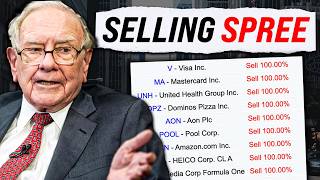
Why Did Berkshire Sell 16 Positions in a Single Quarter?
In a single quarter, Berkshire sold out of 16 positions entirely. That is extraordinary. It doesn't appear to be a panic move or a defensive repositioning — the individual sells were mostly small and didn't dramatically shift the overall portfolio. The largest impact was Visa, which only represented about a 1% change to the overall portfolio.
The more likely explanation involves two factors working together. First, this was Greg Abel's first full quarter as CEO — a natural time to do some spring cleaning and trim positions that don't fit his long-term vision. Second, many of the stocks sold were associated with Todd Combs, one of the three portfolio managers at Berkshire until he departed to join JP Morgan. Names like Visa, Mastercard, Domino's, and Amazon appear to have been part of his book — and with Combs gone, those positions have been wound down.
None of this is confirmed. But it's the most logical interpretation of what we're seeing.
13:15
Amazon's one-year stock chart showing the sharp 18% drop in early February 2025
Watch at 13:15 →
Why Did Bill Ackman Open a $2 Billion Microsoft Position?
Pershing Square, Bill Ackman's fund, opened a brand new $2 billion position in Microsoft this quarter, making it the fourth largest holding in their US portfolio. Why Microsoft, and why now?
Microsoft dropped as much as 25% in Q1 as investors grew increasingly nervous about the company's enormous AI infrastructure spend. Building data centres, buying GPUs, expanding power infrastructure — it all costs money, and the free cash flow figures started looking ugly. Many investors hit the sell button.
Ackman sees it differently. Having listened to him speak publicly, he doesn't view the AI capex spending as a problem. He sees it as optionality — a bet on future returns from infrastructure that most competitors simply can't afford to build. And at a price-to-earnings ratio of around 25, Microsoft is actually cheaper than many of its Magnificent Seven peers which trade at PE ratios in the 30s, 40s, and 50s. Discounted cash flow analysis suggests the stock may be around 27% undervalued. For a value investor who isn't spooked by the spending cycle, that's a compelling entry point.
Why Did Amazon Drop 18% and Why Did Smart Investors Buy?
On February 5th, Amazon released their Q4 earnings and announced they expected to spend approximately $200 billion in capital expenditures in 2026, primarily on AI infrastructure, AWS expansion, chips, data centres, and networking. Within days, the stock had fallen roughly 18%. In other words, the market decided Amazon was suddenly worth nearly a fifth less than it had been the week before.
Both Seth Klarman and Bill Ackman viewed that as an overreaction — and moved accordingly. Klarman increased his Amazon position by 47%, making it his single largest holding at 12.7% of Baupost's US portfolio. Ackman added 20% to his Amazon position.
Their reasoning is straightforward. A voluntary increase in capital expenditure is not a death sentence. Amazon's revenue and earnings are still trending upward. Analysts continue to forecast growth. And crucially, if the spending becomes unjustified, it can simply be paused. There is nothing structurally broken about the business. The drop was emotional, not fundamental — and that is exactly the kind of opportunity value investors are always scanning for.
Sure enough, when Amazon released Q1 earnings, AWS growth came in stronger than expected. The company confirmed it was supply constrained, not demand constrained. The stock bounced back sharply. Klarman and Ackman both timed it close to perfection.
Other Notable Moves From This Round of 13F Filings
A few other items worth flagging from this quarter:
- Li Lu (Himalaya Capital), who managed money for Charlie Munger, sold 71% of his Bank of America position — notable, though the reasoning isn't publicly available.
- Mohnish Pabrai sold out of Arris and reduced his Trans Ocean position by 25%. He continues to hold his bet on metallurgical coal.
- Bill Ackman finally closed his Hilton position, which he had held since 2018.
- Howard Marks opened a new position in Pinduoduo — but at $493,000 out of a $4 billion portfolio, it's probably not worth reading too much into.
The big picture takeaway from this round of 13F filings is that the best value investors in the world are selectively finding opportunity even in a market trading near all-time highs. They aren't buying everything — they're buying specific, high-quality businesses at moments when fear has temporarily pushed prices to more attractive levels. That discipline is the whole game.