
What Happened to the US-Iran Ceasefire?
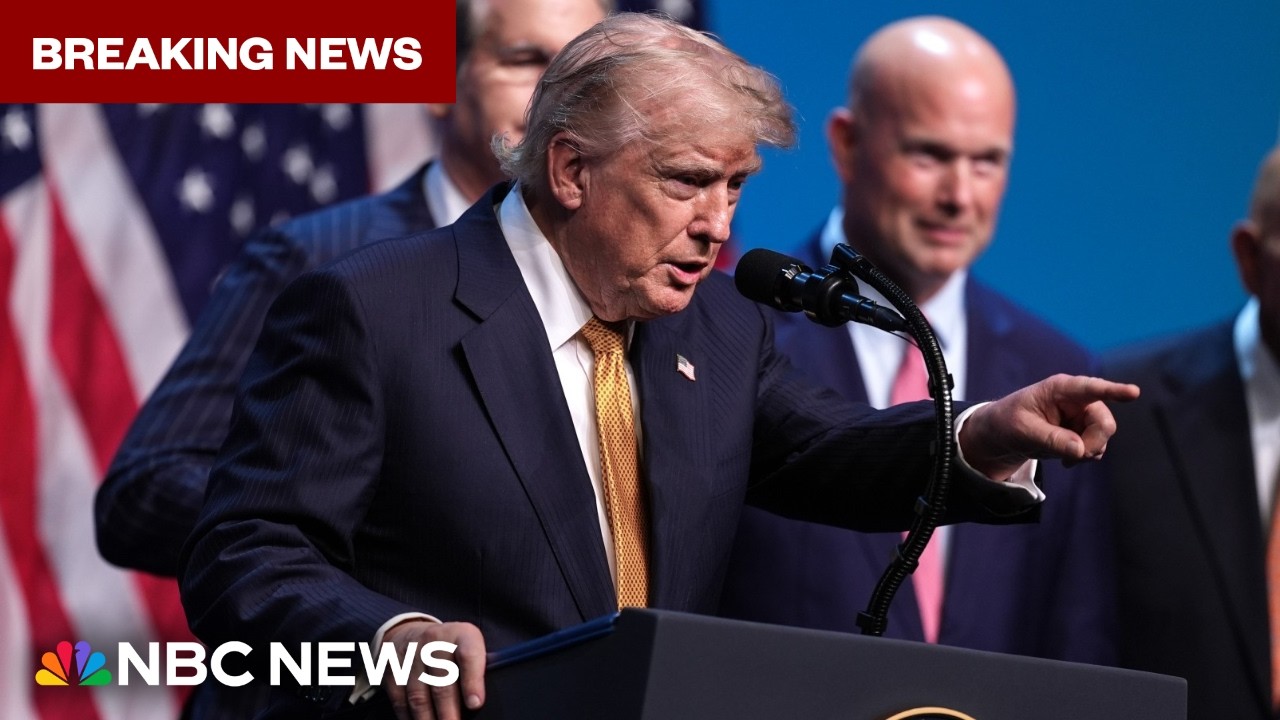
The US-Iran ceasefire, formalized roughly three weeks ago through a memorandum of understanding, has effectively collapsed. President Trump authorized new military strikes against Iran while attending the NATO summit in Ankara, Turkey — signaling that the fragile diplomatic window has, at least for now, closed. US Central Command confirmed the strikes in an official statement, saying forces had begun "conducting additional strikes against Iran to further degrade their ability to threaten freedom of navigation in the Strait of Hormuz."
The breakdown came swiftly and with striking rhetorical whiplash from the President himself. Just weeks ago, Trump described Iranian negotiators as "smart people" and "fair to deal with." On the day the new strikes were announced, he called those same negotiators "scumbags" — unstable and crazy people who couldn't be trusted. The shift in tone underscored just how quickly the diplomatic situation deteriorated.
 02:15
Monica Alba reporting from Ankara on the President's sharp rhetorical shift toward Iranian negotiators
Watch at 02:15 →
02:15
Monica Alba reporting from Ankara on the President's sharp rhetorical shift toward Iranian negotiators
Watch at 02:15 →
NBC News White House Correspondent Monica Alba, traveling with the President in Turkey, noted significant mixed messaging from the administration. Trump said this won't return to a full-scale military operation — but in nearly the same breath, he said it may have to if diplomatic negotiations don't produce results. Meanwhile, his negotiating team of Steve Witkoff and Jared Kushner has had meetings paused due to funeral services in Tehran following the death of the Ayatollah.
How Did the Iran Conflict Spike Oil Prices?
Oil markets reacted immediately. Brent crude, which had been trading roughly $10 lower just days earlier, surged toward the $80-per-barrel mark as news of the ceasefire collapse broke. NBC News Business Correspondent Brian Cheung put the impact in plain terms: for every $10 increase in the price of a barrel of oil, Americans pay approximately $0.25 more per gallon at the pump.
With the national average already sitting around $3.80 per gallon according to AAA, that math points to prices potentially crossing the $4-per-gallon threshold — if conditions hold or worsen. Trump pushed back on this concern at his press conference, insisting that oil prices are "dropping like a rock" and pointing to what he called an existing oil glut following the clearing of tankers from the Strait of Hormuz. Analysts, however, were quick to note that market reality looks considerably different from that characterization.
08:40
Brian Cheung breaks down how oil price increases translate directly to gas prices for American consumers
Watch at 08:40 →
The key variable going forward is whether new escalations disrupt shipping through the Strait of Hormuz — including the potential reintroduction of a blockade or the use of mines in the waterway. Either development would send oil prices significantly higher.
Why Is the Strait of Hormuz the New Flashpoint?
Perhaps the most significant strategic development in this conflict isn't Iran's nuclear program — it's the Strait of Hormuz. NBC News Senior National Security Correspondent Courtney Kube made a striking observation: Trump's stated objectives for this conflict have narrowed considerably since the very first night, when he outlined five strategic goals in a social media video. At his NATO press conference, the President reduced it to one — ensuring Iran doesn't acquire a nuclear weapon.
But the real action is happening at sea. Iran has been conducting strikes against commercial shipping in and around the Strait of Hormuz for months. The US military has been responding — but last night's response was qualitatively different. Rather than a proportional counterstrike, the US hit more than 80 targets along Iran's coastal areas, in response to Iran attacking three commercial ships and then launching retaliatory strikes against Bahrain and Kuwait.
Kube described the Strait of Hormuz as effectively becoming "the new nuclear weapon" — a means of coercion that may be even more dangerous in practice than Iran's ballistic missile program or its nuclear ambitions. Control of that waterway means control over a massive percentage of the world's oil supply.
14:22
Courtney Kube reads the live CENTCOM statement confirming new strikes against Iran as the panel discussion continues
Watch at 14:22 →
What Is Kharg Island and Why Does Trump Want It?
In a moment that raised eyebrows across the national security community, President Trump mentioned the possibility of taking Kharg Island — almost offhandedly, as if it were a simple logistical maneuver. It is not. Kharg Island is the location where Iran stores and exports the vast majority of its oil. Controlling it would effectively cut off Iran's primary revenue source.
But the military reality of such an operation is daunting. Taking the island would require a significant assault against existing Iranian military infrastructure. Holding it would be exponentially harder. Iran retains the ability to fire coastal missiles directly at the island, deploy drones, and use fast attack boats — the US military destroyed roughly 60 Iranian fast boats in last night's strikes, but Iran's remaining capabilities are still considerable.
Elise Labott, host of the CosmoPolitics podcast, was direct: President Trump is unlikely to commit the ground troops that a sustained Kharg Island operation would require. The more likely outcome, she argued, is a prolonged cycle of strikes and pauses — with a negotiated deal eventually emerging that won't fully satisfy Iran hawks, but may be the only realistic exit ramp available.
How Did Markets React to the New Iran Strikes?
Wall Street's reaction was notable but not catastrophic — at least on day one. The Dow Jones Industrial Average fell as much as 1% during the session, and at one point appeared headed for a 2% down day before recovering somewhat. The S&P 500 closed down just 0.25%. Interestingly, the Nasdaq Composite — buoyed by tech and AI stocks — actually ended the day up 0.2%.
Brian Cheung framed the market's mood accurately: traders aren't panicking, but they are pricing in volatility. The collapse of the ceasefire introduces real uncertainty around energy supply chains, and any escalation involving the Strait of Hormuz — mines, a renewed blockade, or sustained attacks on tankers — would likely trigger a much sharper market reaction.
What Did Trump Say About Iran at the NATO Summit?
The NATO summit in Ankara provided an unusual backdrop for what became a significant military escalation announcement. Trump's press conference touched on several themes simultaneously: the collapse of the ceasefire, the prospect of further strikes, and the ongoing question of what a final deal with Iran might look like.
On NATO itself, Trump struck a surprisingly positive tone — describing the summit as having "a lot of love in the room." NATO Secretary General Mark Rutte has worked carefully to give Trump credit for pushing European allies toward greater defense self-sufficiency, and that framing appeared to land well. A notable development on Ukraine: NATO announced it would allow Ukraine to produce Patriot missiles domestically — a significant shift that Labott described as emblematic of how the war is transforming Ukraine from a candidate for NATO membership into a source of military innovation for the alliance.
Why Did Trump Fly Home on the Old Air Force One?
In a lighter but genuinely puzzling subplot, President Trump departed Turkey on the older Air Force One backup aircraft rather than the newly retrofitted $400 million luxury jet donated by Qatar — the plane that generated significant controversy when the gift was first announced and which Trump had just taken on his first overseas trip.
The White House explanation: the new plane flew ahead to a UK air base so that service members stationed there could tour it as a perk. The older plane, which travels as a backup support aircraft on all presidential trips, was used instead. Trump was asked directly about potential security concerns with the arrangement and did not answer them directly. It's a detail that may seem minor — but in the context of a presidency where Air Force One has become something of a political symbol, it was enough to draw questions.