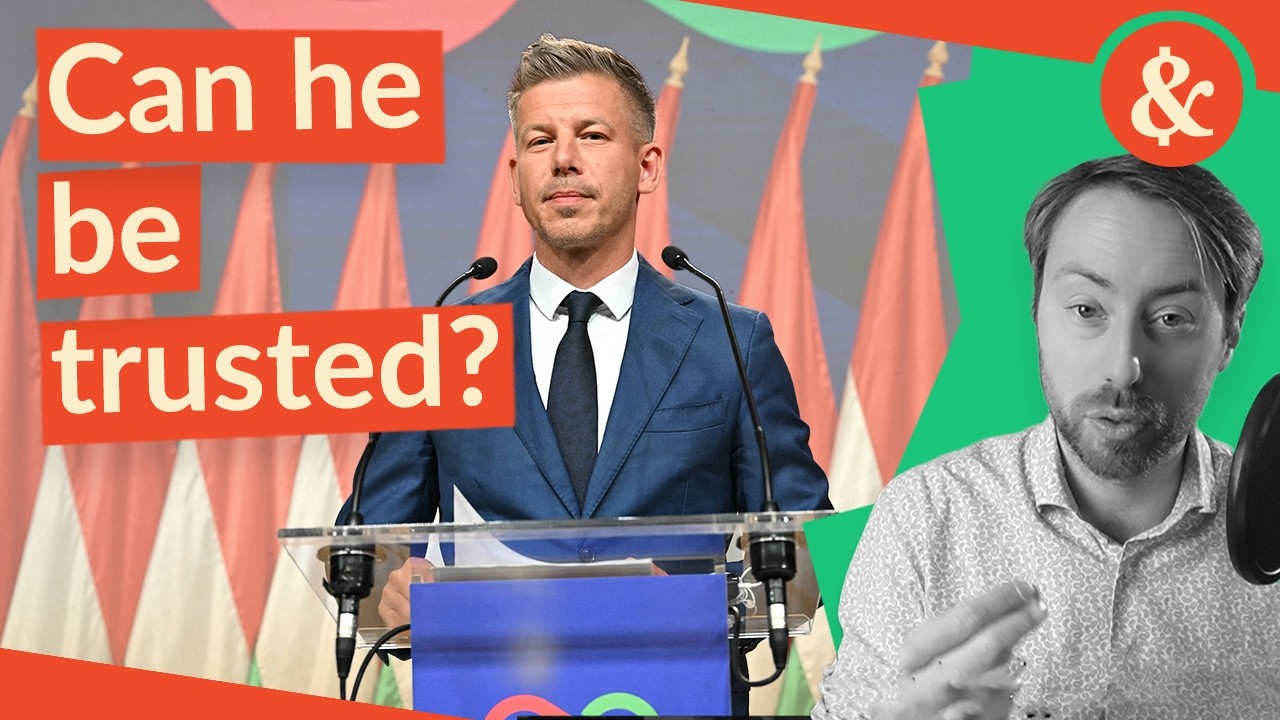

What Happens to Hungary Now That Orbán Lost?
Viktor Orbán — far-right icon, EU thorn, and self-styled defender of illiberal democracy — just lost big in Hungary. His challenger, the conservative Péter Magyar, won a stunning supermajority with his Tisza party, turning 53% of the vote into the two-thirds parliamentary majority needed to begin rewriting the rules Orbán spent 16 years putting in place. But here's the uncomfortable truth: winning the election is the easy part. What happens to Hungary after Orbán lost is a far more complicated story — one involving a deeply embedded deep state, a struggling economy, and serious questions about what Magyar actually stands for.
This is not a fairy-tale ending. It's the beginning of a long, difficult process. And whether Hungary emerges as a restored liberal democracy or simply swaps one strongman for another depends on factors that go well beyond the ballot box.
 00:45
How Orbán's electoral system was designed to entrench Fidesz power — and how it backfired spectacularly
Watch at 00:45 →
00:45
How Orbán's electoral system was designed to entrench Fidesz power — and how it backfired spectacularly
Watch at 00:45 →
Why Did Viktor Orbán Lose the Election?
Most political analysts point to two core reasons Orbán lost, and both come down to a simple formula: when corruption is acceptable to voters, the economy has to be growing. When the economy stalls, voters stop looking the other way.
Hungary's Economy Fell Behind Its Neighbors
Orbán did bring unemployment down sharply after winning in 2010, and that initial economic boost bought him enormous goodwill. But over time, Hungarian wages fell badly behind comparable Eastern European countries — most notably Poland. Then came the compounding blows: a massive COVID-era spending spree, surging energy prices triggered by the Ukraine war, and a sharp depreciation of the Hungarian Forint. The result was the worst inflation crisis in all of Europe under Orbán's watch. People weren't just unhappy — they were getting poorer in real terms, and they knew it.
The Corruption Became Too Obvious to Ignore
Orbán's second problem was that the scale of corruption under his rule became impossible to paper over. His childhood friend Lőrinc Mészáros — who conveniently became Hungary's richest man after Orbán took power — won up to 25% of all state contracts during Orbán's tenure. That kind of brazen cronyism is tolerable when living standards are rising. When inflation is eating your salary and your neighbor is leaving for Germany, it becomes politically toxic. Voters who once accepted the system turned on it — and despite Orbán controlling virtually all of Hungary's traditional media and having redrawn voting districts in his favor, the backlash was too large to overcome.
03:10
The five layers of Orbán's institutional deep state that Magyar now has to dismantle
Watch at 03:10 →
What Is Orbán's Deep State and Can Magyar Dismantle It?
Here's where things get genuinely complicated. Orbán didn't just win elections — he used his supermajority to systematically rewire Hungary's institutions so that losing an election wouldn't mean losing power. He built what analysts describe as a multi-layered deep state, and Magyar now inherits all of it.
- The Constitutional Court: Stacked with 15 Fidesz loyalists. The president — also a Fidesz ally — can refer any new legislation to this court, effectively giving Orbán's allies a veto over reform.
- The Fiscal Council: Can reject any new government budget at any time, potentially strangling Magyar's economic agenda before it starts.
- The Prosecutor General: Has the power to selectively prosecute Tisza officials while protecting Fidesz-linked oligarchs from accountability.
- The Media Authority: Ensures that Hungary's broadcast and print media landscape remains ideologically loyal to Orbán's movement.
- Privatized Trusts and Foundations: Orbán transferred major state assets into nominally independent institutions — the Foundation for Hungarian Culture, multiple university trusts, and the state oil giant MOL's New Europe Foundation — all controlled by Fidesz loyalists and largely insulated from government interference.
Magyar's supermajority gives him the legal tools to rewrite many of the laws underpinning these structures. But replacing laws is fast — changing how entrenched networks of people actually behave is painfully slow. These institutions are filled with individuals whose careers, incomes, and loyalties are bound up in the Fidesz system. That doesn't change overnight because a new law says so. This is a turning point, not a resolution.
How Bad Is Hungary's Economy Right Now?
Even if Magyar successfully dismantles Orbán's institutional defenses, he inherits an economy in serious trouble. Hungary remains one of the European Union's poorest member states. Orbán spent approximately 5% of GDP on natalist policies designed to boost fertility rates — a program that showed early promise before fertility collapsed back to all-time lows, well below replacement level. Combined with Orbán's extremely strict anti-immigration stance, Hungary's population is shrinking while neighboring countries grow.
05:30
Hungary's economic indicators compared to EU neighbors — wages, inflation, and deficit levels
Watch at 05:30 →
That demographic decline compounds an already weak fiscal position. Hungary's government deficit is among the worst in the EU. Borrowing costs and inflation remain some of the highest on the continent. And a brain drain — educated Hungarians leaving for higher wages elsewhere in Europe — has been quietly hollowing out the workforce for years.
There is one significant bright spot: Magyar's commitment to restoring the rule of law would gradually unlock approximately €22 billion in EU funding that was frozen due to concerns about democratic backsliding under Orbán. Markets noticed immediately — the Hungarian Forint rallied on the news of Magyar's victory. That capital injection won't solve Hungary's structural problems, but it gives Magyar breathing room that Orbán's increasingly isolated government never had.
Will Hungary Rejoin the EU Mainstream Under Magyar?
For EU liberals, Magyar's win is genuinely exciting. Orbán had made a habit of blocking EU consensus — most visibly on support for Ukraine — while aligning himself with figures like Donald Trump and Vladimir Putin, both of whom reportedly wanted Orbán to win this election. Magyar has signaled clearly that he intends to break with that foreign policy posture.
EU leaders are hoping for more than just a policy shift on Ukraine, though. They want Hungary to be not merely a democracy — which it technically was, given that Orbán lost — but a fair democracy, one with independent media, independent judges, and a level playing field for political competition. That's the distinction between a free democracy and a liberal democracy, and it's the standard Hungary hasn't met for over a decade.
Whether Magyar can actually deliver that — or whether EU enthusiasm is running ahead of what's realistically achievable — remains an open question.
Could Magyar Become the Next Orbán or Erdoğan?
This is the question that should make everyone pause before celebrating too loudly. History offers uncomfortable precedents. Viktor Orbán himself started out as a liberal. Recep Tayyip Erdoğan in Turkey began as a pro-EU democracy reformer. Vladimir Putin was greeted with cautious optimism by Western European governments in his early years. All three became authoritarian in their own ways.
Péter Magyar is a staunch conservative who began his political career as an Orbán ally. He turned against Orbán's movement, yes — but turning against one leader is not the same as being committed to the institutional principles of liberal democracy. He now holds a supermajority, which is exactly the same position Orbán held when he began dismantling Hungary's checks and balances in 2010.
Will Magyar use that power to restore independent institutions — or gradually absorb them under his own influence? Will he purge the Fidesz deep state or simply replace it with a Tisza deep state? These aren't paranoid hypotheticals. They're the natural questions that follow any dramatic transfer of power in a system that has been seriously compromised.
The Bottom Line: A Turning Point, Not a Transformation
Hungary's election result matters enormously. Péter Magyar won the supermajority he needs. The legal tools to dismantle Orbán's carefully constructed power structures are now in his hands. EU funding can flow again. Hungary can stop blocking collective European action. These are real, meaningful changes.
But Orbán's oligarch network still controls major Hungarian banks and telecoms. The deep state institutions are populated by 16 years' worth of loyal personnel. The economy is in poor shape with a shrinking population and a weak fiscal position. And Magyar himself is an unknown quantity when it comes to whether he truly believes in liberal democratic norms or simply wants to win.
Hungary is at a genuine crossroads. The path toward becoming a free and fair democracy is open for the first time in over a decade. Whether Magyar takes it — and whether he has the will, the skill, and the integrity to see it through — is the question that will define Hungary's next chapter.