The ceasefire announcements and falling oil prices have given many people the impression that the economic danger has passed. It hasn't. The financial shockwave from the Iran conflict and the Strait of Hormuz closure is still working its way through the global economy, and for most households, the worst effects haven't arrived yet. Here is a clear-eyed breakdown of the six impacts that matter most for your money over the next six to twelve months.
What Actually Happened
On February 28th, the US and Israel launched coordinated strikes on Iran — nearly 900 strikes in twelve hours targeting military sites, nuclear facilities, and senior leadership. Iran responded with missiles and drones aimed at Israel, US bases, and allied positions across the Middle East. The move that rattled global markets came on March 2nd: Iran closed the Strait of Hormuz.
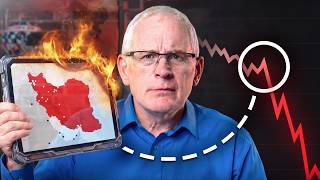
The Strait of Hormuz is the single chokepoint through which approximately 20% of the world's oil passes every day. With no viable alternative route, the closure sent oil prices from around $61 a barrel at the start of the year to over $118 by the end of March — nearly doubling in three months, the largest rise in close to forty years.
 03:10
Oil price chart showing spike from $61 to $118 per barrel between January and March
Watch at 03:10 →
03:10
Oil price chart showing spike from $61 to $118 per barrel between January and March
Watch at 03:10 →
A two-week ceasefire was subsequently announced, prices pulled back, and markets rallied. But the situation remains genuinely unclear. Both sides have declared the strait open, yet they cannot agree on what "open" means, who controls it, or for how long. The US Navy is still warning vessels to avoid the waterway entirely due to an unresolved sea mine threat. The damage, in other words, is already done — and these are the six ways it will reach you.
Impact 1: Rising Prices Across Everything You Buy
The most common misconception right now is that calming military tensions means prices will also calm down. They won't — at least not quickly. Think of it like food poisoning: the moment you stop eating the bad food doesn't mean you immediately feel better. The damage is already in the system and takes time to work through.
Oil is not just a fuel. It is an input cost embedded in virtually everything you buy. Every item in a supermarket was grown, processed, packaged, and transported using energy derived from oil. When oil doubles in price, every one of those steps becomes more expensive, and that cost eventually lands on your receipt.
Energy prices have already risen double digits this year, and given that price shocks typically take three to six months to fully transmit through supply chains, the peak impact on household bills is likely still ahead. The practical implication: avoid making large financial commitments — new leases, significant debt, major purchases — based on the assumption that your monthly costs are about to fall. Build in extra breathing room instead.
Impact 2: Job Market Vulnerability
When energy prices spike, businesses are squeezed from two directions simultaneously. Their operating costs rise — transport, manufacturing, electricity — while their customers spend less because household bills have gone up. The typical corporate response follows a predictable sequence: first, overtime is cut and hiring is frozen; then, as the pressure mounts, layoffs follow.
This would be concerning in any environment, but the oil shock is landing on a job market that was already showing strain. The hiring rate before the conflict began was running at levels last seen during the 2008–2009 financial crisis. An energy shock layered on top of an already weakening labor market historically accelerates the deterioration.
The protective steps worth taking now are straightforward: treat your income as less certain than it feels, focus on making yourself genuinely difficult to replace within your organization, and develop an income stream that is not dependent on a single employer.
Impact 3: Government Has Fewer Tools Than in Previous Crises
If you lived through 2008 or the pandemic, you likely remember waiting for governments to act — and eventually they did. Interest rates were cut, money was printed, stimulus was distributed, and things stabilized. That safety net held. The concern this time is that the same tools are far less available.
The standard crisis response — cutting interest rates — pumps money into the economy and stimulates borrowing and spending. But it also pushes prices higher. With oil having just posted its biggest spike in four decades, inflation is already rising. Cutting rates into rising inflation is counterproductive.
The alternative — printing money — runs into a different wall. The US is currently carrying $39 trillion in national debt. Interest payments alone now consume roughly $1 trillion per year — approximately 19 cents of every tax dollar collected. For every dollar raised in taxes, nearly a fifth goes straight to servicing existing debt before a single public service is funded.
14:20
Graphic showing US national debt at $39 trillion and $88 billion monthly interest payments
Watch at 14:20 →
The practical takeaway is not that governments will do nothing, but that the standard playbook has changed significantly. Waiting for a rescue that looks the same as 2008 is probably the wrong strategy.
Impact 4: The Stagflation Risk
When you combine rising prices, a weakening job market, and a government with constrained policy options, economists have a name for what follows: stagflation. It is one of the most difficult economic environments to navigate because the tools that address one problem directly worsen the other. Raising rates to fight inflation makes the recession deeper. Cutting rates to fight the recession makes inflation worse.
The last serious stagflation episode was the 1970s, and it lasted an entire decade — ten years of high prices, weak growth, and declining living standards for ordinary households.
Current data is moving in that direction. US inflation jumped to 3.3%, up from 2.4% the previous month, while Goldman Sachs has trimmed GDP growth forecasts. Separately, Moody's AI recession-prediction model — which has been tested against eighty years of economic data and has preceded every recession without exception when crossing the 50% threshold — was sitting at 49% before the Iran conflict began.
The asset allocation implication is meaningful. During stagflation, cash erodes in real terms because inflation is eating it, but high-growth equities can also fall as the economy contracts. The households that fared best in the 1970s tended to hold real assets — things with intrinsic value that people need regardless of economic conditions. If your savings are concentrated entirely in cash or growth stocks, this is a reasonable moment to review diversification.
Impact 5: Dollar Weakness and What It Means for Your Savings
The US dollar functions as the world's reserve currency — the common language of global trade and the default store of value for governments worldwide. That status is now under quiet but meaningful pressure.
The US currently faces three options, and none of them are good for the dollar. Raising interest rates aggressively would curb inflation but likely crash markets and deepen any recession. Printing money would keep the economy moving but risk pushing inflation into double digits. Stepping back from the Iran situation entirely raises a question other countries are already beginning to ask: if the US cannot reopen a critical global shipping lane, is American power — and by extension the dollar's primacy — what it once was?
The behavioral data from large institutional players is telling. Foreign central bank holdings of US Treasuries have fallen to their lowest level since 2012. Meanwhile, gold now represents 24% of global central bank reserves, compared to 21% for US Treasuries — a near-complete reversal from 2015, when Treasuries stood at 33% and gold at just 9%.
22:45
Chart comparing central bank reserve allocations between gold and US Treasuries in 2015 versus today
Watch at 22:45 →
A weaker dollar does not just affect Americans. Because so much global trade is dollar-denominated, dollar depreciation reduces purchasing power everywhere. It is worth asking whether your savings and investments are too concentrated in a single currency or a single asset class.
Impact 6: The Unequal Distribution of the Damage
Economic shocks do not land evenly. For higher-income households, rising energy and food prices are an inconvenience. For lower-income households, they are a fundamental disruption to daily life.
The numbers are stark: low-income households spend approximately 33% of their income on food alone, compared to around 13% for middle-income households. When oil doubles and food prices follow, a higher earner notices the change at the checkout. A lower earner is deciding whether they can afford to drive to work.
Government interventions — subsidies, price caps — tend to be well-intentioned but structurally leaky. During the Ukraine energy crisis, the world's ninety-five largest food and energy corporations made $306 billion in windfall profits in a single year, with 84% going directly to shareholders. The mechanism is straightforward: governments cap what consumers pay, energy companies continue charging governments full price, and the subsidy flows to the companies rather than the households it was designed to protect.
The pattern is consistent across crises. During the recovery from the 2008 financial collapse, the top 1% of US earners captured 95% of all income gains. The conclusion is uncomfortable but worth confronting directly: institutional support for ordinary households in a crisis is structurally limited. The people who come through these periods strongest are those who have built their own financial resilience — diversified income, reduced fixed costs, and assets that hold value when inflation rises — before the worst of the shock arrives.