
Did religion help or hurt the Byzantine Empire? It's one of the most provocative questions you can ask about a civilization that lasted over a thousand years — and the honest answer is: both. Eastern Orthodoxy was inseparable from Byzantine identity, contributed meaningfully to the empire's cohesion and longevity, and yet it also came with very real costs. The most dramatic of those costs came at the very end, when Byzantine leaders faced an impossible choice between Catholic union and Ottoman conquest. Understanding that choice tells you almost everything about how religion really functioned in this extraordinary society.
Did Religion Help or Hurt the Byzantine Empire?
The short answer is that religion was neither purely constructive nor purely destructive — it was deeply integrated into what made the empire what it was. To remove it, as one historian puts it, would mean you're no longer talking about Byzantium at all. You'd be talking about something else entirely.
 00:45
Historian explains why religion and Byzantine identity are nearly impossible to disentangle
Watch at 00:45 →
00:45
Historian explains why religion and Byzantine identity are nearly impossible to disentangle
Watch at 00:45 →
Byzantine society increasingly defined itself around what it called Orthodoxy — a Greek word simply meaning "correct belief." Over the centuries, this religious identity became so central to the culture that it's genuinely difficult to study the society without it. Historians who try to isolate religion as a single variable — to ask whether the empire would have been "better off" without it — quickly run into a wall. The religious, political, and cultural threads are too tightly woven together.
That said, religion clearly played a role in the empire's remarkable success. It provided social cohesion, a shared moral vocabulary, and a sense of collective purpose across a vast and ethnically diverse territory. For a society spanning centuries and continents, that kind of ideological glue matters enormously. But it was never free. Things that matter to a civilization always carry a price — and the Byzantines paid theirs willingly.
Why Did the Byzantine Empire Last So Long?
The Byzantine Empire — the eastern continuation of the Roman Empire — endured for roughly a thousand years after the fall of Rome in the West. That is a staggering achievement, especially in a geopolitically volatile region surrounded by rivals: Persians, Arabs, Bulgarians, Normans, Crusaders, and eventually Ottomans. So what explains such extraordinary durability?
03:10
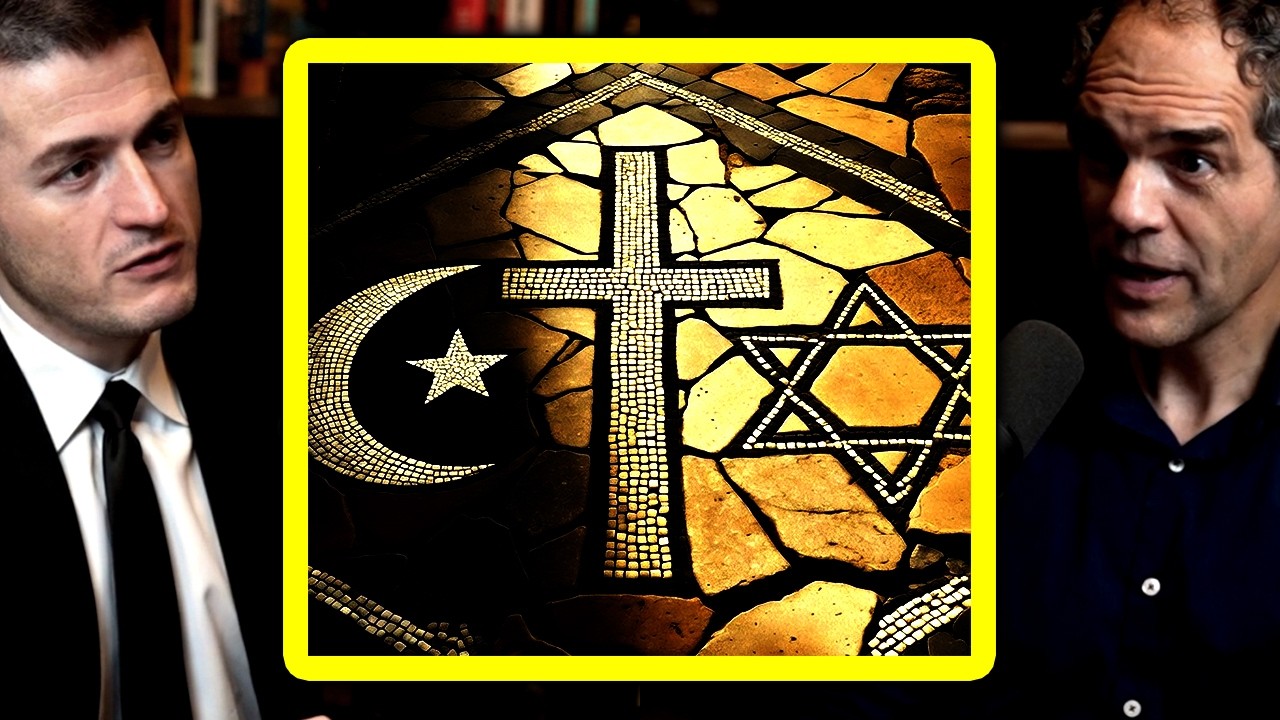
The three overlapping identities — Roman, Christian, Greek — that defined Byzantine civilization
Watch at 03:10 →
Part of the answer lies in the very combination of identities that defined Byzantine civilization. The empire wasn't just Christian. It wasn't just Roman. It wasn't just Greek. It was all three simultaneously — and in different proportions depending on the context, the era, and the individual. This layered identity gave the society a kind of resilience and adaptability that purely ideological empires often lack.
- Roman identity provided a framework for law, governance, and legitimate imperial authority.
- Orthodox Christianity gave the population a shared spiritual life and a sense of divine mission.
- Greek language and culture preserved classical learning and gave the empire its literary and intellectual tradition.
These three elements weren't always in harmony — they sometimes pulled in different directions — but their coexistence created a rich, adaptive civilization that could reinvent itself without losing its core identity. As one historian described it, Byzantium was a kind of "laboratory" for these three forces working in combination. And it is, quite literally, the only society in history where that particular experiment was run.
What Is Eastern Orthodoxy and Why Did It Matter?
Eastern Orthodoxy — today known as Greek Orthodoxy — is the branch of Christianity that became the defining religion of the Byzantine world. The word "orthodox" simply means correct or right belief, and the Byzantines used it to distinguish their theological tradition from what they saw as the errors of Western Catholicism and various heretical movements within Christianity itself.
05:20
Why Byzantines commemorated Christian martyrs killed by Roman emperors every week in church
Watch at 05:20 →
But Orthodoxy in Byzantium was more than a set of doctrines. It was a cultural identity, a political framework, and a social bond. The church calendar structured daily and civic life. The liturgy connected ordinary people to a cosmic narrative about salvation and empire. The Patriarch of Constantinople wielded genuine influence alongside the emperor. And the monasteries served as centers of learning, charity, and political power.
Critically, Orthodoxy also shaped how Byzantines related to other peoples. When neighboring nations like the Bulgarians or the Rus converted to Christianity, the Byzantines shared a religion with them — but did not consider them Romans. The religious and political identities overlapped but were never identical.
Were Byzantines Roman or Christian First?
Ask a Byzantine whether they were Roman or Christian, and they'd probably want to say both. But push them — force them to distinguish — and the answer becomes genuinely interesting.
The two identities were not the same thing, even if they were deeply intertwined. The Byzantines knew perfectly well that there had been Romans before Christianity. How did they know? Because almost every week, in churches across the empire, they commemorated Christian martyrs who had been killed by Roman emperors. The memory of Roman persecution of Christians was actively performed and celebrated. That made it impossible to simply collapse "Roman" and "Christian" into one thing.
Conversely, there were Christians who were clearly not Romans — the Bulgarians, the Rus, the Armenians, the Ethiopians. Being Christian did not make you Roman in Byzantine eyes. The two categories overlapped significantly, but neither absorbed the other completely.
What you find instead is a spectrum. Some Byzantines were primarily politicians and administrators who engaged with religion mostly at the level of ceremony. Others went all in on Orthodoxy — becoming monks, withdrawing from public life, devoting themselves entirely to spiritual matters. And others still oriented themselves primarily around the Greek literary and philosophical tradition, engaging deeply with classical texts and ideas. All three orientations were available. All three were legitimate. That flexibility, historians argue, is part of what made Byzantine society so enduring.
How Did Greek, Roman, and Christian Identity Coexist?
One of the most fascinating things about Byzantine civilization is precisely this three-way coexistence. No other society in history has been simultaneously Roman in its political tradition, Christian in its religious life, and Greek in its language and literary culture — and sustained all three for a thousand years.
In practice, these identities showed up differently depending on context. In legal and administrative documents, the Roman tradition dominated. In theology and church practice, Orthodoxy was paramount. In literature, philosophy, and education, Greek classical culture set the terms. Most Byzantines lived comfortably across all three registers, code-switching as the situation demanded.
What's striking, though, is that even at the highest levels of society, these elements remained somewhat distinct. The operations of the state — taxation, law, military logistics — functioned on largely pragmatic grounds that didn't require religious justification at every step. Religion might provide the vocabulary at the top, the ceremonial framing of imperial authority, but the actual machinery of governance was its own thing. Historians who treat Orthodoxy as the explanation for everything Byzantine, it's argued, miss this crucial point.
Why Did Byzantines Prefer Ottomans Over Catholic Union?
Perhaps the most striking evidence of how much religion mattered to the Byzantines is what happened at the very end. As the Ottoman Turks closed in on Constantinople in the mid-fifteenth century, Byzantine leaders faced a stark choice: accept union with the Catholic Church in exchange for Western military support, or reject that union and face the Ottomans without it.
Some Byzantines chose the Ottomans. And some of them said so explicitly: better to be ruled by Muslims, who will at least respect our religious identity, than by Catholics, who will demand we compromise our faith. The famous line attributed to the period captures it starkly — better the sultan's turban than the cardinal's hat.
This was not a reckless or irrational choice. The Byzantines had long experience of Western crusaders — including the catastrophic sack of Constantinople by the Fourth Crusade in 1204 — and had reason to distrust Catholic promises. And they were right that the Ottomans, following standard Islamic practice, did allow Christian communities to maintain their religious institutions under the millet system.
It was a real cost. But it was one the Byzantines were willing to pay. That willingness tells you more about the depth and authenticity of Orthodox identity in Byzantine life than any theological treatise could.
Did Religion Actually Run the Byzantine State?
Not exactly — and this distinction matters. It's tempting to see Orthodoxy as the engine of Byzantine civilization, the force that drove everything else. But a more precise picture is that religion functioned as the cultural and ideological layer over a state that ran on more pragmatic foundations.
The tax system, the legal code, the military, the bureaucracy — these operated according to their own logic, their own inherited Roman traditions. Religion intersected with them, often providing the vocabulary of legitimacy or the ceremonial framework within which power was exercised. But it didn't determine the day-to-day operations of government in any simple sense.
This distinction is important for understanding both the empire's strengths and its limits. Byzantine civilization was not a theocracy in any straightforward sense. It was something more complex and more interesting: a society in which religion, politics, and culture were deeply entangled but never fully merged — and in which that very tension produced a thousand years of remarkable, complicated, irreplaceable history.