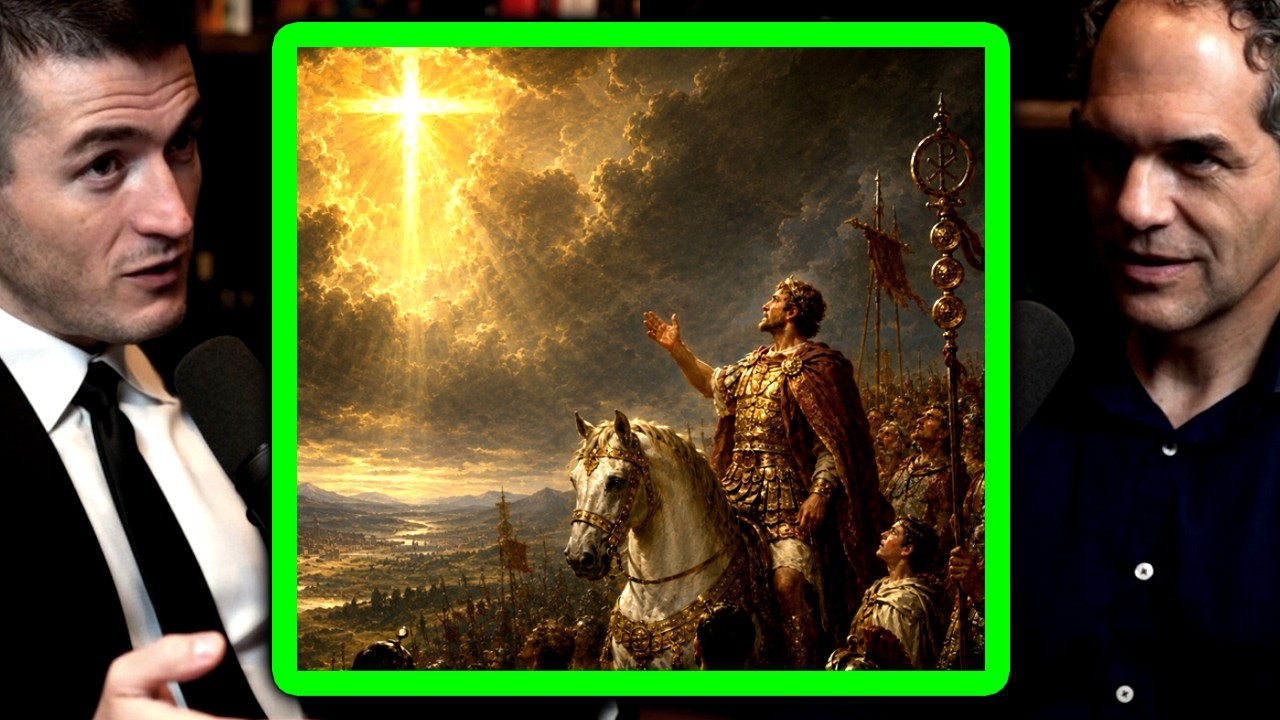

Was Constantine's conversion to Christianity a genuine spiritual transformation — or the most consequential piece of political branding in Western history? The short answer is: probably both. Constantine's conversion, traditionally dated to 312 AD and tied to a vision before the Battle of the Milvian Bridge, is plausible as a sincere belief that the Christian God had helped him win in battle. But sincerity and pragmatism are not mutually exclusive, and Constantine was, above all else, a pragmatist.
What Really Happened at the Battle of the Milvian Bridge?
The famous story goes that before the Battle of the Milvian Bridge in 312 AD, Constantine experienced a divine vision — a sign in the sky — that led him to convert to Christianity and march to victory. It's a dramatic origin story. But historians have serious problems with it.
 00:45
Historian explains why the primary sources for Constantine's Milvian Bridge vision are unreliable
Watch at 00:45 →
00:45
Historian explains why the primary sources for Constantine's Milvian Bridge vision are unreliable
Watch at 00:45 →
For one thing, the sources are deeply suspect. The most detailed account comes from a writer who claimed to have had a private dinner conversation with Constantine decades after the fact, in which the emperor personally recounted the vision. As one historian puts it bluntly: "I'm not going to take that at face value." These accounts were written after Constantine's victory, in an atmosphere where the emperor controlled how he wanted to be remembered. That context matters enormously.
There's also the inconvenient fact that Constantine had religious visions before — and they weren't Christian. Earlier in his career, he reportedly experienced a vision of Apollo at a temple in Gaul, where the god appeared to him in the form of light. In other words, Constantine seemed to have religious visions with a certain strategic regularity, each one conveniently aligning with a political shift he was about to make.
How Did Roman Emperors Use Religion as Branding?
To understand Constantine, you have to understand how Roman emperors used religion as a tool of political identity — what we might today call branding. Before Constantine, the dominant imperial model was built around Jupiter and Hercules. Constantine's pivot to Apollo represented a deliberate rebranding: a way of distinguishing himself from rival emperors and projecting a particular image of divine favor.
03:10
The Apollo statue at Constantinople — Constantine's mixed religious messaging in stone
Watch at 03:10 →
His shift toward Christianity followed the same logic. After his victory at Milvian Bridge, supporting the Christian God — who had, in his view, delivered him the win — made both theological and political sense. For someone like Constantine, divine military assistance was as good a reason as any to back a religion.
But Constantine never fully abandoned his old associations. The centrepiece of his new capital Constantinople was a towering gilded statue of himself — repurposed from a statue of Apollo. It was naked, with rays emanating from the head. Everyone who saw it knew exactly what they were looking at: Constantine in the guise of Apollo. He was simultaneously championing Christianity and identifying himself with a pagan sun god. Mixed messaging? Absolutely. Deliberate? Almost certainly.
Did Constantine Actually Believe in Christ?
Here's where it gets nuanced. Constantine was not a theologian. He was not a devout Christian in the way we might picture a modern believer. He was a spiritually inclined person who thought broadly about religion — what made a religion good or bad, how divine power operated in the world, and how a ruler ought to relate to the divine.
It is entirely plausible, even probable, that he genuinely believed the Christian God had intervened on his behalf at Milvian Bridge. That belief, for a man of his era and temperament, would have been real and meaningful. But it coexisted comfortably with a pragmatic, audience-aware religiosity. When speaking to Christians, he would invoke Christ. When addressing a general audience in imperial decrees, he would refer more vaguely to "good religion" — leaving room for interpretation, keeping everyone in the tent.
05:50
How incentives and disincentives drove the slow Christianization of the Roman Empire
Watch at 05:50 →
He also remained strategically non-committal about baptism. Constantine was not baptized until he was on his deathbed. This was not unusual for the era — many Christians delayed baptism to ensure a clean slate of sins before death — but it also conveniently allowed him to operate in the murky middle ground throughout his reign. He institutionalized the church, gave bishops power and funds, built Christian basilicas, and yet kept enough ambiguity to avoid alienating the substantial non-Christian portions of his empire.
How Did Christianity Spread Through the Roman Empire?
One of the most common misconceptions about Constantine is that he simply declared Rome Christian and it was done. The reality was far slower and more complex. Christianity's spread through the Roman Empire was a half-millennium process — roughly five full centuries from the time of Jesus to a solidly Christian society.
Under Constantine himself, Christians probably made up no more than 10% of the empire's population. The majority Christian tipping point likely wasn't reached until the 5th century. A society that could genuinely be called overwhelmingly Christian — where non-Christians were perhaps 10 to 15% of the population — didn't arrive until the early 6th century. That's 500 years after the Crucifixion.
So how did it happen? Through a careful combination of incentives and disincentives applied over generations:
- Incentives: Bishops were given imperial funds to distribute charity and support to local communities. Lists of widows and vulnerable people were maintained and supported. Land was granted to the church through imperial gifts and private wills, enabling the church to build real institutional power and social infrastructure.
- Disincentives: Laws were gradually passed restricting traditional religious practice. Animal sacrifices were banned. Then smaller folk practices — tying ribbons to trees, making wishes at sacred sites, certain forms of divination — were reframed as magic or nefarious activity and outlawed. Over time, non-Christians faced restrictions on holding high office and encountered legal disadvantages around inheritance and wills.
It was a slow squeeze rather than a sudden switch. And critically — it worked.
When Did Rome Actually Become a Christian Empire?
Constantine's reign marked the beginning of the process, not its completion. His successors continued the work, some more aggressively than others. The empire shifted from tolerating Christianity, to favoring it, to eventually mandating it — but this played out across multiple reigns and centuries.
What Constantine did was provide the institutional foundation: he legalized Christian worship, funded the church, and gave bishops a formal role in the imperial system. That structural support was the launchpad. But the conversion of hearts, minds, and communities across a vast empire took generations of social, economic, and legal pressure to achieve.
Why Did Traditional Roman Religion Die Out?
Traditional Roman religion — the old sacrifices, the festivals, the sacred groves and temples — didn't simply lose a theological debate. It was incrementally outlawed, defunded, and socially stigmatized over the course of the 4th and 5th centuries. Practices that had been central to Roman civic and family life for centuries were recast as superstition, magic, or outright paganism.
The process was less about Romans being convinced by Christian theology and more about the structural power of the church growing while the infrastructure of traditional religion was dismantled. When bishops control the charity networks, when temples lose their funding, when holding a major office requires Christian credentials — the incentives reshape behavior across generations, regardless of private belief.
The Bottom Line on Constantine's Faith
Constantine's conversion to Christianity was real enough — in the sense that he likely believed, sincerely, that the Christian God had delivered him victory and deserved his support. But it was layered on top of a fundamentally pragmatic, politically savvy personality that never stopped thinking about branding, audience management, and power. He was a man of his time: a Roman emperor who wrapped himself in divine imagery because that was simply how emperors operated, and who saw in Christianity a powerful, organized, and increasingly significant force worth having on his side.
The vision at Milvian Bridge may or may not have happened exactly as reported. What's certain is that the consequences of Constantine's embrace of Christianity reshaped the entire Western world — not overnight, but over the slow grind of five centuries.