Why does communism stay in power but fail economically, time and time again? The answer is both simple and chilling: communist party systems are brilliantly engineered for seizing and holding political control, but structurally incapable of generating prosperity. From Mao's China to North Korea to post-war Vietnam, the pattern repeats. The party survives. The people suffer. And yet the regime endures — often for generations — without a successful coup or major insurgency to topple it.
Why Does Communism Hold Power But Deliver Poverty?
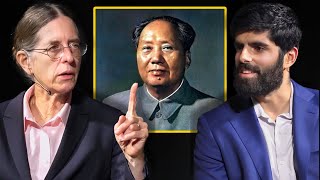
Consider the scale of what Mao caused. Tens of millions of people died under his rule — more than Hitler and Stalin combined by most estimates. And yet there was never a successful insurgency after he took power. No coup worked. The man died in his bed, his portrait still hanging in Tiananmen Square to this day, revered in a way that neither Hitler nor Stalin are revered in their home countries.
 00:12
Discussion of why communist regimes never face successful coups despite mass suffering
Watch at 00:12 →
00:12
Discussion of why communist regimes never face successful coups despite mass suffering
Watch at 00:12 →
That's not an accident. The communist party system — the political commissars, the cell structures, the loyalty mechanisms built into every layer of government and military — is extraordinarily effective at neutralizing threats to leadership. It's a machine built for one purpose: maintaining control. And at that purpose, it excels.
But that same rigid centralization is exactly what destroys economic output. Look at North Korea — it's a catastrophe by every measurable standard of human welfare. Yet the Kim family remains in power. Or consider Vietnam: a country with three rice harvests per year, one of the most agriculturally rich nations on earth, somehow managed to produce a famine after the communists won the war. That's not bad luck. That's the inevitable consequence of collectivized agriculture and centralized economic control stripping away every incentive for productivity. Communism delivers, reliably, compounding poverty.
What Really Caused Mao's Cultural Revolution?
To understand the Cultural Revolution, you have to understand that it was never really about ideology. It was about Mao's survival.
After the catastrophic failure of the Great Leap Forward — the forced industrialization and collectivization campaign that killed tens of millions through famine — Mao's senior colleagues had seen enough. Peng Dehuai, the celebrated general who commanded Chinese forces during the Korean War and was part of the legendary Long March generation, had personally lost siblings to starvation during the civil wars. He, along with Liu Shaoqi, moved to push Mao aside. Mao was demoted from key positions. He was on his way out.
01:45
Explanation of how Mao used the Red Guards to eliminate political rivals through the Cultural Revolution
Watch at 01:45 →
So what does a cornered authoritarian do? Mao did something breathtaking in its cynicism: he mobilized the teenagers.
Children who had been raised entirely within the communist education system — who had been taught from birth that Mao was the beloved Chairman, a god-like figure — were suddenly told by Mao himself that they were in charge. Think about what that means. Young people with almost no life experience, handed authority over adults, over teachers, over the entire social order. The results were predictable and horrifying.
The Red Guards started by turning on their teachers — probably some they already resented — and then worked their way through the entire educational system and outward into society. It became something close to a semi-civil war. Intellectuals were humiliated, imprisoned, killed. The entire educated class was gutted. And anyone who might have removed Mao from power was neutralized in the chaos.
Lin Biao, a powerful military leader, was then brought in to restore order — conveniently eliminating the people who had tried to oust Mao in the first place. The Cultural Revolution worked exactly as intended, for Mao. For China, it was ruinous — economically, intellectually, and socially — for a generation.
Part of what terrified Mao into launching it was Khrushchev's 1956 speech denouncing Stalin's crimes. Mao watched that and thought: I cannot let that happen to my legacy. And it hasn't. His portrait still hangs in the square.
04:10
Analysis of Xi Jinping's personal history during the Cultural Revolution and his beliefs about communism
Watch at 04:10 →
How Did Mao Survive the Great Leap Forward Disaster?
This is one of history's most disturbing questions. How does a leader preside over the deaths of tens of millions of his own citizens — through entirely preventable famine — and not only survive politically but die in power decades later?
The answer goes back to the communist party system. There was no free press to expose the scale of the disaster. There was no opposition party to capitalize on public outrage. There was no independent military leadership that could organize a coup without being detected by the political commissar system woven through every unit. When Peng Dehuai tried to raise concerns through legitimate internal channels, he was purged. When Liu Shaoqi moved against Mao, Mao unleashed the Cultural Revolution on him.
Every mechanism that might translate popular suffering into political change had been systematically dismantled. That is the genius — and the horror — of the communist party structure.
Is Xi Jinping Really Acting Like Mao?
When analysts say Xi Jinping is acting like Mao, it's worth understanding who Xi actually is and what shaped him.
Xi's father was a high-ranking communist official who was purged during the Cultural Revolution — but not killed, and sent to the interior of China. When Xi was caught up in the "Down to the Countryside" movement, where urban youth were sent to rural areas for ideological re-education, he was sent somewhere near where his father was, or where his father's protectors had influence. So his experience, while genuinely difficult, was likely less brutal than what many others endured.
There's a reported story that at one point, because his father had been denounced, Xi himself was denounced — and when he tried to return home to be fed by his mother, she was forced to turn him away. He experienced the Cultural Revolution personally. And yet he remains a true believer.
This shouldn't surprise us. Stalin was abused as a child and became one of history's most abusive leaders. Hitler similarly. Experiencing trauma does not inoculate someone against inflicting it — particularly when we're talking about individuals who display sociopathic traits.
What's clear is that Xi Jinping genuinely believes in communism. The Chinese Communist Party hasn't secretly become capitalist — it adopted some market mechanisms under Deng Xiaoping, but it is now actively recentralizing the economy, moving back toward the old model. Xi reveres Mao. He is not playing a character. And that should inform how the world engages with China's economic and political trajectory.
Why Do Chinese People Still Revere Mao Today?
This is perhaps the most psychologically complex question of all. How can a population continue to revere a leader responsible for the deaths of more of their countrymen than any figure in history?
Part of the answer is information control — the same machinery that kept Mao in power also controls the historical narrative. But that's not the whole story.
Human beings need pride. Chinese civilization has an extraordinary record of achievement — in philosophy, science, mathematics, art, literature, governance. That is a genuine and legitimate source of national pride. But people also want to feel proud of their modern leaders and their modern nation. Mao, whatever his crimes, is consequential. He unified China. He ended what Chinese historians call the "century of humiliation." For many Chinese citizens, looking unflinchingly at the full darkness of his rule means confronting something too painful about their own national story.
This is not unique to China. The American South — the region where slavery was most deeply embedded — continues to grapple with that legacy more than 150 years later, and the wounds remain visible in economic and social outcomes today. Confronting the darkest chapters of your own country's history is among the hardest things any society can do.
Why Did Vietnam Suffer Famine After Winning the War?
Vietnam is one of the most agriculturally productive countries on earth — capable of producing three rice harvests per year in many regions. And yet after the communists won the Vietnam War, the country experienced famine. How is that even possible?
It's the communist economic model, applied consistently. Collectivized agriculture removes the individual incentive to produce. Central planning misallocates resources in ways that markets self-correct. The result, inevitably, is declining output — even in conditions where abundance should be the default. Vietnam's famine wasn't a natural disaster. It was a policy outcome.
What Happened When the Nazis Captured Stalin's Son?
During World War II, the Nazis captured Yakov Dzhugashvili, Stalin's son from his first marriage. The Nazis offered a prisoner exchange. Stalin's response was characteristically cold: he reportedly refused, saying he would not trade a marshal for a soldier — or words to that effect. Yakov died in German captivity.
This story illuminates something important about the psychology of authoritarian leaders. Mao similarly showed no particular tenderness toward his own children — abandoning some, and sending one son directly into the Korean War, where he was killed. The personal cruelty toward family members is not incidental to their political behavior. It is of a piece with it.