
In a prime-time address, President Trump made explosive claims about China hacking US elections, announcing the immediate declassification of intelligence documents he says reveal the largest compromise of election data in American history. According to Trump, the People's Republic of China illicitly acquired 220 million US voter files — including names, addresses, phone numbers, and political party affiliations — beginning during the 2020 election cycle. He framed the disclosure as a matter of national trust, stating plainly: "No trust, no greatness."
The speech, which major broadcast networks NBC and ABC declined to air, covered five distinct areas of concern outlined in the newly released documents. Here is a complete breakdown of every major claim made and what it means for American voters.
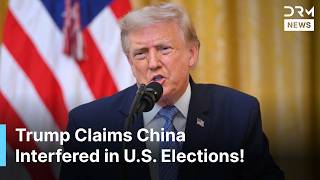 00:45
Trump opens his address framing election trust as the foundation of national greatness
Watch at 00:45 →
00:45
Trump opens his address framing election trust as the foundation of national greatness
Watch at 00:45 →
What Did Trump Say About China Hacking US Elections?
Trump's central allegation is that the People's Republic of China carried out what he described as "the largest compromise of election data in history." The intelligence he referenced purportedly shows China acquired 220 million US voter files over a period of years, with the operation accelerating during the 2020 election cycle.
According to the claims, the stolen data included:
- Full legal names
- Home addresses
- Phone numbers
- Political party preferences
- Other sensitive identifying information usable for voter registration fraud
Trump further alleged that China assigned a dedicated data exploitation unit specifically to this project — suggesting a coordinated, state-level intelligence operation rather than opportunistic hacking. He tied the motive directly to his own trade and military policies, arguing China wanted him to lose re-election because he had imposed billions in tariffs and built up US military strength.
02:10
Trump describes China's alleged acquisition of 220 million US voter files
Watch at 02:10 →
Important context: These are allegations drawn from documents Trump's administration says it is declassifying. Independent verification of these specific claims had not been confirmed by intelligence agencies or outside experts at the time of the speech.
What Intelligence Documents Did Trump Just Declassify?
Trump outlined five major categories covered by the newly released documents, though he detailed three most prominently during the address:
Document Set One: China's Voter Data Theft
The first set of documents allegedly details the scope and mechanics of how China obtained 220 million voter records, including the dedicated unit assigned to exploit the data.
Document Set Two: The Deep State Cover-Up
The second release claims that members of what Trump called the "deep state" within US intelligence agencies actively worked to suppress and downplay information about Chinese election interference. The documents allegedly show efforts to use Chinese contacts at large US companies to turn American business leaders against the sitting president, and to identify and pay US journalists to write negative coverage.
05:30
Trump calls on Congress to pass the Save America Act requiring photo voter ID
Watch at 05:30 →
Document Set Three: Electronic Voting Machine Vulnerabilities
The third set of documents reportedly proves that Americans were "blatantly lied to" about the security of electronic voting machines and ballot counting systems for many years.
Trump announced he is directing the Office of the Director of National Intelligence, the Department of Justice, the FBI, and the CIA to investigate how this information was hidden, with instructions to fire those involved in any cover-up and to pursue criminal charges where appropriate.
Did China Really Steal 220 Million US Voter Files?
This is the claim generating the most immediate scrutiny. The number — 220 million voter files — is significant because the total number of registered voters in the United States is approximately 160 million, meaning the alleged theft would encompass records beyond the active registered voter rolls, potentially including historical or inactive voter data.
Trump did not provide a public-facing summary of the underlying intelligence during the speech, instead announcing the documents would be released. Analysts and fact-checkers will be closely examining whether the sourcing, methodology, and chain of custody for this intelligence holds up to independent review. Voter data has historically been vulnerable — individual state-level breaches have been documented — but a theft of this scale would represent an unprecedented event in US election security history.
Did the Deep State Cover Up China's Election Meddling?
The second major allegation moves from foreign interference to domestic suppression. Trump claimed that figures inside US intelligence agencies — people he described as "very, very famous" — deliberately worked to minimize public awareness of China's election activities.
The alleged tactics included:
- Using Chinese-connected contacts at major US corporations to pressure American business leaders
- Identifying journalists who had written negatively about Trump and paying them to produce more critical coverage
- Systematically downplaying the intelligence community's own findings on Chinese meddling
Trump used this section to call for accountability, directing multiple federal agencies to begin investigations and stating that criminal charges should be filed against those responsible if the evidence supports it.
What Vulnerabilities Exist in US Electronic Voting Machines?
While Trump did not detail specific technical vulnerabilities in the speech itself, the third category of released documents allegedly addresses long-running concerns about the security of electronic voting machines and ballot counting systems. Election security researchers have for years flagged issues including outdated software, lack of paper audit trails, and remote connectivity risks in certain voting systems used across the country.
Trump's framing went further, claiming Americans were deliberately misled about these vulnerabilities rather than simply uninformed — a distinction that, if proven, would carry serious legal and political consequences for officials who certified election security in past cycles.
What Is the Save America Act and What Does It Require?
The policy centerpiece of Trump's speech was a call for Congress to pass the Save America Act. The bill, as described by Trump, has one primary requirement: all voters must show photo identification to cast a ballot.
Trump argued this is a straightforward safeguard, saying the only reason to oppose it is to enable cheating. Proponents of voter ID laws argue they protect election integrity and are standard practice in many democracies. Opponents argue such requirements disproportionately affect minority, elderly, and low-income voters who are less likely to hold qualifying photo ID, and that in-person voter fraud — the type ID laws would address — is statistically rare.
The Save America Act would represent a federal mandate overriding varying state-level ID requirements, which is itself a significant constitutional and political debate separate from the underlying policy question.
Why Did NBC and ABC Refuse to Air Trump's Speech?
In a notable moment at the close of his remarks, Trump directly addressed the fact that NBC and ABC both declined to broadcast the speech. He accused both networks of being aware of the content and choosing to suppress it because it exposed election corruption they want to protect.
Trump went further, suggesting that networks which refuse to air such content should face revocation of their broadcast licenses, arguing that they use publicly owned airwaves — worth billions of dollars — without paying for them, and therefore owe the public honest coverage. He characterized their decision as part of a broader media plot to protect the political left.
Neither NBC nor ABC issued detailed public statements explaining their editorial decisions before the speech aired elsewhere, which will likely fuel ongoing debate about media gatekeeping and what constitutes newsworthy presidential addresses.
What Happens Next?
Trump closed his address by outlining immediate steps his administration is taking:
- Notifying states whose election data was allegedly compromised by China
- Working with states to mitigate harm from the data breach
- Strengthening protections for sensitive voter data going forward
- Directing four federal agencies to investigate the alleged cover-up
- Pushing Congress to pass the Save America Act
The release of the underlying intelligence documents will be the critical next step. If the documents support the specific claims made — particularly the 220 million voter file theft and the coordinated suppression effort — it would rank among the most significant political and national security revelations in modern US history. If the sourcing proves thin or contested, the speech will itself become a major story about the use of declassification as a political tool. Either way, the debate over US election security has been dramatically escalated.