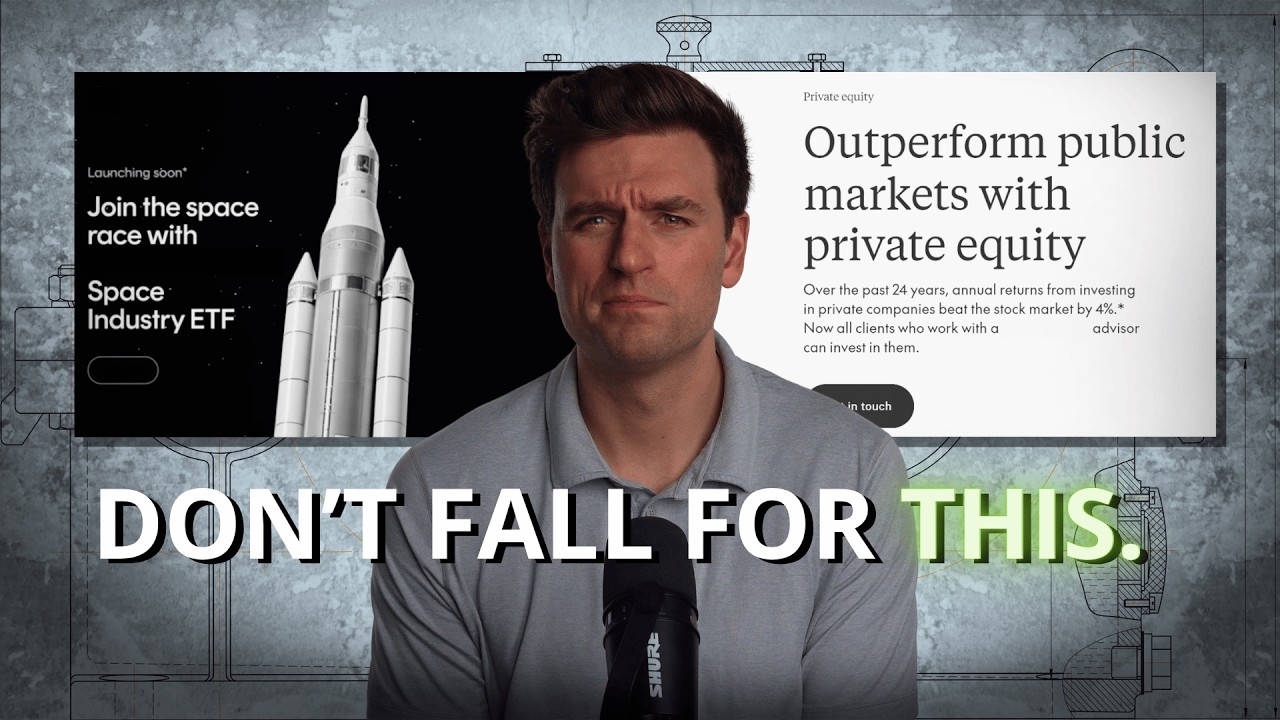

Financial product advertisements are designed to manipulate investors — not by lying outright, but by strategically highlighting what excites you while burying what actually matters. If you've ever felt drawn to a high-yield investment, a flashy thematic ETF, or the "power" of margin trading after seeing an ad, you've already been targeted. The more aggressively a financial product is marketed, the more profitable it tends to be for the firm selling it. And since you're the one funding those profits, that's a problem worth understanding.
How Do Financial Ads Manipulate You Into Buying Bad Products?
Research on financial product advertising consistently finds that more heavily advertised products tend to be more expensive for consumers, that the ads contain little relevant information, and that whatever information they do highlight is often enticing but incomplete. This isn't accidental — it's a deliberate strategy.
 01:45
The five psychological techniques financial advertisers use to manipulate investor decisions
Watch at 01:45 →
01:45
The five psychological techniques financial advertisers use to manipulate investor decisions
Watch at 01:45 →
Financial advertising relies on five core psychological techniques:
- Transference: Borrowing credibility from something real — like the expected growth of a sector — and applying it to an area where it's irrelevant, like the expected returns of a fund investing in that sector.
- Framing: Using empty but positive language to put you in a good mental state about a product. Think words like "power" or "opportunity" attached to inherently risky strategies.
- Salience: Highlighting specific attention-grabbing features — like a high distribution yield — that may have little bearing on whether the product is actually a good investment.
- Shrouding: Burying fees, risks, and costs in footnotes and fine print while the headline screams returns.
- Complexity: Making products so hard to evaluate that you default to trust and gut instinct — instincts the ads are actively working to manipulate.
One analysis found that marketing and distribution expenses account for roughly a third of the cost of actively managed mutual funds. The conclusion: marketing makes investors worse off overall, because heavily marketed funds attract more assets than they deserve and often underperform. The financial industry has since moved on to even more profitable — and arguably more misleading — products.
Do Retail Investors Actually Make Money Trading Options?
Options trading is one of the most aggressively marketed financial products online today. Scroll through Reddit or Instagram for a few minutes and you'll find ads promising low or zero commissions and framing options as a path to getting ahead financially.
08:30
Retail options traders lost $2.1 billion in aggregate — the data behind the headline
Watch at 08:30 →
The reality is starkly different. A 2023 study estimated that the aggregate portfolio of retail investors lost $2.1 billion trading options from November 2019 to June 2021. The losses weren't primarily from commissions — they came from indirect trading costs, particularly wide bid-ask spreads. Around 50% of retail options trades in the sample involved high-risk options expiring in less than a week, with an average bid-ask spread of 12.6%. A separate study of 68,000 trading accounts found that most investors take significantly larger losses on options trades than on equity trades.
Why are brokerages so eager to promote options trading then? Because payment for options order flow — selling your trade to a market maker — is far more lucrative for brokerages than payment for stock order flow. Low commissions make for a great ad headline, but they're not the full story. The total cost of an options trade is often much higher once you account for those wide spreads.
14:10
How covered call ETFs cap upside while leaving downside exposure largely intact
Watch at 14:10 →
Options themselves aren't inherently bad. They're powerful tools used responsibly in risk management and hedging. But for most retail investors, the empirical reality is clear: options trading tends to be a losing game.
Are Covered Call ETFs Actually Worth It for Income Investors?
Covered call ETFs are heavily promoted online — through ads and through financial influencers — almost always leading with their high distribution yields. The yield is the entire pitch. But that specific data point is misleading when it comes to evaluating whether these funds are actually good investments.
04:55
Private equity return data using secondary market prices vs. reported NAVs — a very different picture
Watch at 04:55 →
Here's what the marketing doesn't explain: when a covered call fund sells a call option on a stock it holds, it collects a premium (which gets distributed to you as income) but simultaneously caps its upside. If the stock rises above the strike price, the fund has to sell at below-market value. The result is a portfolio that keeps most of the downside exposure of equities while giving up much of the upside. That asymmetry destroys long-term returns.
In many ways, covered call funds behave like a blend of stocks and cash — a combination most long-term investors recognize as suboptimal for building wealth. They also charge higher fees than simple index funds, which is precisely why they get marketed so aggressively. Even for investors who genuinely need income, the better approach is typically to own a diversified low-cost portfolio and sell small portions as needed, rather than structurally capping your returns with a covered call overlay.
Is Private Equity Worth It for Retail Investors?
Private equity and private credit are increasingly being sold to everyday investors with a compelling pitch: private markets deliver higher returns than public markets. Some of the marketing is visually striking and confidently presented. But the claim deserves serious scrutiny.
One of the core problems with private equity return data is that it's typically based on net asset values — what the fund says its assets are worth, not what it can actually sell them for. This creates the illusion of smooth, strong returns, a phenomenon sometimes called volatility laundering. When researchers use actual secondary market transaction prices instead of reported NAVs, the picture changes dramatically. One analysis from 2006 to 2017 found that private equity's performance was fully explained by taking on roughly double the public equity market risk. Once that extra risk was accounted for, excess risk-adjusted returns were statistically indistinguishable from zero.
Using a different measurement approach — the public market equivalent (PME) — research finds that private equity performed about the same as public equity from 2006 through June 2025, after accounting for its high fees. Meanwhile, private equity funds are illiquid, meaning investors may not be able to get their money back when they want it. This isn't a minor footnote; it's a defining characteristic of the asset class.
Private credit has similar issues. Often marketed on its yield, private credit funds loan money to private companies at high rates — but total returns consistently trail headline yields due to volatile loan values and defaults. One example fund advertised a 9.6% target yield while delivering a 7.7% total return since inception, roughly in line with a publicly traded high-yield bond ETF you could buy with no liquidity risk.
And the incentive structure for advisors recommending these products is deeply conflicted. Billions of dollars have been paid from private market funds to the banks and brokerages placing client assets into them. When a wealth manager earns a kickback for recommending a private fund over a low-cost index fund, the marketing pitch starts to make a lot more sense — for everyone except the investor.
Why Do Thematic ETFs Almost Always Underperform?
Thematic ETFs are built around exciting ideas: space exploration, artificial intelligence, clean energy. The ads lean into that excitement with real conviction — and the underlying theme often represents a genuinely significant economic opportunity. That's the transference at work. The real growth story of a sector gets borrowed to sell a financial product, even though the two aren't the same thing.
The structural problem is simple: thematic ETFs tend to launch after a theme has already delivered strong returns, when investor enthusiasm is at its peak. By the time the fund exists and you can buy it, the exciting future is already priced in. A 2021 academic study found that thematic ETFs underperform broad market benchmarks by an average of 6% in the five years after launching. Morningstar's 2025 global thematic fund landscape report found that the long-term odds of picking a thematic fund that both survives and outperforms global equities is very low. In Canada, the data is even starker: 100% of Canadian-listed thematic funds have either closed or underperformed at the 10-year mark.
ETF companies love launching these funds because they can charge much higher fees than a plain index fund — and unlike with index funds, investors in thematic funds tend not to care about fees. They're buying the story. That dynamic made thematic ETFs 18% of the ETF market in 2019 while accounting for about 35% of the industry's revenues.
Is Margin Investing as Powerful as Brokerages Claim?
Discount brokerages have largely eliminated trading commissions, making margin loan interest an increasingly important revenue stream. It should come as no surprise, then, that margin investing gets marketed aggressively — often with language focused on its "power" to boost returns.
Borrowing to invest isn't inherently wrong. Used responsibly as part of a long-term plan, it can make sense. But the empirical reality of how retail investors actually use margin tells a very different story. A 2020 study found that investors with margin accounts trade more actively, more speculatively, and less profitably than those without. Crucially, the more experience an investor has trading on margin, the worse those outcomes become. Twenty percent of Canadian retail investors surveyed in 2020 reported using leverage to invest — and the evidence suggests most of them would have been better off without it.
How to Avoid Expensive Financial Products and Beat the System
Here's the counterintuitive upside to everything covered here: understanding how financial advertising works is genuinely useful. Financial firms can afford to offer loss-leader services — free trading, ultra-low-cost index funds — because they expect to recoup profits from more lucrative channels: private fund kickbacks, margin interest, options order flow, and fees on thematic or covered call products.
If you stay disciplined and avoid those profitable-for-them products, you get the free trading and the low-cost index funds without subsidizing the rest. You are, in effect, receiving a subsidy from less financially informed consumers. That's a harsh way to put it, but it's accurate.
The funds worth owning tend not to advertise at all. That's not a coincidence — it's part of why their fees are so low. The best investment strategy isn't the one with the most compelling ad. It's usually the one nobody's trying to sell you.