If you want to know how much money you actually need to retire comfortably, the answer is almost certainly much higher than you think — and inflation is the reason why. A million dollars sounds like a dream retirement goal. But in 50 years, thanks to inflation, that million will have the purchasing power of roughly $170,000 in today's money. That's not a comfortable retirement. That's a financial trap. Alex Hormozi, founder of Acquisition.com and owner of a portfolio generating over $250 million per year, argues that most people are playing the wrong game entirely — and the fix starts with rethinking your numbers from the ground up.
How Much Money Do You Actually Need to Retire?
The traditional advice goes something like this: save $100 a month from age 18, earn a 9% compounding return, and retire at 67 with a million dollars. On paper, that works. In reality, it's a disaster.
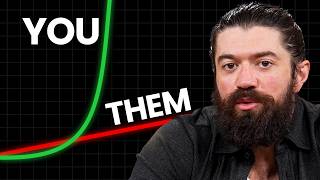 01:15
Hormozi illustrates how $1M at retirement is really only worth $170K in today's purchasing power
Watch at 01:15 →
01:15
Hormozi illustrates how $1M at retirement is really only worth $170K in today's purchasing power
Watch at 01:15 →
That $1 million at retirement will only buy what $170,000 buys today. Why? Because $1 in 1975 had the same purchasing power as $6.20 today. That's a 6x erosion in 50 years — and that's a conservative estimate based on the last half-century, not a prediction of what's ahead.
So what's the right number? Hormozi lays it out simply: if your goal is $4 million at retirement so you can live on $200,000 a year, you actually need to target $24 million in future dollars to have the equivalent purchasing power. That's not pessimism — that's just math.
The encouraging part? Compounding still works. You just need to deploy it more aggressively and combine it with four key strategies.
04:30
The compounding math on a $500 belt purchase — shown as $40,000 in future dollars
Watch at 04:30 →
How Inflation Silently Destroys Your Retirement
Most financial planning tools show you a future balance without adjusting for inflation. That's like showing someone their salary in Monopoly money and calling it progress.
Here's the brutal reality of inflation on retirement planning:
- A $50,000-per-year passive income from a $1 million nest egg will only feel like $8,000 per year in today's purchasing power after 50 years.
- A $500 luxury purchase today costs you roughly $40,000 in future dollars — or about $6,500 in today's equivalent value when you factor compounding in reverse.
- A single three-year car lease at $500 per month ($18,000 total) represents over $234,000 in lost future wealth.
The framework that changes everything: stop thinking in today's dollars and start thinking in future dollars. Every spending and savings decision looks completely different when you apply that lens.
Why Increasing Income Beats Cutting Expenses
Most financial advice focuses on cutting costs. Hormozi flips that entirely. His argument: if you're not making much, there's a hard floor at zero. There's no ceiling on what you can earn.
09:45
Hormozi draws the 'skill bridge' analogy showing how each investment adds a plank toward crossing
Watch at 09:45 →
Consider this: an extra $1,000 per month — from freelancing, content creation, flipping items online, or affiliate commissions — invested consistently from age 18 grows to $10 million by retirement. That same $1,000 invested today, in 50 years, becomes $80,000. But adjusted for inflation, that $80,000 is worth about $13,000 in today's money. Still: every dollar you earn and invest today is worth $13 at retirement. That makes even a $200 gig — helping someone move, DJing at an event — the equivalent of a $2,600 investment.
That reframe alone should change how you think about side income. The hustle isn't just for today. It's compounding for decades.
Every Dollar You Spend Is Worth 80x — Stop Wasting It
The flip side of that compounding math cuts both ways. Every dollar you waste now is a dollar that won't compound for 50 years. And the numbers get uncomfortable fast.
One of the most powerful points Hormozi makes about how to stop overspending is reframing discretionary purchases in their true cost:
- That $500 designer belt? In 50 years, that's $40,000. In today's purchasing power equivalent, that's $6,500 gone.
- That car lease at $500/month for three years? That's $234,000 in future wealth you just handed to a dealership.
His personal approach when building wealth: protein shakes and Chipotle for food, splitting a bedroom with a roommate in a six-person house, a used car paid for in cash with no payment, ever. Not because he had to — but because he understood that every dollar saved was worth 80 dollars compounded into the future.
The practical rule he recommends: set a cash watermark (say, $5,000 in your account) and invest everything above it automatically. Or better yet — decide on a fixed monthly investment amount first, then live on whatever's left. The wealthiest people he knows think in the second way, not the first.
What Compound Interest Actually Does Over 50 Years
One of the most underappreciated variables in compounding isn't the interest rate — it's when you start. Hormozi is blunt about this: starting at 18 versus starting at 28 is the difference between an 80x return and a 33x return on your money. That's not a small gap. That's 2.5x more wealth from the same inputs, just by starting earlier.
Younger people often feel discouraged because they're earning less. But that's backwards. Your dollars are worth more now than they ever will be again, precisely because they have the most time to compound. Someone making $40,000 at 22 and investing consistently will often retire wealthier than someone making $120,000 at 35 who starts late.
The math doesn't lie: $3,000 per month invested consistently from a young age, with no raises and no changes, grows to $31 million over 50 years. That's the baseline. Everything else — skill development, income growth, smarter investing — is upside.
Should You Invest in Skills or the Stock Market?
Here's where Hormozi's advice diverges most sharply from conventional financial wisdom. His answer to whether you should invest in skills or index funds: skills first, always — especially early in your career.
His example: spending $2,000 on a course or coaching that takes your income from $30,000 to $90,000 per year doesn't just earn you $60,000 more annually. After taxes and lean living expenses, that's $35,000 per year in additional investable income — permanently. Invested over a working lifetime, that one $2,000 decision becomes worth tens of millions of dollars.
He spent $750 per hour for 8 hours of one-on-one ads tutoring from an expert. That $6,000 investment generated hundreds of millions in revenue. The return on skill acquisition is asymmetric in a way that no index fund can match in the early stages of building wealth.
His mental model: think of skill acquisition like building a bridge. Each course, coach, or mentor adds a plank. You might buy five things before you cross. That doesn't make the first four a waste — they're prerequisites, like arithmetic before algebra. The people who get results from the same education are the ones who already had the foundational skills in place.
His recommended ladder for investing in skills:
- Free tier: YouTube deep-dives, online forums, free school communities, podcast content
- $10–$200/month: Low-ticket communities with aggregated resources and peer feedback
- $500–$3,000: DIY programs with limited coaching access
- $5,000–$35,000: High-depth programs with in-person components, real feedback loops, and peer networks ahead of you
How Alex Hormozi Actually Built His Wealth
Hormozi didn't start with capital. He started with compression — compressing his lifestyle to near zero while maximizing every dollar going toward income-generating skills.
The turning point came at a mastermind event for entrepreneurs doing $10 million or more per year. A speaker making $35 million annually shared one habit: he maintained a dedicated learning budget — a fixed percentage of income spent every month on experiments, new strategies, and skill development. Not optional. Mandatory.
Hormozi applied it immediately. He was doing $300,000–$400,000 per month with his gym launch business. He increased his ad spend by $1,000 per day — from $400 to $1,400 daily. Within months, the business scaled from $300K to $2.2 million per month. The willingness to lose money in service of learning is what unlocked the scale.
His advice distilled: make more, spend less, invest the difference in skills first — then let compounding do the rest. The goal isn't just a retirement number. It's building the income engine powerful enough that compounding becomes inevitable.
Most people fail not because they lack discipline, but because they're playing with numbers that are already too small before they even start. Adjust for inflation. Invest in skills. Start now. The time value of your money is higher today than it will ever be again.