When the United States moved against Venezuela and removed Nicolás Maduro from power, the immediate explanation offered by most media was straightforward: America wanted Venezuela's oil. With roughly 300 billion barrels in reserves — the largest in the world — the narrative wrote itself. At $57 a barrel, that's approximately $17 trillion in value, a figure larger than the GDP of every nation on Earth except the U.S. and China. It's a clean story. But it's largely the wrong one. The real reasons Venezuela mattered to Washington involve rare earth minerals, currency warfare, a 200-year-old foreign policy doctrine, and a global chessboard being contested simultaneously by the U.S., China, Russia, and Iran.
Why Oil Is a Distraction
If this operation were purely about seizing oil, it would have happened years earlier — when Venezuela's production was significantly higher and its energy infrastructure less degraded. The U.S. also has abundant domestic oil supply. As Marco Rubio stated plainly: "We don't need Venezuela's oil. What we're not going to allow is for the oil industry in Venezuela to be controlled by adversaries of the United States."
That distinction matters enormously. The concern isn't access to oil — it's who controls the oil, what currency is used to trade it, and what foreign powers are embedding themselves in the Western Hemisphere as a result.
The Three-Part Framework the Pentagon Uses
Large-scale military and strategic decisions like this one aren't made on presidential impulse. They emerge from institutional analysis. The basic framework requires three conditions to align simultaneously:
- A rival power establishes itself in a strategically significant region
- That presence begins to affect global trade, security, or geopolitical leverage
- The region falls within or near America's defined enforcement zone
Venezuela checked every box. Geographically, it sits inside the Western Hemisphere — a zone the U.S. has treated as a core security perimeter for two centuries. Strategically, China had invested over $100 billion into the country, was receiving discounted oil settled outside the U.S. dollar, and was routing Venezuelan minerals — including rare earths, coltan, gold, and bauxite — through Chinese-controlled processing pipelines. Militarily, foreign advisers and intelligence-sharing arrangements had taken root, bringing rival power projection uncomfortably close to American shores.
Any one of these factors might be manageable. Two could be monitored. All three, simultaneously, inside the hemisphere — that's when the calculation changes.
The Monroe Doctrine: Still Very Much Alive
To understand the ideological backbone of this decision, you have to go back to 1823. President James Monroe established what became the foundational principle of U.S. foreign policy in the Western Hemisphere: no foreign empire would be permitted to colonize, militarize, or use the Americas as a base of operations. In exchange, the U.S. would stay out of European conflicts.
 14:20
Map of the Western Hemisphere highlighting the Monroe Doctrine's geographic scope
Watch at 14:20 →
14:20
Map of the Western Hemisphere highlighting the Monroe Doctrine's geographic scope
Watch at 14:20 →
Over two centuries, the doctrine evolved. It stopped being about European colonization and became about any form of rival influence — economic, military, or strategic — that threatens U.S. interests in the region. The Cuban Missile Crisis was the Monroe Doctrine in action. So was this. When Rubio says, "This is the Western Hemisphere. This is where we live, and we're not going to allow it to be a base of operations for adversaries" — he is reciting, almost verbatim, the logic of Monroe.
Heartland, Rimland, and the Geometry of Global Power
The other half of the strategic picture comes from two competing theories of geopolitical power that have shaped how nations think about dominance for over a century.
The Heartland Theory
The older of the two argues that whoever controls the vast interior of Eurasia — the landmass stretching from Eastern Europe through Russia and into Central Asia — controls the most defensible and resource-rich region on Earth, and therefore holds a foundational advantage in global power. Russia is the living embodiment of this theory: enormous territory, vast mineral wealth, massive manpower.
The Rimland Theory
An American counter-theory argues that controlling the interior is not enough. What matters are the edges — coastlines, trade routes, naval chokepoints, and the places where economies actually connect. If rival powers control the countries along your coast, they don't need to invade. They simply box you in, limiting trade and naval access until a landlocked power withers strategically.
This is why Crimea matters to Russia — it provides a year-round warm-water naval port into the Black Sea and onward to the Mediterranean. It's why Ukraine matters — it sits between Russia's heartland and the sea. NATO membership for Ukraine, from Moscow's perspective, is an existential rimland threat. The same logic applies globally: the U.S. uses rimland strategy to maintain maritime dominance, and it does not want rival powers replicating that approach inside its own hemisphere.
The Real Stakes: Rare Earths and Supply Chain Control
The most underreported dimension of the Venezuela story is minerals. The U.S. Department of Defense has set aside $7.5 billion specifically for critical mineral acquisition, with over a billion already spent on stockpiling. The reason is stark: the U.S. is 100% import-dependent on foreign sources for 12 critical minerals, and more than 50% dependent for 28 of the 50 materials classified as essential to national security. These materials cannot be substituted — they are required for weapons systems, semiconductors, electronics, and the AI and robotics infrastructure the next era of economic and military power will run on.
24:10
Chart showing China's share of global rare earth processing capacity
Watch at 24:10 →
China controls between 60% and 95% of global processing capacity for most of these minerals, and processes approximately 91% of the world's rare earth elements. Venezuela holds significant deposits of coltan, rare earths, gold, and bauxite. For years, China was working directly with the Maduro government to extract those materials and route them into Chinese-controlled refineries — not buying on an open market, but embedding itself at the source of the supply chain. From a U.S. strategic perspective, that represents an unacceptable concentration of leverage in a competitor's hands, located inside America's own security perimeter.
What Comes Next: Iran, Taiwan, and Ukraine
A widely-discussed working theory in geopolitical circles holds that what we're witnessing is a structured consolidation of spheres of influence among the major powers, each locking down what it considers non-negotiable based on its own geographic and strategic logic.
- Russia's priority is Ukraine — the rimland buffer between its heartland and maritime access
- China's priority is Taiwan — control of the Western Pacific and global semiconductor supply chains
- The U.S. priority is the Western Hemisphere — denying rival powers a foothold in Venezuela, Cuba, or anywhere else that could threaten American leverage
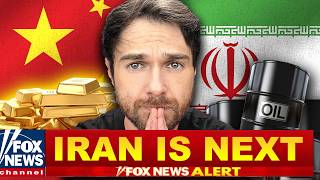
Under this framework, Iran emerges as the likely next major flashpoint for American strategic action. Iran controls the northern edge of the Strait of Hormuz — a chokepoint through which roughly one-fifth of the world's oil passes daily. It supplies discounted oil to both China and Russia outside of dollar-denominated settlement, weakening U.S. sanction power. It has coordinated closely with Russia since 2022, supplying drones and military hardware. And it poses a direct threat to Israel, which functions as a critical U.S. security proxy in the Middle East. Iran's interests were also present inside Venezuela — making it a thread that connects multiple strategic concerns at once.
None of this is inevitable. But understanding the frameworks — Monroe Doctrine, Heartland theory, Rimland theory, mineral supply chain competition — makes the direction of travel considerably less surprising. The world is not being reorganized around oil. It's being reorganized around who controls the materials, the chokepoints, the currencies, and the geography that will define the next century of power.