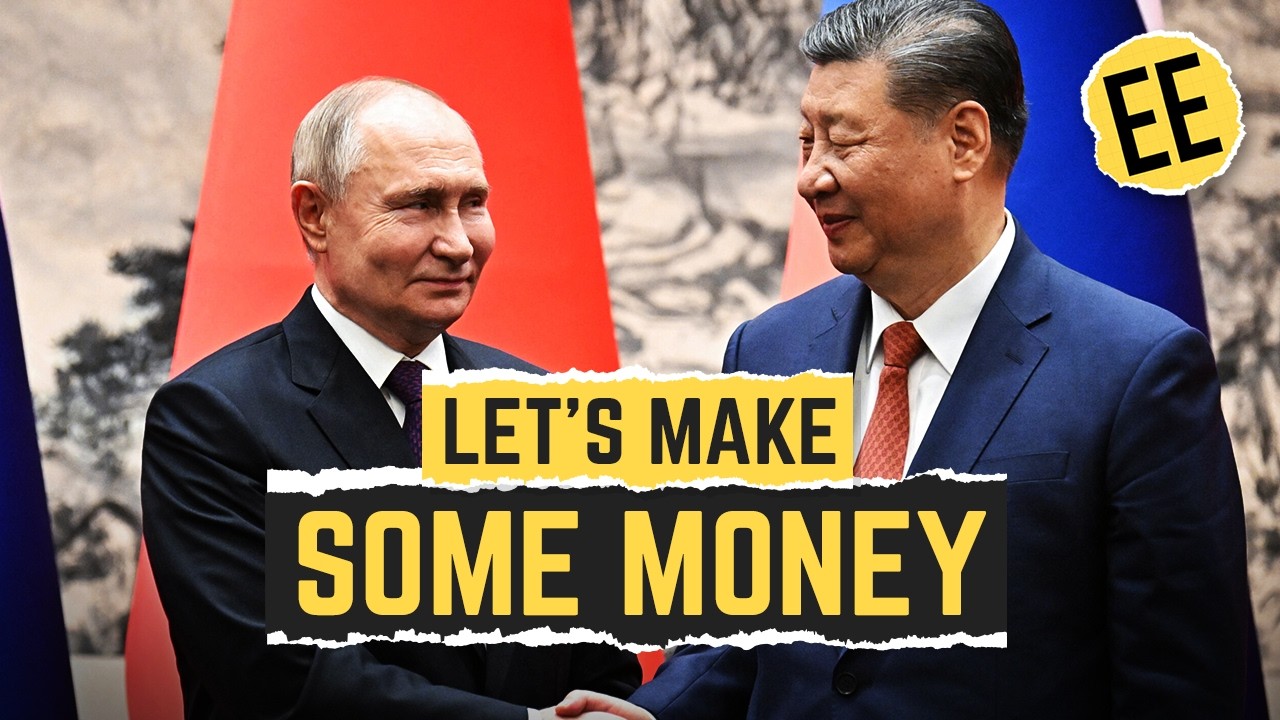

The Iran war has two unlikely winners — and neither of them is anywhere near the Middle East. Russia and China are both benefiting economically from the Iran conflict, though in very different ways and for very different reasons. Russia is getting something it desperately needed: time, higher oil revenues, and a distracted Western audience. China, meanwhile, is treating the whole situation as a generational opportunity to cement its economic influence, challenge the US dollar's dominance in global trade, and position itself as the world's most reliable dealmaker. Neither country fired a shot. Both are quietly coming out ahead.
How Is the Iran War Benefiting Russia and China?
To understand why both countries are quietly celebrating, you have to look at where their economies were before the conflict started — and what they needed most.
 01:45
How Russia and China benefit from Iran war disruption without direct involvement
Watch at 01:45 →
01:45
How Russia and China benefit from Iran war disruption without direct involvement
Watch at 01:45 →
Russia entered this period as the most heavily sanctioned economy on Earth, an economy that was surviving but not thriving. China, by contrast, was already executing a long-term plan to shift its economic weight upward — it just needed a catalyst. The Iran conflict has served as both a lifeline for one and a launchpad for the other.
For Russia, the benefits are almost embarrassingly direct. When Gulf oil supplies get disrupted, global oil prices rise. And when global oil prices rise, even discounted Russian barrels fetch significantly more on the gray market. If oil jumps $30 a barrel, Russia's discounted sales — routed through intermediaries in India and Turkey — still land at a higher net price than before the disruption started. At the same time, Western governments that were loudly condemning Russian aggression are now quietly loosening energy sanctions because their own citizens are facing doubled heating bills. The moral calculus shifts fast when the political cost of an energy crisis at home outweighs the political cost of hypocrisy abroad.
China's benefits are longer-term but arguably more structural. Higher oil prices accelerate the global transition to clean energy — and China manufactures more than 80% of the world's solar panels and roughly 75% of all lithium-ion batteries. Every nation that decides to reduce its fossil fuel dependency is almost certainly buying Chinese equipment to do it. The West talked about energy transition for years. China built the supply chain.
What Is the Petrodollar and Why Does It Matter?
One of the most significant economic developments to emerge from this conflict has been the direct challenge to the petrodollar system — and to understand why that matters, you need to understand how it works.
04:10
The Strait of Hormuz renminbi announcement — a direct challenge to the petrodollar system
Watch at 04:10 →
Since the 1970s, the vast majority of global oil has been priced and traded in US dollars. That means every country importing oil needs to hold dollar reserves, which creates enormous structural demand for dollars and for US government debt. That demand is a core reason America can borrow as cheaply as it does and run the deficits that it does.
About two weeks into the Iran conflict, it was announced that the blockade of the Strait of Hormuz would be relaxed specifically for ships transacting oil in Chinese renminbi rather than US dollars. That is not a minor diplomatic footnote. That is a direct economic warning shot at America's financial architecture. If even a fraction of global oil trade shifts to renminbi denomination, it reduces structural demand for dollars and increases demand for the yuan — with very real consequences for US borrowing costs, currency stability, and geopolitical leverage.
It won't happen overnight. The renminbi is still a compromised currency: capital controls, government intervention in exchange rates, and opacity in China's financial system all limit its appeal as a true global reserve currency. Countries will use it when they have to — not because they love it. But having a second option reduces vulnerability to American financial pressure, and that alone is valuable to a growing number of nations.
How Is Russia's Economy Surviving Despite Sanctions?
Russia became the most sanctioned country on Earth following its 2022 invasion of Ukraine, and by most reasonable assessments, its economy should have buckled by now. The fact that it hasn't comes down to three structural advantages that the Iran conflict has now amplified.
06:30
How Russian oil gets laundered through intermediary countries to avoid sanctions
Watch at 06:30 →
First, resources. Russia is the most resource-rich nation on the planet — oil, natural gas, metals, and timber — and those resources are fungible. Once a barrel of Russian crude enters the global system through an intermediary like India or Turkey, it gets refined, blended, and re-exported with a new country of origin. The provenance gets laundered out of the supply chain, plausible deniability gets baked in at every step, and Russian energy revenues keep flowing.
Second, food self-sufficiency. Russia can feed its own population entirely through domestic agricultural production. In an economic siege, that is a massive strategic advantage. Russia is also one of the world's largest wheat exporters, giving it leverage over countries that depend on grain imports. As oil prices rise and fertilizer costs climb — nitrogen fertilizers are made from natural gas — food security becomes a card Russia can play more aggressively.
Third, the China relationship. Russia provides cheap energy and raw materials; China provides manufactured goods and a willing buyer. Neither side particularly loves the arrangement, but both need it. The Iran war has deepened this partnership because both countries now have an even stronger shared interest in maintaining it.
The Iran conflict has also given Russia something harder to quantify but arguably just as valuable: indifference. Global media attention, diplomatic energy, and Western political capital are all being redirected toward the Middle East and away from Ukraine. Sanctions enforcement loosens. Electoral pressure to maintain a tough line on Russia diminishes. Russia doesn't have to do anything to benefit — it just needs the world to stay distracted.
Is China Using This War to Replace the US Dollar?
China isn't exactly hiding the ambition. The Strait of Hormuz renminbi arrangement was the clearest signal yet that Beijing is actively working to position its currency as an alternative to dollar-dominated trade — and the Iran conflict has handed it an ideal moment to push that agenda forward.
10:50
China's dominance in solar panels, batteries, and EVs — sectors boosted by high oil prices
Watch at 10:50 →
China had been building toward this through the BRICS expansion, through the Belt and Road Initiative — which creates trade dependencies by funding ports, railways, and telecommunications networks across Africa, Asia, and Latin America — and through direct investment into developing economies that are broadly skeptical of Western-led financial institutions.
The argument China is making, implicitly and explicitly, is simple: the United States has shown it is willing to weaponize its payments infrastructure as a geopolitical tool. If you want to reduce that vulnerability, you need an alternative. The renminbi is that alternative. And with the Iran conflict creating real urgency around energy security for dozens of countries, that pitch is landing better than it ever has before.
Beyond the currency play, China is also gaining something money genuinely can't buy: the appearance of being the responsible adult in the room. Whether or not it is actually operating in good faith behind the scenes, China is publicly positioning itself as the stable, sensible actor trying to broker a peaceful and profitable resolution. In a geopolitical environment defined by chaos and shifting alliances, looking reliable is itself a form of power.
How Do Rising Oil Prices Hurt China's Economy?
It would be dishonest to frame this as an entirely free win for Beijing. China is by far the world's largest net importer of oil and natural gas, and every dollar added to the global oil price hits Chinese factories, power plants, and transport networks in real and immediate ways.
This conflict is also arriving on top of existing economic headwinds. The property market — which represents the primary store of wealth for most Chinese households — is still struggling, with major developers like Evergrande and Country Garden still working through debt restructuring years after their initial collapses. Trade tensions with the United States have disrupted supply chains and compressed margins across Chinese industry. Domestic consumption has been slower to recover than expected.
All of the abstract long-term geopolitical gains China is accumulating need to be weighed honestly against the concrete reality that the workshop of the world is currently paying significantly more to keep the lights on. That tension is real, and it shapes how China is approaching this conflict — not as a passive beneficiary, but as an actor with an interest in shaping the outcome.
Do Russia and China Actually Want Peace in Iran?
This is where it gets uncomfortable. The countries with the most economic influence over the parties involved — the ones best positioned to apply pressure and broker a resolution — are also the ones benefiting most from the conflict continuing. That creates a structural incentive problem that makes a negotiated peace significantly harder to achieve.
For Russia, the incentives are almost entirely in favor of the conflict dragging on. Higher oil prices, loosened sanctions enforcement, and a distracted Western audience are all functions of the war continuing. If the Iran conflict ended tomorrow and oil prices dropped back to pre-conflict levels, many of the pressures building on the Russian economy before the war started would come roaring back almost immediately.
For China, the calculus is more nuanced. A prolonged conflict serves some of its interests — the renminbi push, the coalition building, the green energy demand boost. But China's ideal outcome is probably a resolution it gets to broker. A swift, Chinese-mediated peace would deliver diplomatic credibility while bringing oil prices back to levels more favorable for Chinese manufacturing. That's why Beijing has been so carefully positioning itself as a neutral mediator even while quietly benefiting from the chaos.
The honest answer is that neither country is strongly incentivized toward a swift resolution, and both are rational economic actors making decisions based on their own interests rather than abstract principles. Eleanor Roosevelt once noted that no one truly wins a war. But in this particular conflict, Russia and China are finding that you don't need to fight one to come out ahead.
What Does the Iran Conflict Mean for BRICS?
BRICS has expanded significantly beyond its original five members and now includes both Iran and Saudi Arabia — two countries currently in active conflict with each other. Geopolitical coalitions work considerably better when their members aren't attacking one another, and the credibility of BRICS as a serious alternative to Western-led institutions takes a genuine hit when the group can't maintain basic peace among its own partners.
For China, which has been the primary architect of BRICS expansion, this creates a delicate diplomatic balancing act. Maintaining good relations with both Iran and the Gulf States simultaneously gets harder as the conflict escalates. At some point, Beijing may face pressure to pick a side — and that's a choice it has been working very carefully to avoid. The coalition is more important than ever as a vehicle for Chinese influence, and simultaneously more difficult to manage than at any point in its history.
Whether BRICS can survive this stress test will say a great deal about whether China can actually deliver on its ambitions to lead an alternative global economic order — or whether that project remains more aspiration than reality.