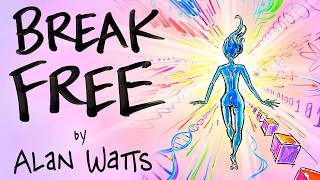
The illusion of the separate self is, according to Alan Watts, the single greatest source of human suffering. The idea that you exist only inside your skin — that your identity begins at your fingertips and ends at your skull — is not a scientific fact. It is a myth. A deeply embedded, culturally reinforced story that shapes every fear you have, including your fear of death. And once you genuinely see through it, Watts argues, the world looks entirely different.
What Is the Illusion of the Separate Self?
Watts defines a myth not simply as something untrue, but as an image through which we try to make sense of the world. The most powerful myth operating in modern Western culture is this: you are a thing, a separate event, contained within a body, moving from birth to death in isolation. You arrived by fluke, and when your wave crashes, that's it.
 01:15
Watts explains how defining yourself as only inside your skin cuts you off from the Big Bang that you still are
Watch at 01:15 →
01:15
Watts explains how defining yourself as only inside your skin cuts you off from the Big Bang that you still are
Watch at 01:15 →
But Watts challenges this head-on. Define yourself differently, he says, and everything shifts. You are not just a complicated arrangement of matter that happened to appear billions of years after the Big Bang. You are the Big Bang — the original force of the universe expressing itself in this particular, specific, unrepeatable way. The universe didn't produce you as a byproduct. It is doing you, the same way the ocean does a wave.
This isn't poetic metaphor. Watts insists it's closer to scientific reality than the isolated-self story we've been handed. You and the physical universe are as continuous as a wave and the ocean. The wave is not separate from the ocean — it is the ocean moving in a particular pattern. And you are not separate from the cosmos. You are the cosmos, shaped right now into a human being reading these words.
Are Humans Truly Connected to the Universe?
From a strictly physical and scientific standpoint, your organism is a continuous energy system with everything else happening around it. You don't stop at your skin. To fully describe what a person does, you cannot confine yourself to what happens inside their body. You have to describe their environment. You have to describe the people around them. You have to describe the world they move through.
03:40
The wave and ocean analogy — you and the universe are as continuous as a wave is with the sea
Watch at 03:40 →
This means, Watts argues, that what you are involves what everyone else is. "I don't know who I am unless I know who you are." We are not isolated units bumping into each other. We are interdependent systems, locked together, co-defining one another moment by moment. Any good scientist, he notes, already knows that the so-called external world is as much a part of you as your own body. The problem is simply that we haven't been taught to feel that way.
The myths underlying our culture have consistently reinforced the opposite: that we are parts in a machine, strangers in a foreign universe, visitors on probation. We have been — in Watts's striking phrase — hypnotized by social convention into sensing ourselves as trapped inside our own skins.
Why Do We Fear Death? The Root of Human Anxiety
When you believe you are only a separate event — a brief fluke between the maternity ward and the crematorium — death becomes catastrophic. Your wave is going to disappear. The thing you've identified as "you" will cease to exist. Of course you're terrified.
But Watts points out the fundamental problem with this logic: a wave doesn't disappear when it breaks. The water remains. The ocean continues. If you identify yourself only with the wave, you'll spend your entire existence in dread. If you identify with the ocean, death looks completely different — not an ending, but a transformation in the continuous movement of something much larger than any single form.
06:20
Watts draws the line between voluntary and involuntary action — and shows how arbitrary that boundary really is
Watch at 06:20 →
This is not wishful thinking or spiritual escapism. It is, Watts argues, a more accurate picture of what is actually happening. The fear of death is not a natural law. It is the emotional consequence of a mistaken identity.
What Did Alan Watts Mean by 'Myth'?
Before unpacking his ideas, Watts is careful to define his terms. When he calls something a myth, he doesn't mean it's simply false or made up. A myth, in his framework, is a foundational image or story through which a culture makes sense of existence. Myths are built into language, into logic, into what we consider common sense. They operate beneath conscious thought.
The myth of the separate self is so deeply embedded that it doesn't feel like a belief at all — it feels like plain reality. You don't choose to feel isolated inside your body. You just do. That's how effective the myth is. It has shaped the structure of your experience so thoroughly that alternatives feel abstract, academic, even absurd.
Recognizing this is the first move. You cannot question an assumption you don't know you're making.
Is What You Do Really Voluntary or Involuntary?
One of Watts's most disarming observations concerns the boundary between voluntary and involuntary action. We typically define ourselves as the part that acts deliberately — the chooser, the decider. Everything that happens automatically (heartbeat, digestion, circulation, bone growth) gets filed under "not me."
But think about it carefully. When you decide to open your hand, how do you decide? Do you first decide to decide? You don't. The decision simply arises. And if you don't know how you produce that decision, is it really voluntary? What about breathing — you can control it consciously, but when you forget about it, it continues on its own. Is that you or not you?
The dividing line between self and not-self turns out to be completely arbitrary. Watts argues that if you fully inhabit yourself — if you get with the whole of what you are — something remarkable happens: you discover that your so-called involuntary functions are continuous with the larger processes of the universe. The circulation of your blood is one continuous process with the stars shining. Your physical organism is one energy system with the entire cosmos. It's all you. You've just been playing the game that you're only a small piece of it.
What Is the Ego According to Alan Watts?
The ego, for Watts, is not a villain. It's a tool — specifically, the focus of conscious attention. He compares it to radar on a ship. The radar scans for obstacles, trouble, danger. That's its job. Conscious attention works the same way: it's a function of the brain designed to monitor the environment for anything that needs addressing.
The problem is not that the ego exists. The problem is that we have made the catastrophic mistake of identifying ourselves with the radar. If the radar were sentient and believed it was the entire ship, it would live in a permanent state of alarm — because that's all it ever sees: problems, threats, incoming obstacles. And that, Watts says, is exactly the psychological state most people inhabit. Perpetual anxiety. Because we've mistaken the troubleshooter for the self.
The moment you step back and identify with the whole organism rather than just the scanning tool, something shifts immediately. You notice the extraordinary harmony of everything functioning together. Even the internal conflicts — the biological battles happening inside you right now — are part of what keeps you healthy and alive. What looks like discord at one level is harmony at a higher level.
How Do You Stop Identifying With the Ego?
Watts doesn't offer a technique so much as a realization. The shift happens when you genuinely see — not just intellectually accept, but viscerally feel — that you are the fabric and structure of existence itself. Not a guest in the universe. Not a tourist passing through. The thing doing the existing, shaped right now into a human form.
When that recognition lands, the world stops being something you're up against. The patterns in waves, the markings in marble, the way a cat moves — they're not more natural than you. You belong here with the same depth, the same inevitability, the same strange perfection. Everything you are and do, viewed from a high enough level, is as free of blemish as any other pattern in nature.
This, Watts says, is what it means to awaken from the illusion. Not to become someone else. Not to transcend humanity. But to finally feel what was always true: your existence is not accidental, not temporary in any meaningful sense, and not separate from the universe that produced it. You are the universe, happening as you — and there's no better time to stop pretending otherwise.