When your nervous system is running on overdrive — too much screen time, noise, social input, or stress — what it needs is not intensity but permission to slow down. This gentle yoga session is designed specifically for those moments of overstimulation. You don't need a fully equipped studio. A blanket, bolster, block, or even just the floor beneath you is enough. The goal is simple: reconnect with your body, soften your focus, and breathe.
Arriving: Settling Into the Body
Begin in a comfortable seated position. Bring your palms together in front of your heart. Let your gaze drop softly downward — eyes open only about fifteen percent, creating what you might call a soft focus. Begin slowly rubbing your palms back and forth against each other, feeling the warmth and texture of your own touch.
This seemingly small act matters. When we are overstimulated, even this — finding a soft gaze, feeling our own hands — can be surprisingly difficult. That difficulty is useful information. Stay with it. Relax your shoulders. Let the movement be slow and steady, or slightly brisker if you need a little warmth. Either way, you are already beginning to call the nervous system back toward balance.
After a few moments, press your palms gently against your heart space, using that physical contact to lift and open the chest. Then cup both hands softly over your eyes — knuckles gently bent, not pressing hard. If this doesn't feel comfortable, simply return to the soft downward gaze. Take two or three deepening breaths here. Nothing forced, nothing fast. Just more attention arriving at the breath. Then release the hands to your sides.
 02:30
Hands cupped gently over the eyes, soft focus or eyes closed, shoulders relaxed
Watch at 02:30 →
Seated Movement: Side Stretches and Gentle Twists
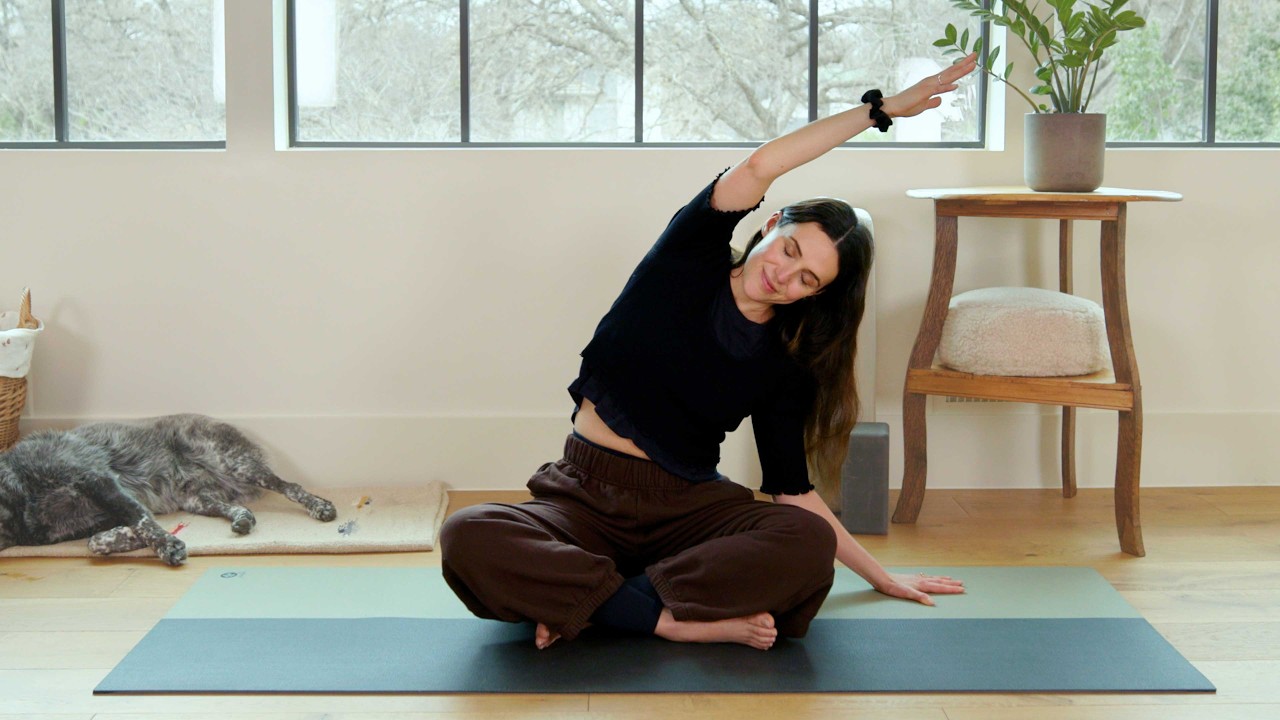
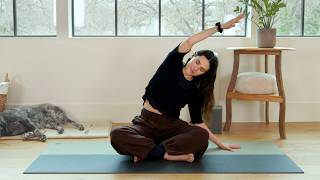
From your seated position, press your left palm into the ground and slowly raise your right fingertips toward the sky, drifting into a side body stretch. Move as if through water — that image of resistance and slowness is worth holding onto throughout this practice. Let your breath guide the movement: feel the inhale create space, feel the exhale deepen the stretch.
From the side stretch, drop your right hand to your left knee and ease the spine back upright into a gentle twist. Left fingertips trail behind you. This is not a deep, cranking twist — it is a subtle, exploratory rotation. Breathe. Then return to center and repeat on the other side: right hand to earth, left arm rising and arcing into a left side body stretch, followed by a soft twist in the opposite direction.
06:00
Seated side body stretch with one arm reaching overhead, slow and fluid movement
Watch at 06:00 →
Return to center. Bring the palms together again and repeat the slow rubbing motion. Then place your palms on your knees and begin making slow circles with your torso — forward, to the right, back (rounding through the spine, chin to chest), then to the left. Let your face stay soft. Let the movement feel almost effortless. Reverse the circle. Then settle back into stillness, stacking the head over the heart, the heart over the pelvis, finding that vertical alignment by feel rather than by sight.
Seated Forward Fold: Five Breaths of Release
Extend your legs out in front of you. If you have a blanket or bolster, place it across your hip creases to create a gentle compression in the low belly — this is grounding and calming to the nervous system. Sit up tall on an inhale, then on the exhale begin to fold your heart forward over your legs. Your version of this might be deep, or it might mean knees bent and belly resting on the thighs. Both are valid.
12:00
Seated forward fold with bolster at hip crease, head relaxed, knees can be bent
Watch at 12:00 →
Once you find your position, close your eyes or soften your gaze and count five full cycles of breath — in and out. Let each exhale carry you a little further into stillness. There is no destination here. There is only the breath and the body, right now.
Supine Sequence: Grounding Through the Back Body
Slowly — moving through water — transition to lying flat on your back. Bend your knees and hug them into your chest. This compression of the knees toward the torso is soothing: it creates a sense of containment and safety. Let the shoulders relax completely. Let the jaw go soft. Breathe.
Then extend one leg at a time: left foot to the ground, right leg reaching up toward the sky. Hug the right knee in, find that compression, then extend the left leg long. You have the option to gently lift the nose toward the knee — or simply rest the head. Breathe. Switch sides. Left leg rises, right foot grounded, then left knee hugs in as the right leg extends.
17:30
Supine single-leg stretch with one leg extended toward ceiling, other leg long on mat
Watch at 17:30 →
From here, if you have a block, slide it beneath the small of your back on its lowest setting. If not, simply press the low back gently into the ground. Extend both legs upward into a Viparita Karani — legs up, a waterfall pose. Let the upper body go heavy. Toes soft, fingertips soft, shoulders melting into the floor. Take a few easy breaths here before gently lowering one foot, then the other.
19:30
Legs extended up toward ceiling in Viparita Karani (waterfall pose), block optional under low back
Watch at 19:30 →
Savasana: Softening and Letting Go
Remove the block if you used one. Place a blanket or bolster beneath the backs of your knees, and if available, a gentle weight across the hips. Pillow the head if you like. Find a position for your hands that feels grounding — perhaps palms facing up, perhaps one hand on the belly.
Take one full, deliberate breath in together. Then exhale everything: the weight of the body, the noise of the day, the busyness of the mind. You are not alone in needing this. Allow the breath to find its own natural rhythm. Let the body get quiet. Let the mind follow.
When you are ready to close, rub the palms together one final time and cup them softly over the eyes. One long, slow breath in. A full, releasing breath out. Bring the thumbs to the third eye center. The practice is complete — but you are welcome to stay as long as you need.