Core work in yoga doesn't have to mean grinding through crunches or holding a plank until you shake. This session treats the abdominal wall as a centering mechanism — a physical and energetic anchor — drawing on breath, slow deliberate movement, and body awareness to build functional strength from the inside out. Whether you're returning to movement after a break or simply want a gentler approach to core training, this practice meets you where you are.
Setting the Foundation: Seated Tuning In
Begin in a comfortable seated position, lifting the hips slightly if needed to allow the spine to lengthen. Let the shoulders soften away from the ears and let the breath arrive without effort.
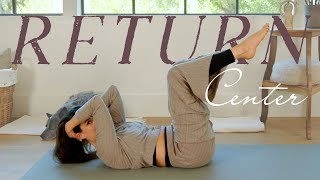
Bring both hands to the heart and take several full breaths — inhaling deeply, exhaling completely. After a few cycles, release the arms and begin to move in slow circles, letting the navel center guide the motion. Move forward, to one side, back, and to the other, then reverse the direction. Gradually allow the circle to shrink until you arrive at stillness — head stacked over heart, heart over pelvis.
 03:10
Instructor demonstrating seated circular spinal movement guided by the navel center
Watch at 03:10 →
From this centered position, inhale and reach both arms overhead, then exhale and float them back down. Repeat three times, using each breath to reinforce the vertical line you've found. Follow with a seated twist in each direction — inhaling to arrive, exhaling to deepen, then returning through center before switching sides.
Floor Work: Activating the Abdominal Wall
Transition to lying on your back and hug both knees into your chest. Rock gently side to side, feeling the support of the mat beneath you. Take a moment to simply notice the groundedness of this position before beginning to move.
Single-Leg Stretch
Keep the right knee hugged in and extend the left leg long, allowing the left heel to rest on the floor. This is a valid resting position. For more challenge, engage the lower abdominals and lift the left foot to hover above the mat. Draw inward from the hip points and press the navel down toward the earth, then hug the lower ribs in to engage the upper abdominals. Switch sides, bringing the left knee in and extending the right leg.
09:45
Instructor demonstrating single-leg stretch with heel hover modification
Watch at 09:45 →
Once familiar with the movement on each side, begin to alternate — switching legs in a slow, controlled scissoring motion. Move at a pace that allows the muscles to work rather than momentum to take over. If the lower back protests, scoop the tailbone upward, reduce the range of motion, and check that you haven't stopped breathing. Continue for a count of four on each side before resting.
Tabletop Leg Work
Place the feet flat on the mat, knees bent, and rest the hands on the belly for a recovery breath. Then press the palms into the mat — or grip the outer edges of the mat for added stability — and lift one knee at a time to bring the shins parallel to the ceiling, forming a tabletop position with the legs.
Begin opening the knees and toes slightly outward, then drawing them back in, as if the shins were sliding along an imaginary surface overhead. Keep the movement small and deliberate. The goal is recruitment of the deep core, not large visible motion. If you want more challenge, extend one leg out long as the knees draw in, alternating sides. Continue for several breaths, then squeeze the knees together and repeat the motion with inner thighs connected — this increases the demand on the lower abdominals while protecting the lower back.
14:30
Instructor demonstrating tabletop leg variations with knee open-close and single-leg extension options
Watch at 14:30 →
Crunches with Intention: Upper Abdominal Work
Walk the feet hip-width apart, heels aligned under the knees. Interlace the fingers behind the head, keeping the elbows relatively close together rather than splayed wide. Inhale to prepare.
On the exhale, tilt the pelvis so the tailbone lifts slightly toward the ceiling, pressing the lower back flush with the mat. Inhale to reinforce this position. Then exhale and curl the lower ribs toward the hip points, lifting the chest, chin, and elbows. The gaze travels upward rather than into the knees, and there is a small but deliberate space between chin and chest throughout.
Inhale to lower, exhale to lift. With each repetition, visualize drawing the hip points toward the navel — cinching everything inward as you rise. The feet remain grounded without gripping. Continue for several cycles, focusing on the quality of each contraction over speed or quantity.
Breathwork: The Sound of Stillness
After releasing the crunch work, allow the knees to fall open with the soles of the feet together in a reclined bound angle shape. Place the right hand on the belly and the left hand on the heart. Let the lower body relax completely.
Begin breathing in and out through the nose. On each exhale, silently imagine making the sound ahhh — not aloud, but as an internal resonance. Track the inhale arriving, and on the exhale, let that silent sound accompany the release. After several rounds, experiment with making the imagined sound quieter, almost a whisper inside the mind. Notice how even this subtle shift affects the quality of your breath and attention.
22:00
Instructor demonstrating reclined bound angle pose with hand placement for breathwork visualization
Watch at 22:00 →
Final Sequence and Rest
Hug the knees back into the chest, give them a full squeeze, then return the feet to the mat. Interlace the fingers behind the head one final time. Inhale, then exhale and lift the chest and elbows. Maintaining this lifted position, bring the shins back to tabletop — one leg at a time. Alternate tapping the toes down and lifting, keeping the navel drawn in and the face relaxed. Imagine a rubber band connecting the hip points to the lower ribs, keeping that space compact throughout the movement. For the final repetitions, tap both feet down simultaneously, then lift both together.
Release everything. Extend the legs long and let the arms fall naturally to the sides. Arrive in final resting pose — savasana. Inhale deeply, and on the exhale, release a full audible sigh. Allow the body to be completely supported. Rest here for several quiet breaths, returning to the same quality of presence you cultivated at the very beginning of the practice.
To close, draw the feet together and reach both arms overhead for a full-body stretch. Inhale fully, then exhale and bring the palms together at the heart. This practice of returning to center — through movement, through breath, through patient attention — is itself the core work.