Real-time voice to image AI works by capturing spoken narration through voice recognition, converting it into a text prompt, and feeding that prompt into an image generation pipeline — all in seconds. At a recent machine learning conference, a live demo showed exactly this in action: a user described an angry dragon searching for a lost egg, and the system generated and evolved a visual panorama in real time, responding to every new sentence. No typing. No clicking. Just talking — and watching a world appear.
How Does Real-Time Voice to Image AI Actually Work?
The system demonstrated at the conference captures your voice on a laptop, runs it through voice recognition software, and sends the resulting text to an image generation backend. What makes it especially impressive is the pipeline's ability to compose images over and over on an evolving panorama — meaning the scene doesn't reset with each new sentence. It grows, changes, and responds.
 0:15
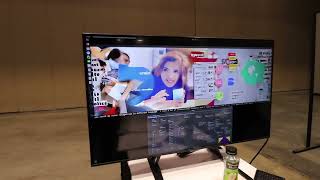
Live demo: narrator describes a dragon searching for a lost egg as the AI generates an evolving panoramic scene in real time
Watch at 0:15 →
0:15
Live demo: narrator describes a dragon searching for a lost egg as the AI generates an evolving panoramic scene in real time
Watch at 0:15 →
In the demo, a narrator described a beautiful garden, introduced a dragon, made it rain, and then sent the dragon on a frantic search for a lost egg. Sentence by sentence, the image shifted — rain fell, the dragon's mood darkened, and eventually the egg was found in a cupboard. The visual story unfolded fluidly, in real time, from nothing but spoken words.
The creators also built in a set of sliders that let users modulate the mood or stylistic context of the generation. Rather than changing the image directly, these sliders add finely weighted terms to the underlying prompt — nudging the output toward Picasso-esque abstraction or dialing in a specific visual atmosphere. It's prompt engineering made tactile and immediate.
What AI Model Powers Voice-to-Image Generation?
The system is built on Stable Diffusion 2.1, one of the most capable open-source image generation models available. However, the team didn't use it off the shelf. They had to rebuild the pipeline from scratch to support the evolving panorama format — where each new narration layer composites on top of the last rather than generating an isolated image.
1:45
Researcher adjusts mood sliders on the interface, showing how prompt weighting shifts the visual style toward Picasso-like abstraction
Watch at 1:45 →
This is a meaningful technical distinction. Standard Stable Diffusion usage generates a single image per prompt. This system treats the canvas as a living document, continuously updated by what you say. The result is something that feels less like a static image generator and more like an AI cinematographer following your script in real time.
The voice recognition runs locally on the laptop, which keeps latency low, while the heavier image generation workload is handled server-side. The combination makes the experience feel surprisingly snappy for something so technically complex.
Does AI Image Generation Work in Multiple Languages?
Here's where things get honest — and a little uncomfortable. The system currently only works in English, and the researchers openly acknowledged this is a serious limitation. The core issue isn't voice recognition. Modern voice-to-text tools can handle many languages. The real bottleneck is that the underlying image generation model was trained predominantly on English-language captions.
Even if you did voice recognition in French, Mandarin, or Arabic and then translated the result into English before passing it to the model, you'd still lose nuance. The model's understanding of imagery is baked into its relationship with English text. A translation step helps but doesn't fully bridge the gap.
3:30
Artist shows her original vegetable drawing alongside the AI-transformed version — vegetables planted in a forest with the machine that made them
Watch at 3:30 →
One of the researchers put it bluntly: "Colonialism sneaks in in so many places with these technologies. We have to be on our lookout all the time for that." It's a candid admission that the English-centricity of most large AI models isn't just a technical quirk — it's a structural bias with real consequences, especially for educators and creators working with international communities.
Why Is English Bias a Problem in AI Image Models?
The language limitation matters beyond just inconvenience. For educators, researchers, and artists working globally, tools that only respond meaningfully to English prompts exclude entire communities from the creative and expressive potential of generative AI. One researcher noted that language accessibility is the first question international students ask when introduced to these tools.
Solving this properly would require training image generation models on multilingual caption datasets — not just bolting on a translation layer. Until that happens, non-English speakers are essentially second-class users of these technologies, forced to work in a language that may not be their own to access tools that are increasingly central to creative and professional life.
How Are Artists Using Stable Diffusion in Their Work?
One of the most compelling conversations at the conference was with an artist who had been making diary comics for years — small, absurd illustrations of everyday moments. Potato mushrooms. Odd things that just pop up in daily life. The kind of material that makes a perfectly decent comic strip on its own.
But now, she's running those same moments through AI image tools built on Stable Diffusion, and the results are genuinely strange and funny in ways she says she never would have arrived at alone. One image started as a simple drawing of vegetables. After passing it through the tool with a generated caption, it became a scene of vegetables planted in a forest, accompanied by the machine that made them — surreal, unexpected, and somehow perfect.
Her approach to the tool is refreshingly practical: "It exists. We might as well use it in positive, funny ways before we use it in ways that make us cry." She's not fetishizing the technology or treating it as a replacement for her artistic instincts. She's treating it as a collaborator — one that occasionally produces something so bizarre and delightful that you have to laugh.
She also described a project called "Being Moose", in which she uses AI transformation tools to insert herself into increasingly absurd visual contexts. The project is ongoing, deadpan, and exactly the kind of weird creative territory that becomes possible when you stop asking whether AI art is "real" art and just start making things.
Can AI Turn Everyday Comics Into Animated Art?
The short answer is yes — and the process is more accessible than most people realize. The workflow the artist described involves a few key steps: start with a source image (in her case, original drawings), add a text prompt describing how you want to transform it, and optionally ask the tool to generate its own caption interpretation of the image first.
One of the tool's features lets you ask it what it thinks the image is — and the results are often absurd enough to be creatively useful. In one example, a drawing of vegetables on a beach was interpreted as "animals on the beach," which the artist then ran back through the system to produce something that looked like a Doctor Seuss fever dream. Her cat had been, in her words, "shrimp-ified." The house had become a mouse. Surfers appeared on the beach for no clear reason.
These aren't happy accidents — they're the kind of generative surprise that can only happen when a human creative sensibility is in dialogue with a system that doesn't fully understand what it's looking at. The result is a new kind of collaboration: part authorship, part curation, part controlled chaos.
What Does This Mean for the Future of AI Creative Tools?
What the conference showcased wasn't just impressive demos — it was a glimpse at how generative AI is already being absorbed into real creative practices by real artists. Not as a shortcut, and not as a gimmick, but as a genuinely new kind of tool that produces results no individual could have reached alone.
The voice-to-image system is still specialized and English-only. The language bias issues are real and largely unsolved. But the creative possibilities — evolving panoramas narrated in real time, comics transformed into surreal animations, artists inserting themselves into AI-generated worlds — suggest that the most interesting applications of this technology are going to come from people who already have something to say, and who are willing to let the machine say something unexpected back.