If AI keeps giving you generic, surface-level answers even when you think you wrote a good prompt, the problem isn't the prompt — it's the context surrounding it. Specifically, it's the context you're not giving. The fix isn't a fancier prompt formula. It's a three-layer system called Personal Context Management (PCM) that tells the AI not just what you want, but who you are, what you're working on, and the fine-grained nuance that makes the difference between a one-size-fits-all answer and something you can actually execute on.
Why Does AI Give Generic Answers Even With Good Prompts?
Here's what happens when you ask an AI to create a book launch plan with minimal context: it asks you basic questions, delivers a passable framework, and produces something that would look exactly the same for any author writing any book on any topic. It's not bad — it's just completely generic.
The AI isn't being lazy. It's working with what it has. When you give it only a task description, it has no choice but to fill in the blanks with averages — average assumptions about your audience, your platform, your goals, your constraints. The output reflects the inputs, and vague inputs produce vague outputs.
This is the core insight behind PCM: AI quality is a context problem, not a prompt problem. Most people try to fix their results by rewriting the prompt. The real leverage is in building the context layers that surround every prompt you ever write.
What Is Personal Context Management (PCM)?
Personal Context Management is the practice of cultivating the right context so that AI can do meaningful, personalized work on your behalf. It evolved directly from Personal Knowledge Management (PKM) — the decade-old discipline of capturing and resurfacing your best thinking. The key difference? Your notes are no longer just for you. They're now inputs to an AI system that can act on your behalf.
PCM is the recognition that your notes, your project folders, your research, your opinions, and your values are all raw material that an AI can use — but only if you give it access. The skill isn't writing better prompts. It's managing your information so that when you sit down with an AI, the right context is already there, ready to be loaded.
What Are the Three Layers of AI Context?
PCM operates on three distinct layers, each serving a different purpose and covering a different time horizon. Together, they form what we mean when we say "context."
Layer 1: Persistent Context — Who You Are
Persistent context is the stable, durable information about you that should inform every single interaction you have with AI. Your role, your values, your communication style, your team, your audience, your professional background. This is the stuff that doesn't change conversation to conversation.
This layer lives in what's called a master prompt — stored in your AI tool's custom instructions or personal preferences. Once it's there, the AI loads it automatically with every conversation. You stop repeating yourself. The AI already knows who it's talking to.
The difference this makes is striking. Without it, the AI asks you basic questions. With it, the AI asks whether your internal team includes specific people it already knows about, flags that your son's birth might shift your timeline, and references your YouTube channel as a key distribution channel — all because that information was already there.
Layer 2: Project Context — What You're Working On
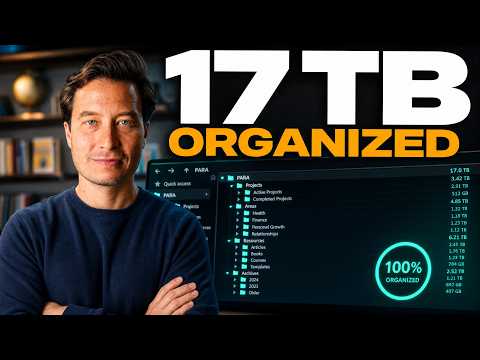
Project context is the active, scoped information specific to a current initiative: product details, decisions already made, research you've gathered, stakeholder information, deadlines, objectives. If you've used the PARA method — organizing your digital life into Projects, Areas, Resources, and Archives — this layer already exists in your project folders. You've been building PCM infrastructure without knowing it.
Adding project context transforms the AI's output from generic to genuinely close to executable. In a real example of building a book launch plan, adding access to the book's project folder and the Obsidian vault where the manuscript lived meant the AI could reference the specific launch date, cite that YouTube drives 53% of audience growth, pull in the author's origin story from the manuscript, and account for a newborn's arrival in the scheduling recommendations. That's not a generic marketing plan anymore. That's a working document.
Layer 3: Perishable Context — What Only You Know Right Now
Even with detailed project files, there's always a final layer of nuance that lives only in your head: the most recent update, the decision you made yesterday, the idea you've quietly abandoned, the constraint that just changed. This is perishable context — precise, minimal, and time-sensitive.
A short brain dump before you submit your final prompt closes the gap. A few sentences about the baby arriving early and everyone sleeping well, confirming you're ready to go full swing in a few weeks, dropping the podcast idea, and flagging a preference for highest-leverage activities only — those four or five sentences reshape the entire plan. Phases get restructured. Low-value activities get cut. The output becomes something you'd actually act on.
What Is a Master Prompt and How Do You Build One?
A master prompt is a structured document that captures your persistent context — the foundational information about you that the AI should always have available. Think of it as your professional and personal biography written for an AI assistant.
A solid master prompt includes things like your name, location, family situation, professional title and company, what your business does and sells, your communication preferences, your team members, your primary platforms and audience, and your working style. The goal is to give the AI the same holistic picture of your life that a close colleague or trusted friend would have — so it stops giving you advice that ignores everything it doesn't know.
Once built, the master prompt lives in your AI tool's custom instructions settings. It loads automatically. You write it once, and it works in the background of every conversation you have from that point forward.
Is Context Engineering Actually a Technical Skill?
The term gaining traction in the AI industry is context engineering — but that framing is worth pushing back on. Engineering implies a technical skill, something requiring specialized knowledge or a systems background. That's not what this is.
What PCM actually involves is arranging the kinds of information you already work with every day — text, images, files, documents, folders — into loosely curated collections, and pointing the AI at them. That's information management. That's content curation. It's accessible to anyone who takes notes, runs projects, or maintains any kind of organized workflow.
Accessible, however, doesn't mean easy. The shift required is conceptual: you have to start thinking one level up, in terms of the broader system the AI operates within, rather than just the individual task in front of you. That's a mindset change, not a technical one.
How to Think Like a Context Architect
Embracing PCM fully means working through three identity shifts that tend to sneak up on practitioners:
- Shift 1 — Curating context becomes your job. More and more of your professional time goes toward finding, gathering, and organizing the best context: the most specific, most opinionated, most up-to-date information you can source. Think like a scientist or an explorer. Seek out sources and perspectives that aren't already baked into the AI's training data.
- Shift 2 — You stop executing and start delegating. The better your context management, the less time you spend doing the work yourself. The bottleneck in your professional life used to be output. Now it moves upstream to clarity and intention. PCM is delegation — not to a person, but to a system. And like all delegation, the quality of the result is determined entirely by the quality of the handoff.
- Shift 3 — You get radically clearer about what you actually want. AI has a homogenizing effect. It flattens and averages. The only way to stand out in an AI-saturated world is to inject more of yourself: your values, your taste, your perspective, your opinions. You have to make your implicit judgment explicit — to externalize it so the AI can borrow it.
What you're really curating in PCM isn't data. It's yourself. The practice has a name — Personal Context Management. The identity that comes with it is Context Architect. And it's not a methodology to bolt onto your existing workflow. It's a new way of seeing what you already do: the notes you take, the projects you start, the prompts you write. One decision, one context layer at a time.