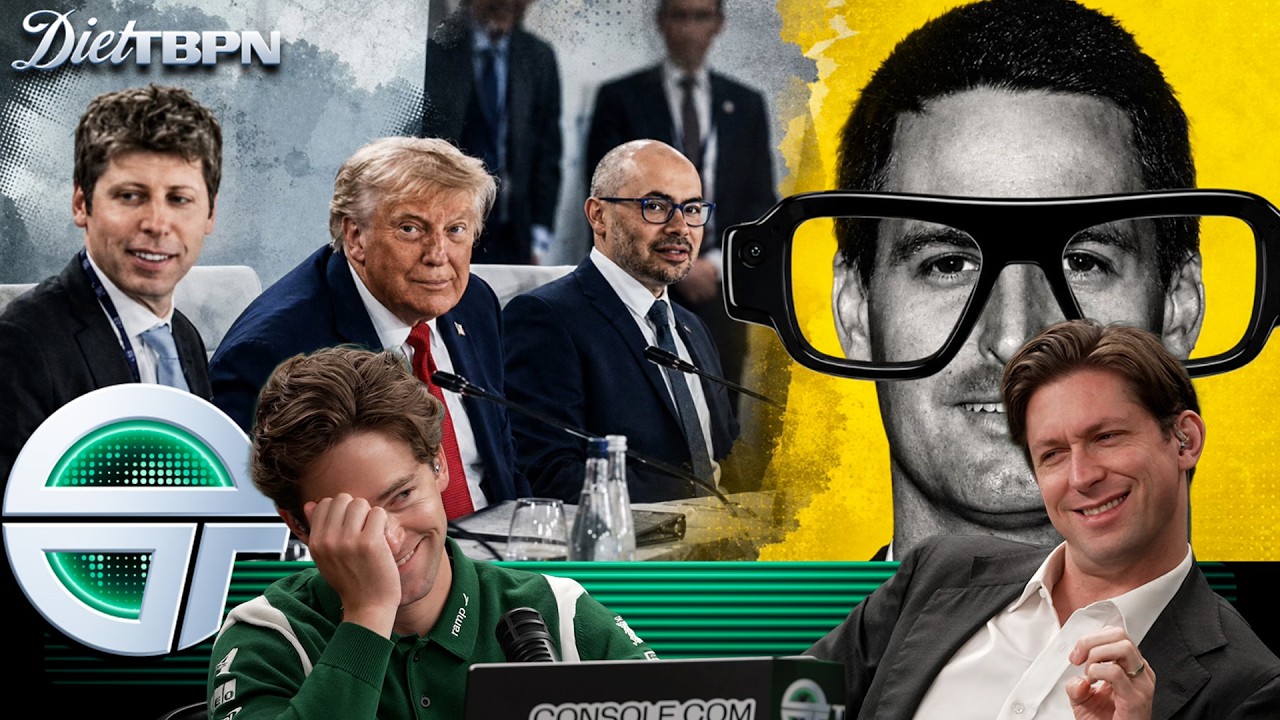

Are Snap Spectacles Worth $2,200 in 2025?
The short answer: for most people, probably not — at least not yet. Snap Spectacles AR glasses were unveiled at Augmented World Expo 2025, and whether snap spectacles are worth buying depends entirely on who you are and what you expect from them. At $2,200 a pair, they're a hard sell. The feature set is genuinely impressive on paper — augmented reality overlays, restaurant reviews in your visual field, shared virtual whiteboards, distance measuring, maps, and a heads-up display. But impressive demos don't automatically translate into a product people will wear every day. And that's the core tension here: Snap has built something technically interesting that doesn't yet have a killer use case compelling enough to justify the price or the discomfort of wearing it for hours at a stretch.
 00:45
Side-by-side comparison of Snap Spectacles next to an exaggerated mockup — the contrast makes the real glasses look surprisingly normal
Watch at 00:45 →
00:45
Side-by-side comparison of Snap Spectacles next to an exaggerated mockup — the contrast makes the real glasses look surprisingly normal
Watch at 00:45 →
Even Evan Spiegel, Snap's CEO, was spotted with a visibly bent ear from wearing the temple arm — the part of the frame that hooks behind your ear. There's clearly some weight back there, likely housing the battery and compute. Wear that for four hours on a golf course or in an office and you'll feel it. That's not a small problem to dismiss.
What Can Snap Spectacles Actually Do?
According to Snap's own specs page, the glasses are pitched at a surprisingly broad audience. Here's what they're capable of:
- Augmented navigation and maps — turn-by-turn directions overlaid on your actual field of view
- Restaurant and location reviews — see ratings and info as you look at a storefront
- Shared AR whiteboards — remote collaboration in a shared virtual space, aimed at prosumers and enterprise teams
- Distance and measurement tools — skip the tape measure; the glasses measure for you
- General AI assistance — context-aware answers to questions based on what you're looking at
- Furniture and space visualization — see how a couch fits in your living room before you buy it
Every single one of those features is genuinely cool. But cool and essential are very different things. The furniture visualization use case, for example, might come up once every couple of years for the average person. The golf rangefinder use case? You can buy a dedicated rangefinder for around $150 that doesn't run out of battery after three and a half hours — and serious golfers are often out for five or six hours at a stretch. These are features without a daily home.
04:10
On-air demo of Snap Spectacles being worn during a live interview, showing the audio mix shifting as the reporter puts on the headset
Watch at 04:10 →
Snap Spectacles vs. Meta Ray-Bans: Which Is Better?
This is where the market positioning gets tricky. Meta Ray-Bans retail for $299 — a full $1,900 less than Snap Spectacles. Yes, the Spectacles have significantly more features and full AR capability, while the Ray-Bans are more of a camera-equipped smart glasses with audio. But the Ray-Bans benefit from a legitimate fashion brand partnership, a massive developer ecosystem tied to Meta's platforms, and a price point that makes impulse purchases possible.
Then there's the Chinese hardware competition. Companies like Xreal are producing screen-equipped glasses for a few hundred dollars that, while not true AR, project what feels like a 200-inch screen in front of you. Plug in an HDMI from an Xbox and you've got a mobile gaming setup. It's not frontier technology, but it chips away at the everyday use cases Snap is trying to own — and it does it at a fraction of the price.
The honest comparison: if a startup with no track record shipped the Spectacles demo, they'd probably raise a billion dollars easily in today's market. But Snap isn't being judged like a startup. They're a public company that has reportedly spent somewhere between $3.5 billion building this product, and the stock has fallen 92% from its peak. That context changes everything about how investors and consumers receive the launch.
08:30
Discussion of Xreal glasses as a cheaper Chinese competitor eating into AR use cases at a fraction of Snap's price
Watch at 08:30 →
Why Is Snap Stock Falling Despite the Spectacles Launch?
Snap's stock dropped more than 8.5% in the five days around the Spectacles launch, and it's down roughly 2% over the last five years. That's the brutal backdrop Evan Spiegel is defending himself against. The critique from market observers is pretty straightforward: Snap has a genuinely strong ads business, a social network with real network effects, and a user base that could make it an AI winner. The question is why so much capital has been deployed into wearables R&D instead of optimizing the core business.
The counterargument is that Spiegel has been building toward this for over a decade. Snap acquired companies working in the AR space as far back as 10 years ago. The first version of Spectacles — essentially just a camera in glasses frames, no screen — was actually reasonably well-received, even if it never reached true escape velocity. The problem is that the investments were greenlit when Snap's stock was near its peak and the market rewarded moonshots. Now, in the AI era, everyone is asking very different questions about capital allocation and ROI.
What Killer Feature Are AR Glasses Still Missing?
The iPhone comparison is instructive here. When the iPhone launched, its killer feature was the phone itself — it replaced the device everyone was already carrying. The App Store, the iPod functionality, the browser — those were bonuses. The core value prop was obvious and immediate.
AR glasses don't have that yet. They don't replace something everyone carries and uses constantly. The closest analogy would be replacing the screen — your phone display, your laptop, your TV. But 80-inch TVs now cost around $500. Apple Vision Pro, which has one of the most jaw-dropping demos in consumer tech (dinosaurs walking through portal walls, butterflies landing on your finger tracked in real time), still hasn't generated a breakout developer ecosystem. Even in the age of vibe coding, where building software is nearly free, developers aren't racing to build for spatial computing platforms because the install base isn't there. No users means no developers. No developers means no killer apps. It's the classic cold start problem, and no amount of impressive hardware solves it alone.
What Is Taste Labs and Can You Really Codify Design Taste?
In a separate story lighting up the tech timeline, a former Exa AI Labs founding team member launched Taste Labs, a startup with the stated mission of ending AI slop. The idea: work with frontier AI labs to improve model outputs along aesthetic lines through curated data labeling, and partner with app-layer startups to improve the visual quality of their products.
The backlash was immediate. Critics argued that taste, by definition, can't be programmed — it emerges from craft, context, genuine subjectivity, and cultural meaning. And there's a real irony in San Francisco tech workers talking about taste when the SF tech aesthetic is famously optimized for efficiency over style.
But the steel man for Taste Labs is simple: even if you can't fully codify taste, you can meaningfully improve the aesthetic output of AI models, and that's worth paying for. The practical version of this has already been happening — data labelers have been tagging things like six-fingered AI hands for years. Moving up the stack to subjective design quality is a natural evolution. The pipeline for Taste Labs probably exploded the moment the controversy hit. Whether it holds up as a long-term business is another question, but in the short term, the labs and hyperscalers who care about design quality will pay for this.
Could SpaceX Go on an Acquisition Spree With Its Valuation?
Rounding out the day's conversations: Bill Ackman shared a Financial Times piece with what's being called a Hall of Fame opening sentence — "One of the things that makes SpaceX so valuable is how valuable it is." Circular, yes, but the underlying point is real. A sky-high stock price functions as currency. Public companies can acquire other companies using their shares, and right now SpaceX's valuation gives it extraordinary purchasing power.
The question being asked is whether SpaceX will use that window to roll up assets in adjacent spaces: NeoCloud infrastructure, energy, chip fabrication (Terrafab has been mentioned), or AI. Ben Thompson flagged the same dynamic around the Cursor acquisition. It's a genuinely interesting strategic moment — but it would represent a very different kind of company than SpaceX has been. Everyone will be watching closely.