
Open Death Threats on NYC Streets: What Happened?
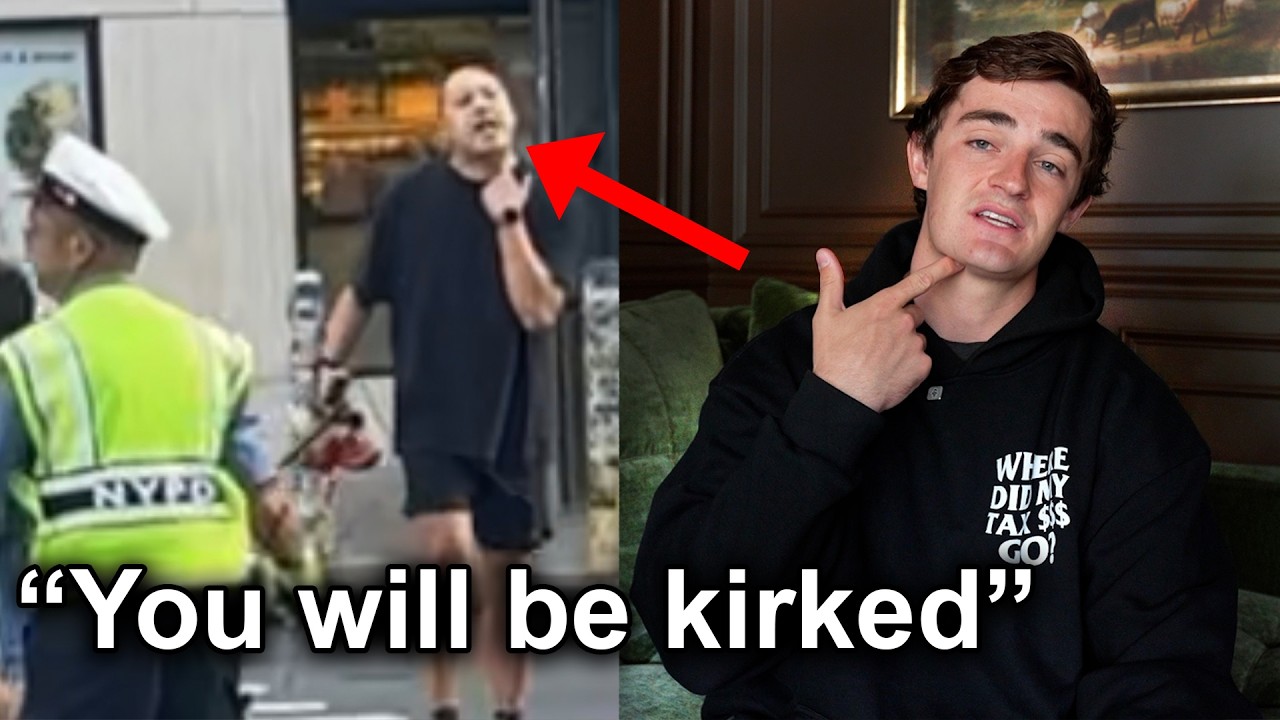
Are death threats being made openly on the streets of New York City? The answer, unfortunately, is yes — and it was caught on camera. While walking toward Central Park near 57th Street on a day off, a man walking his dog spotted me, made direct eye contact, and immediately began screaming profanities. That alone wasn't the most alarming part. What was alarming is what came next: the man made a gesture simulating a gunshot to the neck and said, "Someone's going to find you one day." An NYPD officer was standing right there. He did nothing.
 00:45
The moment Thomas begins yelling and makes the initial threat on the NYC sidewalk
Watch at 00:45 →
00:45
The moment Thomas begins yelling and makes the initial threat on the NYC sidewalk
Watch at 00:45 →
I almost let it go. My security guard told me to keep walking. But when the man yelled a threat from across the street, I made the call to turn around and confront him. Not out of anger — but because people need to see this. They need to understand how emboldened some individuals have become when it comes to threatening those they disagree with politically.
What Happens When You Confront a Death Threat in Public?
When I walked back and asked the man — later identified as Thomas — why he didn't like me, the conversation spiraled immediately. He accused me of being Islamophobic and racist but could not produce a single specific example when pressed repeatedly. Instead, he began shouting into the street, hoping passersby would hear and join his cause. It's a tactic: say it loud enough, say it often enough, and people start to believe it — even without evidence.
What was equally striking was the contrast happening in real time. Right next to Thomas, another person was saying, "He's the best, we love you man." Two completely different reactions, standing feet apart on the same sidewalk. That's the America we're living in right now.
02:10
Thomas unable to name a single example of racism or Islamophobia when directly challenged
Watch at 02:10 →
Throughout the confrontation, Thomas also couldn't defend his claim that welfare fraud isn't real. His argument? That it's "not framed correctly." That's not a rebuttal — that's deflection. And when I asked him what he personally had done to help society, his answer was essentially: "Go show my photo to any leftist organization. They'll know who I am." That response says everything.
How Radicalized Have American Protesters Become?
This isn't just about one man with a dog in New York. This is a symptom of a much larger problem. When we look at the math: the United States has approximately 350 million people. If just 1% become radicalized, that's 3.5 million people. Narrow it down to just 0.1%, and you're still looking at 300,000 individuals who see no problem with openly threatening political opponents — people who believe violence is a justified response to speech they disagree with.
That's not a fringe rounding error. That's a stadium full of people who think it's acceptable to make death threats on a public street in broad daylight, with a police officer standing nearby, and feel zero fear of consequences. The man Thomas even bragged that leftist organizations would recognize his face — positioning himself not as an outlier, but as a known and celebrated figure within those circles.
04:30
Thomas makes a gunshot gesture toward his neck — a direct implied death threat — with an NYPD officer nearby
Watch at 04:30 →
- Radicalization doesn't require a majority. It only takes one person to act.
- Emboldened behavior grows when threats go unanswered by law enforcement.
- Public shaming tactics — screaming accusations without evidence — are designed to intimidate, not inform.
Is Welfare Fraud in Minnesota and Blue States Real?
One of the core reasons Thomas was furious is because exposing fraud — particularly in deep blue cities and states like Minnesota, California, and New York — inevitably shines a light on communities and political ecosystems that benefit from keeping that fraud hidden. But the facts are not in dispute. Federal investigators recently uncovered $90 million in fraudulent spending connected to daycare programs in Minnesota. It was described as the largest autism-related fraud bust in United States history. The woman charged had received the largest single amount of money from those programs.
This is not a framing issue. Fraud is fraud. The money being stolen is federal money — meaning it comes from taxpayers in all 50 states. The grandmother in Illinois. The retiree in Colorado. Every single American is on the hook for this. When someone says the fraud isn't real because of how it was "framed," what they're really saying is: the truth is inconvenient to my narrative.
Did Ilhan Omar Refuse to Condemn Political Violence?
The Thomas incident doesn't exist in a vacuum. At the State of the Union address, President Trump made a statement condemning political violence — something that, in theory, should be universally agreed upon. Members of both parties stood. Republicans and Democrats together. But a small number of individuals remained seated. Among them: Ilhan Omar.
Choosing to remain seated when political violence is being condemned is not a neutral act. It is a signal. And when radicalized individuals on the street are looking for cues about whether their behavior is sanctioned, those signals matter. The Thomas types of the world don't radicalize in isolation — they radicalize within ecosystems that, at various levels, normalize or tacitly approve of political aggression.
How Many Radicalized People Are Actually in the US?
Let's break down the numbers one more time, because they're worth sitting with:
- 350 million — US population
- 3.5 million — 1% radicalized
- 350,000 — 0.1% radicalized
- 175,000 — 0.05% radicalized
Even at the lowest estimate, you're talking about tens of thousands of people who believe there is nothing wrong with threatening to kill someone for exposing government fraud. This is the conversation we're not having loudly enough. And it's exactly why moments like the Thomas confrontation need to be documented, shared, and discussed — not brushed aside or left to die in a social media scroll.
What made the incident particularly chilling wasn't just the threat itself. It was that Thomas made the gesture — a finger gun to his neck — casually, in public, seemingly without thinking twice. That level of comfort with implied violence is not something that develops overnight. It is cultivated.
Should You File a Police Report for a Public Death Threat?
After the video was posted online, people quickly identified Thomas. He had made similar threats to others online, including to a friend of mine named Sweeney who lives in New York. But then something unexpected happened: Thomas reached out through Sweeney's email to apologize. He said the moment had been an "epiphany" for him, that he felt "immensely upset with himself immediately after," and that he wanted to meet in person to have a genuine conversation — filmed or not.
He also acknowledged that filing a police report was a legitimate response, and said he understood if that's the route taken.
So the question becomes: is the apology genuine, or is it damage control? Is this an opportunity to build a bridge — his words — or a calculated move to avoid legal consequences? That's something only time and a face-to-face conversation could reveal. The instinct to file the police report is valid. A public death threat is a public death threat, regardless of what comes after. But there's also something to be said for a real conversation — one that actually gets into the mind of someone who felt comfortable doing what Thomas did, and why.
The goal has never been to punish one person. The goal is to understand — and to expose — how radicalization is taking root in American cities. And if Thomas is genuinely willing to sit across a table and explain his thinking, that conversation might be more valuable than any police report.
Stay tuned. And in the meantime — if you've witnessed fraud in your community and want to report it or stay informed, visit antifrodclub.com for a free weekly newsletter tracking fraud cases across the United States.