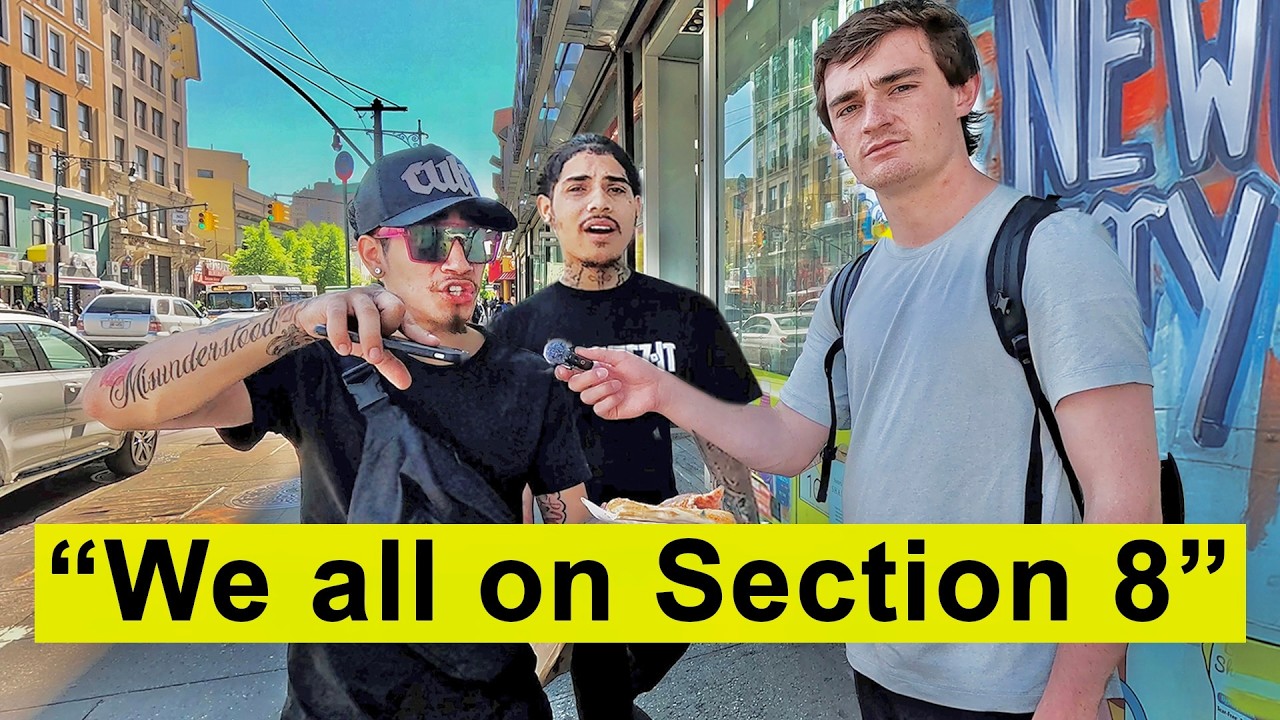

Surviving in New York City is brutally hard — and getting harder every year. With average rents hitting $4,500 a month for a standard apartment and food prices running 30% above the national average, New York has become a city where even people with college degrees are working cash-only side jobs just to stay afloat. On one end, you have residents on Section 8 housing paying as little as $250 a month. On the other end, you have Billionaire Row apartments selling for $30 to $110 million. The gap between those two realities is what New York City truly looks like in 2024.
We traveled through all five boroughs — from the roughest blocks in the Bronx all the way up to the gleaming towers of Billionaire Row — to show you exactly what survival looks like at every income level, and to expose the government system that silently punishes people for trying to get ahead.
Why Is Rent So Expensive in New York City?
New York City has the highest rents of any city in America, and the numbers are staggering. A one-bedroom apartment in Manhattan's East Village will run you around $4,500 a month. Even in the Bronx — the poorest of the five boroughs — a two-bedroom apartment without government assistance can cost $3,500 a month. And here's the kicker: whether you're living in Harlem or on 34th Street, you're paying Manhattan prices either way.
Then layer on top of that a cost that most people outside New York don't even know exists: New York City tax. Unlike residents in other cities who pay only state and federal taxes, NYC residents get hit with a third tax just for living within city limits. That means less take-home pay to cover already sky-high rent. One Manhattan resident we spoke to had her family's medical insurance cut by the government because she supposedly earned "too much" — yet she was still borrowing money from her mother-in-law each month just to cover basic expenses.
It's not just rent, either. A single energy drink costs around $6. A small box of cereal runs about $8. Crime is so rampant in some grocery stores that they lock up Twinkies and Oreos behind security cases. Everything in New York costs more, and the wages — for many residents — simply don't keep up.
How Much Money Do You Need to Live in NYC?
The honest answer depends heavily on which borough you're in and whether you have access to government assistance. Here's a realistic breakdown based on what residents told us on the ground:
- The Bronx (with Section 8): You can technically survive on around $800–$1,000 a month if Section 8 covers most of your rent. But that's rent and utilities only — it doesn't include food, transportation, or anything else.
- The Bronx (without Section 8): A two-bedroom apartment will cost you $3,500 a month before you've bought a single grocery item.
- Manhattan: Plan for at least $2,000 just for a modest apartment, $500 for food, and another $1,000–$1,500 for general living expenses. That's roughly $3,500 a month minimum — before taxes.
- Billionaire Row: A small studio starts at $4,000 a month. A one-bedroom runs over $5,000. To comfortably live here, residents say you need at least $1 million in savings or a salary of $5,000 a week or more.
One local summed it up simply: to live good in New York City, you need to be pulling in at least six figures a year. And even that doesn't guarantee comfort. Many residents we met were going into debt month after month, fully aware it didn't make financial sense — but unable or unwilling to leave the only city they'd ever called home.
What Is It Really Like to Live in the Bronx?
The Bronx is the poorest of New York City's five boroughs, and the contrast with Manhattan is immediate and jarring. Residents describe it as raw, real, and in some ways, free — but also deeply shaped by poverty, drugs, and a lack of opportunity for young people.
One longtime Bronx resident told us the violence rate in the Bronx is consistently number one or two in the city, with Brooklyn historically trading that title back and forth. Brooklyn has since undergone heavy gentrification, but the Bronx remains largely the same. Kids pour out of school with nowhere structured to go. A man visibly intoxicated bit another person in the park in broad daylight while we were filming. Shoes were falling off kids' feet in the street. These aren't isolated moments — they're the backdrop of daily life for hundreds of thousands of residents.
And yet, people push back on the idea that the Bronx is simply a bad place to live. One resident made a point that stuck: celebrities and wealthy people can't walk freely through their own neighborhoods out of fear. In the Bronx, kids roam freely. There's a kind of community and street-level freedom that expensive zip codes can't buy. The rent, if you're on Section 8, can be as low as $400 a month per person — and newer Section 8 buildings are coming with amenities like gyms and laundromats.
But perhaps the most revealing detail was the architecture. The housing projects in the Bronx use the exact same brick-and-block design as Rikers Island, one of New York's most notorious jails. As one observer put it: the design institutionalizes residents, normalizing a style of living that mirrors incarceration. That's not an accident of budget constraints — it's a choice.
What Is Section 8 Housing and Who Qualifies in NYC?
Section 8 is a federal housing assistance program designed to help low-income families afford rent in the private market. The government pays the gap between what a family can afford and what a landlord charges. In New York City, over 500,000 people rely on some form of government housing assistance to survive.
In the Bronx alone, residents estimated that somewhere close to 99% of their community is on some form of government benefits. Section 8 pays the bulk of the rent — tenants may pay only $250 to $500 a month while the government covers the rest of a $3,000+ lease. It sounds like a lifeline, and for many, it genuinely is. But there's a built-in trap embedded in the system that most people don't talk about openly.
What Is the Poverty Trap and How Does Section 8 Keep You Poor?
This is the part of the story that most politicians don't want to explain clearly. Here's how the poverty trap works in practice:
Imagine you're a single mother in New York City earning $30,000 a year. You qualify for Section 8. Your rent is $500 a month while the government covers the rest. You have just enough to survive. Now you work hard, get a raise, and your income climbs to $45,000 a year. The system kicks in: your rent share increases, your benefits shrink, and if you cross a certain income threshold, you lose Section 8 entirely. Suddenly, you're paying market-rate rent of $3,500 a month on a $45,000 salary — and you are poorer in real terms than you were making $30,000.
This is why a woman we met in the Bronx — a woman with a bachelor's degree in clinical psychology — was working cash-only on the street instead of using her degree. The moment she takes a formal job, she loses her government support. She earns just enough informally to survive without triggering the cutoff. She's not lazy. She's not uneducated. She's trapped by a system that punishes upward mobility.
As one resident put it: "If we make a little bit more money, we don't get that support. If you do well, you're going to be paying more. It's twisted." Politicians know this structure exists. And it serves a purpose: a population dependent on government benefits is a population that keeps voting to protect those benefits, regardless of whether the system is actually helping them escape poverty.
What Is Billionaire Row and What Does It Cost to Live There?
Billionaire Row is the stretch of ultra-luxury skyscrapers running along 57th, 58th, and 59th Streets in Midtown Manhattan, between Sixth Avenue and Columbus Circle. These are some of the most expensive residential addresses on Earth, with apartments ranging from $30 million to over $110 million.
Even the rental market here is rarefied: a small studio in a Billionaire Row building — doorman included, five-star amenities — runs about $4,000 a month. A one-bedroom starts above $5,000. The residents we spoke to included a retired prima ballerina who had also designed for Valentino and operated a boutique inside the Plaza Hotel. Her advice for living here? Have at least a million dollars saved, or earn $5,000 a week minimum.
And yes, trust fund babies are moving in. Residents confirmed it: graduates fresh out of college whose parents relocate them directly into Manhattan apartments, skipping entirely the struggle that defines survival for everyone else in this city.
If you're wealthy in New York City, life is extraordinary. You walk out your door and step into one of the most vibrant, culturally rich cities on the planet. Louis Vuitton, Gucci, $450 gym memberships — it's all right there. But if you're not? New York City is a daily grind unlike anything else in America, and the systems supposedly designed to help you might actually be the very thing keeping you stuck.