
Crackolândia in São Paulo, Brazil is widely regarded as the largest open-air drug market in the world. Once a contained zone barricaded from the public — so dangerous that police refused to enter — it has since been broken up by the government and scattered across the streets of South America's most populous city. The result? Thousands of addicts, some as young as 12 years old, now roam the downtown area in what locals call a zombie-like state, openly using drugs on street corners, sleeping under bridges, and living in the ruins of abandoned buildings. This is São Paulo's most urgent and ignored crisis.
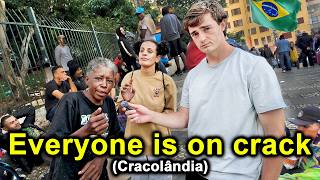 00:45
People openly using drugs at a busy intersection near the original Crackolândia zone in São Paulo
Watch at 00:45 →
00:45
People openly using drugs at a busy intersection near the original Crackolândia zone in São Paulo
Watch at 00:45 →
What Is Crackolândia and Why Is São Paulo Called the City of Zombies?
Crackolândia — which translates roughly to "Crackland" — began as a concentrated open-air drug market in the Luz neighborhood of São Paulo, Brazil. At its peak, it was a walled-off zone that the police refused to enter and the public was warned to avoid. Thousands of crack cocaine addicts lived inside this area in conditions that shocked anyone who saw them. The name "City of Zombies" comes from the visual reality of walking through these streets: hollow-eyed men and women in various states of stupor, shuffling slowly or lying completely motionless on the pavement. It is not a metaphor. It is a description.
São Paulo is the largest city in the Americas, a sprawling metropolis of skyscrapers, world-class restaurants, and vibrant street art. But tucked within its downtown core is a humanitarian disaster that the government has struggled — and largely failed — to address. Crackolândia represents the collision of poverty, addiction, mental illness, and failed urban policy on a massive scale.
What Happened to Crackolândia After the Government Shut It Down?
In recent years, Brazilian authorities moved in and dismantled the original Crackolândia zone. Police took control of the area around the Luz train station, pushing addicts out and reclaiming the blocks that had been dominated by drug use and trafficking for decades. On paper, it sounded like progress. In practice, it created a new and arguably worse problem.
04:20
Destroyed buildings left behind after the government dispersed Crackolândia residents
Watch at 04:20 →
Instead of eliminating the crisis, dispersing Crackolândia simply spread it. Addicts fanned out across the entire city of São Paulo. What was once one concentrated, contained zone became dozens of smaller pockets scattered throughout downtown neighborhoods. A local nonprofit worker who has spent six years working directly with the Crackolândia population described it simply: "They used to stay in just one quarter. Now they are everywhere."
The consequences are visible on nearly every block. People are passed out on sidewalks. Makeshift camps have formed under bridges and in the shells of demolished buildings. Entire city blocks near the former Crackolândia zone sit empty and destroyed — walls caved in, windows shattered — the result of the population that once lived there. New construction stands right alongside this destruction, protected by cameras and iron gates, while the buildings next door crumble.
A São Paulo police officer interviewed on the scene put it plainly: the smaller Crackolândia caused people to spread around the city in search of drugs. Some find what they're looking for. Many don't. Either way, they end up on the street.
09:10
A nonprofit church worker explains how they feed and shelter addicts still living in the zone
Watch at 09:10 →
What Drugs Are Taking Over the Streets of São Paulo?
While crack cocaine is still present, the drug landscape in São Paulo has shifted. The substance drawing the most alarm right now is K2 — a synthetic cannabis also known as spice — which is rapidly spreading through the Crackolândia population and beyond. Users and observers call it the zombie drug, and the label fits. K2 causes severe hallucinations, uncontrolled seizures, and total loss of bodily control. Users can be seen frozen mid-stride, bent at impossible angles, or completely unresponsive while technically still standing.
K2 is gaining ground for two specific reasons: it is cheap, and it is nearly impossible to detect in standard drug tests. As law enforcement has cracked down on crack cocaine supplies, traffickers have pivoted to synthetic alternatives that are harder to trace and harder to regulate. The result is a population of addicts transitioning to a drug that is, in many ways, more dangerous and less understood than what came before.
Fentanyl, which has devastated communities in the United States, is also beginning to appear on the streets of São Paulo — another signal that the drug crisis in Brazil's largest city is evolving and intensifying, not fading.
How Dangerous Is It to Walk Through Crackolândia?
Extremely. Even with local guides, church-affiliated vests meant to signal neutrality, and experienced translators, navigating the current scattered zones of Crackolândia is unpredictable and tense. In a single outing through the area, a film crew encountered multiple near-confrontations. People seeing a camera would shout, chase, or threaten violence. One group charged after the crew simply for walking past with a camera visible.
14:35
The bridge that became one of São Paulo's worst drug congregation points after the Crackolândia shutdown
Watch at 14:35 →
The most dangerous moment came on a bridge that has become one of the city's worst drug congregation points since the Crackolândia shutdown. Walking across it required physically weaving between people who were passed out or mid-high. Near the far end, voices from the crowd began shouting warnings — "He's filming! Go get him!" — and the crew had to move quickly to avoid being robbed or worse. A translator confirmed afterward that if they had stayed even a few more minutes, they almost certainly would have lost everything.
Beneath that same bridge, an entire community lives in a settlement that is visible but largely inaccessible to outsiders. The bridge above is dangerous. What happens below it is something else entirely.
Why Are 12-Year-Olds Using Drugs Openly on the Streets?
One of the most disturbing realities of São Paulo's current drug crisis is the age of some of its victims. During a single visit to the area, a 12-year-old and a 14-year-old were both observed openly using crack cocaine on public street corners — in broad daylight, with buses passing by.
When asked whether this was normal, a local worker who has spent years on the ground in Crackolândia confirmed: yes. It is not rare. It is routine. She explained that older addicts in the community do not typically supply drugs to very young children, but that doesn't prevent them from obtaining substances through other means. By 12, some children in these communities have already been on the streets long enough to develop full addictions.
A mother interviewed nearby, who lives in the neighborhood with her young son, said she keeps him closely supervised at all times and plans to leave São Paulo entirely when he is older. The children of this neighborhood do not have the luxury of not knowing what crack cocaine looks like.
What Is the K2 Zombie Drug Spreading Across Brazil?
K2 — also called spice or synthetic cannabis — is not a natural drug. It is a chemical compound sprayed onto plant material and smoked. Its effects are wildly unpredictable, varying from batch to batch depending on what synthetic compound was used. In the worst cases, users experience violent seizures, psychosis, and complete motor shutdown. In São Paulo's streets, the term "zombie drug" is not hyperbole — it is a clinical description of what the drug does to the human body.
The spread of K2 in Brazil is directly tied to the crackdown on traditional crack cocaine. When supply chains for crack were disrupted by police pressure, suppliers pivoted to synthetics that are legal in a gray area, harder to detect, and easier to manufacture domestically. For addicts, K2 is accessible, affordable, and devastating. Its rise represents one of the most serious emerging threats in Brazil's ongoing drug crisis.
What Is Being Done to Help Addicts in São Paulo?
In the heart of the former Crackolândia zone, a church-run nonprofit operates one of the only consistent support structures available to addicts in the area. It provides meals, temporary refuge, and religious outreach. Staff members — some of whom are former traffickers themselves — work to connect with users on a personal level, offering food and a moment of stability in otherwise chaotic lives.
A former drug trafficker turned outreach worker described what he sees as the core tension in any effort to address the crisis: you cannot force someone to stop using drugs. Recovery requires a personal decision, and that decision is nearly impossible to make from inside a cycle of addiction, homelessness, and survival. The church can offer a meal and a conversation. It cannot substitute for the systemic investment in housing, mental health care, and economic opportunity that the population truly needs.
São Paulo's drug crisis is not a problem without solutions. It is a problem without the political will, funding, and coordination required to implement them. Until that changes, the zombies of Brazil's largest city will keep walking these streets — searching for the next hit, or simply searching for somewhere to rest.