
So why are millionaires leaving Norway? The short answer might surprise you: it's probably not the wealth tax. Despite a flood of dramatic headlines after 2022 — "Norway's Wealth Tax Failure," "Billionaire Exodus Rocks Norway" — the data tells a much messier and more interesting story. When you dig past the headlines, talk to Norwegian tax experts, and actually look at how the country's tax system works, a different culprit emerges entirely: a sweeping 38% capital gains exit tax on shares that entrepreneurs hadn't even sold yet.
Why Are Millionaires Really Leaving Norway?
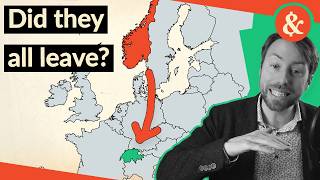
In 2022, Norway's center-left government raised the wealth tax from 0.85% to roughly 1.1% — a bump of just 0.25 percentage points. Almost immediately, headlines erupted about a wave of Norwegian billionaires fleeing to Switzerland. And yes, something clearly did happen in 2022: an unusual number of wealthy business owners left in what looked like three distinct waves.
 02:15
Graph showing the spike in millionaire business owners leaving Norway after the 2022 wealth tax hike, with three distinct waves of departures
Watch at 02:15 →
02:15
Graph showing the spike in millionaire business owners leaving Norway after the 2022 wealth tax hike, with three distinct waves of departures
Watch at 02:15 →
But here's the thing — when Norwegian journalists at the national broadcaster NRK looked at the total taxable wealth that actually departed, it amounted to just 2% of total millionaire wealth in Norway. That's not enough to offset the increased revenue from the wealth tax hike. So the "failure" narrative doesn't hold up to scrutiny.
The real trigger wasn't the wealth tax itself. It was Norway's capital gains exit tax — and specifically, a race against the clock to escape it before the government closed a massive loophole.
Did Norway's Wealth Tax Actually Cause the Exodus?
To understand why the wealth tax hike is the wrong villain here, you need to know something unusual about how Norway taxes business owners specifically. Norway's wealth tax system is actually extremely generous to entrepreneurs and startup founders.
05:40
Comparison of wealth tax revenue as a share of total government revenue in Norway vs. Switzerland — both surprisingly small
Watch at 05:40 →
When the government values a private business for wealth tax purposes, it only looks at hard assets — bank accounts, physical buildings — and subtracts debts. It ignores so-called "soft" intangible assets: intellectual property, brand value, customer loyalty, proprietary technology, and future growth potential. Some economists estimate this means private Norwegian businesses end up valued at 70 to 90% below their true market value for tax purposes.
That's why Norway, despite having had a wealth tax for over a hundred years, still boasts nearly as many billionaires per capita as the United States. For a business owner, Norway's wealth tax was never the problem. So why did a tiny 0.25% hike suddenly spark a rush for the exits?
What Is Norway's Exit Tax and Why Does It Matter?
Norway's wealth tax applies to residents, not to assets inside the country. That means, in theory, you can dodge it simply by moving abroad. Norway has long countered this with an exit tax: a capital gains tax of approximately 38% applied to the paper value of all your investments the moment you change your tax residency — even if you haven't sold a single share.
For a startup founder whose company was valued by early investors at, say, $10 million, leaving Norway could instantly trigger a $3.7 million tax bill — on money they've never actually received. As crypto entrepreneur Fredrik Haga put it in the Financial Times: "It's not about not wanting to pay taxes. It's about paying taxes on money that I don't actually have."
09:10
Timeline of the exit tax loophole closure in 2022 and subsequent policy changes through 2024, showing how each change triggered a new wave of departures
Watch at 09:10 →
Before 2022, there was a famous loophole everyone knew about: if you left Norway and didn't sell your shares within five years, the exit tax obligation simply vanished. The government, anticipating a wave of departures after the wealth tax hike, moved quickly to close this loophole. And that's what caused the exodus.
Entrepreneurs who wanted to leave — and use that five-year loophole — had to move fast, in 2022, before the window closed. It wasn't the wealth tax they were fleeing. It was the capital gains exit tax they were racing to escape. Fishing magnate Kjell Røkke and others like him moved quickly for exactly this reason. Haga himself cited the exit tax — not the general wealth tax — in his public blog post explaining his departure.
The Cat-and-Mouse Game That Kept the Exodus Going
Even after the five-year loophole closed, the migration didn't stop immediately. In 2023, more entrepreneurs left hoping to defer payment indefinitely by simply never selling their shares. In 2024, the government shut that down too, introducing a hard 12-year payment deadline from the date of departure — no exceptions, no extensions. Pay within 12 years, regardless of whether you've sold anything.
Millionaire departures dropped sharply to just 12 in 2024 — a sign the rules were finally working as intended. Then in 2025, a new spike appeared, apparently driven by entrepreneurs fearing further tightening after the center-left party won re-election and uncertainty about future exit tax rules mounted once again.
How Does Norway's Wealth Tax Actually Work?
Norway's wealth tax applies only to the wealthiest 12% of the population — those with a net worth above roughly €173,000 after debts. The tax rate sits at around 1%, with a significant discount applied to your primary residence.
- Landlords and passive investors pay the full rate on property, bank accounts, stocks, and other assets.
- Business owners benefit from the valuation discount on private companies, paying tax on a fraction of their true wealth.
- Everyone can deduct debts from their taxable wealth base.
Interestingly, research conducted before the 2022 hike found that business owners who faced higher wealth taxes actually responded by investing more in their businesses — because business assets were taxed at a lower effective rate than cash or property. Far from destroying entrepreneurship, the wealth tax was quietly nudging money toward active investment.
Does a Wealth Tax Actually Hurt the Economy?
The evidence from Norway suggests the economic damage from millionaire migration has been minor at the national level. The 2% of millionaire wealth that departed wasn't enough to offset the increased tax revenues from the hike. Research into the effects of millionaire migration found very limited macroeconomic impact on Norway as a whole.
That said, the businesses that departing entrepreneurs left behind did appear to suffer — likely because managing a Norwegian company remotely from Zurich or Geneva is harder than doing it in Oslo. There are real microeconomic costs, even if the national numbers look stable.
The bigger concern isn't about existing millionaires leaving — it's about future entrepreneurs never starting. With a strict exit tax in place, ambitious Norwegian founders who dream of scaling their company to London, New York, or San Francisco face a daunting bill if early investor valuations triggered the exit tax clock. That could make Norway less attractive as a startup hub compared to neighbors like Stockholm, which doesn't face the same constraints.
What Can the World Learn From Norway's Wealth Tax?
Norway's experience offers three clear lessons for any country considering similar policies:
- Lesson 1: Small wealth taxes don't trigger mass exodus — but they don't raise much money either. Norway and Switzerland both have wealth taxes, and neither has seen catastrophic capital flight. But as a share of total government revenue, these taxes are almost negligible.
- Lesson 2: Taxing unproductive wealth more than active business investment can actually stimulate the economy. When landlords and passive savers face higher taxes than entrepreneurs, capital flows toward businesses — exactly where you want it.
- Lesson 3: Exit taxes demand careful design. A blunt exit tax that hits founders on unrealized gains can push entrepreneurs out the door and, more worryingly, discourage new ones from ever getting started in the first place.
The Norwegian story is ultimately not a cautionary tale about wealth taxes being unworkable. It's a case study in how a small, poorly timed policy change — closing an exit tax loophole — can create a perception of crisis that dramatically outweighs the economic reality. The headlines were louder than the data. They usually are.